Attenuator With Current Dependent Resistor Challenge

Thread Starter

MrAl

Joined Jun 17, 2014
13,702
Hello there!

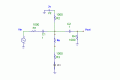
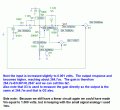
Here is a special challenge with a relatively simple circuit. It's a voltage divider of sorts, but performs an attenuation of the AC input signal.
This is special not only because of the current dependent resistor, but because it challenges the basic theory of how we usually evaluate a transistor circuit when we include the internal resistor value we usually refer to as 're'.

Because of that analogy to a similar transistor circuit, i ask that you analyze this circuit two different ways:
1. The way you would normally handle 're' in a transistor circuit (where Re='re').
2. Allowing the resistor Re to take on its real value for this real problem, which is Re=K/iR3, where K=0.25 and iR3 is current through R3.

Note that in both of these, Re is current dependent, but in (1) we calculate Re from the DC circuit conditions BEFORE we calculate the gain which is really the attenuation in this circuit, and in (2) we put the value in the circuit BEFORE we calculate any DC circuit conditions.

This is a simpler circuit than the transistor circuit with 're' and so is easier for anyone to calculate or do a circuit sim.

The difference in the value of Re is small but measurable and the difference in the attenuation is small and almost insignificant but it still shows how the two different ways of doing it are NOT the same, and the second one above (2) is the more accurate theoretically.

One of the points is that this is probably not shown in books because the difference is small. Circuit theory however sometimes strives for perfection if not for anything else then just to show the most accurate representation.

Here is the circuit, and it has application in real life too...
Keep in mind that in the transistor circuit Re is NOT in the circuit until AFTER it is calculated from the DC circuit conditions, and that clearly flies in the face of accurate circuit analysis. Lucky, it is usually a small difference either way.
 

Attachments

LvW

Joined Jun 13, 2013
2,026
Well - MrAl, here is my answer:

Case 1:
In a transistor circuit the quantity "re" is a differential one and does not influence the DC current.
Therefore:
I=2V/2k=1mA
and
re=0.25/1mA=250 ohms.


Case 2:
I=2V/(2k+0.25/I)=...=0.875mA
and
Re=0.25/0.875mA=285.7 ohms.

Both results are remarkably different - and I ask myself why you are claiming that "the second one above (2) is the more accurate theoretically."
Please, can you explain?

Examples:

A): Re represents a diode: This is an element with a static (Re) as well differential resistance (re). For DC calculations we must use Re and for dynamic signal calculations we must use re only.

B): When Re represents a transistor (like 1/gm=re in the T-model for a BJT) , there is the differential quantity "re" only. There is no static part that must be considered for DC calculations. In this case, only the avovementioned "case 1" is correct.
 
Last edited:

Thread Starter

MrAl

Joined Jun 17, 2014
13,702
Well - MrAl, here is my answer:

Case 1:
In a transistor circuit the quantity "re" is a differential one and does not influence the DC current.
Therefore:
I=2V/2k=1mA
and
re=0.25/1mA=250 ohms.


Case 2:
I=2V/(2k+0.25/I)=...=0.875mA
and
Re=0.25/0.875mA=285.7 ohms.

Both results are remarkably different - and I ask myself why you are claiming that "the second one above (2) is the more accurate theoretically."
Please, can you explain?

Examples:

A): Re represents a diode: This is an element with a static (Re) as well differential resistance (re). For DC calculations we must use Re and for dynamic signal calculations we must use re only.

B): When Re represents a transistor (like 1/gm=re in the T-model for a BJT) , there is the differential quantity "re" only. There is no static part that must be considered for DC calculations. In this case, only the avovementioned "case 1" is correct.
Hello again,

Thanks for the question, it's a good one i think.

The main reason is that we dont do it that way in any other case and with good reason. If we used a different technique for example the perturbed method, then we would never even consider calculating Re without having it in the circuit to begin with. If we calculate a value with conditions DC1 and then insert it into the circuit and find that DC conditions have changed to conditions DC2, then we void the original assumption, in general.
In other words, Re requires feedback in every other case so why not in what we call the 'old' method. The reason is probably because the value of Re does not change much and it is much more difficult to deal with a changing value of Re and when the difference is not much, in the practical it does not make as much sense to go through the extra work. If we want to get into more detail, then we might make Re the thing that it really should be which is simply a current controlled resistor.
Another viewpoint:
If we did not know this was to shadow a transistor circuit, we would never even considered making Re a constant value from the original DC conditions. We would have seen a resistor:
Rx=K/ie

and we would have just used that in the circuit, period.

But knowing that Re is similar to the transistor 're' we resorted to what we learned by rote, which was to do a quick calculation for (ie) with Re absent and then insert it into the circuit and go to the AC analysis part.

To further illustrate the point of why the current controlled resistor model is better than the previous model, consider Re to change much more wildly. NOW when we try to use the estimated value of Re from beginning DC conditions we get a very big difference. The gain would be MUCH different after that.

So when applying general circuit analysis to the problem we ensure that any choice of Re(ie) can be analyzed to any degree of accuracy, but when using the book choice only certain conditions will allow a reasonable result. When the SS models were first introduced, it would have been known that the difference is small in most cases.

If you would like to find out more about this, try to find out some more history on the SS model for transistors. When the value of 're' was first thought of and how it was applied and why it was applied like that (from first DC conditions alone).

Also, note that the value of Re does NOT change in EITHER case. I am not sure if this is apparent from the discussion. The only thing that changes is the point were we introduce Re into the circuit. Once Re is calculated (if needed) it stays at that value just like you calculated in the previous post. The AC analysis is then done, and perhaps the gain is calculated.

I hope i am making this more clear now but if not i'd appreciate another question.

Also, i am betting that a 'proof' of the 'old' method would include a section on how the difference between the always current controlled Re and the one-time-only current controlled Re is small so we use the simpler Re calculation.

We could make this even more interesting by allowing V2 to be a variable input such as a ramp. That would FORCE us to use the 'new' method. This would come into play in the real world where we want to know how the gain changes when the power supply changes.

I hope you find this as interesting as i do.
 
Last edited:

LvW

Joined Jun 13, 2013
2,026
I must admit that I really do not know how to interpret your answer.

In my first answer, I clearly have stated (see case B) that there is only one correct solution if "re" is identical to the "re" as used in the T-model for a BJT. And this solution is re=250 ohms (based on the conditions as mentioned in your question under case 1).

This finding is in contrast to your view (Quote):
"The difference in the value of Re is small but measurable and the difference in the attenuation is small and almost insignificant but it still shows how the two different ways of doing it are NOT the same, and the second one above (2) is the more accurate theoretically."

Therefore, my simple question: Am I right or wrong? (And in case I am wrong, please explain to me WHY)
 

Thread Starter

MrAl

Joined Jun 17, 2014
13,702
I must admit that I really do not know how to interpret your answer.

In my first answer, I clearly have stated (see case B) that there is only one correct solution if "re" is identical to the "re" as used in the T-model for a BJT. And this solution is re=250 ohms (based on the conditions as mentioned in your question under case 1).

This finding is in contrast to your view (Quote):
"The difference in the value of Re is small but measurable and the difference in the attenuation is small and almost insignificant but it still shows how the two different ways of doing it are NOT the same, and the second one above (2) is the more accurate theoretically."

Therefore, my simple question: Am I right or wrong? (And in case I am wrong, please explain to me WHY)
Hi again and thanks,

Are you right or wrong about what? Sorry not sure what question you refer to here.

In my first answer, I clearly have stated (see case B) that there is only one correct solution if "re" is identical to the "re" as used in the T-model for a BJT. And this solution is re=250 ohms (based on the conditions as mentioned in your question under case 1).
But how do you prove that?
My guess (and correct me if wrong) is that you are going to look in one or more books, then repeat what they have printed there.

But now let's allow V2 (the +Vcc supply voltage) to vary using this same circuit and if you care to in the transistor circuit with 're'.
We are then modulating the +Vcc supply line.
Now when you go to calculate Re or 're' what value do you use?
A change in the +Vcc line produces a change in Re or 're'. Now there is no way around it. If you stick to the 'book' procedure, there will be gross errors in the calculation of the gain values.

You must have realized at some point that book solutions are constrained within the context that they were intended. They do not look at every possibility but must be restrained due to size limitations and scope. The scope of the small signal model is to provide a way to quickly calculate the most needed values, not to provide the most accurate solution. So what we see here is we are taking that small signal model one step further, and only void the SS model when necessary.

What we may need here though, and i mentioned this before, we may need some original work which would have been done when the small signal model first came into being. I dont have all my books with me right now so i cant look this up just yet. Maybe there is something online.
The first person to suggest the SS model probably came to the same conclusion that the simpler (we call 'old' method for convenience) method is good enough for most purposes.

HERE IS A QUOTE from Wikipedia:
"A small-signal model is an AC equivalent circuit in which the nonlinear circuit elements are replaced by linear elements whose values are given by the first-order (linear) approximation of their characteristic curve near the bias point."

They admit it is an *approximation*.
 
Last edited:

WBahn

Joined Mar 31, 2012
32,823
I'm not sure I understand the point you are trying to make.

The moment you transform a transistor circuit into a linear circuit using a small signal model, you are explicitly NOT trying for perfection -- you are in fact merely claiming that the actual behavior of the circuit is close enough to the superposition of the solutions obtained with the DC analysis and the small-signal AC analysis for the purpose of the analysis. You can, in fact, put limits on how big your "small signal" can be before the approximation is no longer close enough.

Every EE text I own that I've looked at on this point (which was a good fraction of them when I was choosing a text to use) develops the small-signal model for the various transistor types by looking at the change in one parameter as a function of the change in the other parameters -- i.e., it's differential behavior -- and makes careful note of the fact that only if the deviations about the operating point are kept small enough can we model the behavior of the circuit using a linear subcircuit that approximates the behavior of the transistor. Several of them at least mention that what we are doing is taking the power series approximation to the actual behavior and keeping only the constant and linear terms and neglecting the higher order terms. We call the constant term the DC solution and the linear term the AC solution. Whether they mention this or not, they all emphasize the fact that if you do not abide by this constraint, that the results you get from your analysis will be worthless and not in any way resemble the actual behavior of the circuit. Most of the texts then give an example or a homework problem that underscores this point.

So it is absolutely no surprise at all that a small signal analysis of a transistor circuit will not be as accurate as an analysis that is more faithful to the actual governing equations instead of using a linear approximation to them about an operating point.
 

LvW

Joined Jun 13, 2013
2,026
Are you right or wrong about what? Sorry not sure what question you refer to here.
In post#4 I have stated that - as far as I know - there would be only one correct solution (re=250 ohms) and I have asked you "right or wrong"?
And you are not sure what question I was referring? In my post (two sentences only) there was no other question. I am somewhat surprised.

But how do you prove that?
My guess (and correct me if wrong) is that you are going to look in one or more books, then repeat what they have printed there.
I prove that by making a clear distinction between quantities which are DC relevant and other quantities which are only AC relevant - and the transconductance gm (and its reverse value 1/gm=re) is surely a differential quantity (slope of the Ic=f(Vbe) characteristic. Hence - in contrast to your opinion, it must not appear in the caculation of the DC bias currents.
I can assure you that my "wisdom" does not only come from books. From time to time I am calculating by myself - without using such a model at all. Looking onto the original circuit diagram you can apply all the known relations and formulas. (All the equivalent diagrams are nothing else than a visual representation of these formulas).
As you know - I was teaching this subject over 25 years in a university - and it is in full accordance with corresponding Spice simulations.

As far as some other parts of your answer are concerned:
* Why do you now introduce a modification of the supply voltage into the discussion? I think, this has nothing with the problem under discussion: "Must the quantity re=1/gm appear in the DC equivalent circuit (calculation of the DC currents under fixed conditions) - yes or no ?"

* Regarding your last sentence: Nobody will deny that a model is always an approximation.
More than that, it is a known fact that in electronics no formula can be correct up to 100% because we always neglect some minor or parasitic aspects - and that`s good engineering practice. But this point has nothing to do with the problem under discussion.

May I explain my reasoning in a different way?
It is a well proven fact that both small-sigal transistor models (the well-known and mostly used PI-model and the T-model with the quantity "re") reflect exactly the same set of equations describing the transistor properties for ac signals.
The PI-model does not contain any "part" re, but instead the transconductance gm. Hence, starting with this model there is absolutely no occasion to discuss the question if any "re" must be included in the DC calculation. More than that, it is even not necessary to know about the existence of the T-model (and a quantity called "re") - all the calculations are possible based on the PI-model (as correct as the model allows). Hence, the question "what is re ?" does not appear at all.

Finally, I repeat again: In the T-model, the "part" re is NOT a two-pole element which we call resistor. It is the inverse of the slope of the Ic=f(Vbe) curve (the inverse of the transconductance gm). Therefore, it is a pure differential quantity and (in the T-model) it is treated as a resistive element for practical purposes. That`s all. It has no DC properties!!
 
Last edited:

Thread Starter

MrAl

Joined Jun 17, 2014
13,702
I'm not sure I understand the point you are trying to make.
Hi and thanks for joining,

It's so simple it almost hurts to have to keep repeating myself.
It was and always has been, that using an actual current controlled resistor is more accurate than using the standard 're' from transistor SS theory. Even if one does not want to accept the idea that it is more accurate, the current controlled resistor technique is certainly more widely applicable.

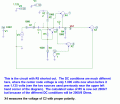
A circuit to help this idea along, but it may not be of significance to you because you already know that some models are just approximations.
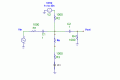
Note this new circuit has a more or less +Vcc but it is a ramp now. Using the old idea of 're' now would not be very wise.
 

Attachments

Thread Starter

MrAl

Joined Jun 17, 2014
13,702
In post#4 I have stated that - as far as I know - there would be only one correct solution (re=250 ohms) and I have asked you "right or wrong"?
And you are not sure what question I was referring? In my post (two sentences only) there was no other question. I am somewhat surprised.


I prove that by making a clear distinction between quantities which are DC relevant and other quantities which are only AC relevant - and the transconductance gm (and its reverse value 1/gm=re) is surely a differential quantity (slope of the Ic=f(Vbe) characteristic. Hence - in contrast to your opinion, it must not appear in the caculation of the DC bias currents.
I can assure you that my "wisdom" does not only come from books. From time to time I am calculating by myself - without using such a model at all. Looking onto the original circuit diagram you can apply all the known relations and formulas. (All the equivalent diagrams are nothing else than a visual representation of these formulas).
As you know - I was teaching this subject over 25 years in a university - and it is in full accordance with corresponding Spice simulations.

As far as some other parts of your answer are concerned:
* Why do you now introduce a modification of the supply voltage into the discussion? I think, this has nothing with the problem under discussion: "Must the quantity re=1/gm appear in the DC equivalent circuit (calculation of the DC currents under fixed conditions) - yes or no ?"

* Regarding your last sentence: Nobody will deny that a model is always an approximation.
More than that, it is a known fact that in electronics no formula can be correct up to 100% because we always neglect some minor or parasitic aspects - and that`s good engineering practice. But this point has nothing to do with the problem under discussion.

May I explain my reasoning in a different way?
It is a well proven fact that both small-sigal transistor models (the well-known and mostly used PI-model and the T-model with the quantity "re") reflect exactly the same set of equations describing the transistor properties for ac signals.
The PI-model does not contain any "part" re, but instead the transconductance gm. Hence, starting with this model there is absolutely no occasion to discuss the question if any "re" must be included in the DC calculation. More than that, it is even not necessary to know about the existence of the T-model (and a quantity called "re") - all the calculations are possible based on the PI-model (as correct as the model allows). Hence, the question "what is re ?" does not appear at all.

Finally, I repeat again: In the T-model, the "part" re is NOT a two-pole element which we call resistor. It is the inverse of the slope of the Ic=f(Vbe) curve (the inverse of the transconductance gm). Therefore, it is a pure differential quantity and (in the T-model) it is treated as a resistive element for practical purposes. That`s all. It has no DC properties!!

Hello again,

It looks like you just dont want to do it any other way than how you had learned in the past. For some reason you hold onto that like it was gold or something. It's just a circuit analysis technique, and there are many and there will be many more in the future.

There is no reason on earth why i cant introduce a transistor circuit with a +Vcc ramp instead of constant +Vcc.
In this circuit, it's the same as before but the Vcc is a ramp. It is a variable attenuation circuit and you must calculate the gain. Watch what happens when you try to hold 're' constant.
Why introduce this circuit? Two reasons:
1. It is a circuit that can be constructed and used in real life and should be able to be analyzed.
2. You cant accept the fact that the emitter current changes once you insert the calculated 're' value, and so no you have no choice because that is part of the NORMAL circuit operation. We want to be able to control the attenuation with the +Vcc signal.

Oh sorry i did not realize that your question in that post was the only question you were referring too. I just wanted to make sure i knew which one you were talking about because we asked each other various questions in this thread. Thanks for point it out although it may seem redundant to you. I sometimes ask questions so i know exactly what the other person wants even though it may seem apparent to them.

It may just be that we think on different 'wavelengths' as they say and that would mean that you may never agree that this 'new' thing is an interesting way to do the analysis. It's not new though really, it's just a different way of doing it.

If you would like to attempt that new circuit with the ramping Vcc supply i'd like to hear your take on how to do that one, using the 're' we've talked about. If you dont, i'll try to understand :)
 

LvW

Joined Jun 13, 2013
2,026
If you would like to attempt that new circuit with the ramping Vcc supply i'd like to hear your take on how to do that one, using the 're' we've talked about. If you dont, i'll try to understand :)
MrAl - hello again.

I like to propose not to analyze a new (resp. modified) circuit until we have agreed on an answer to your original question.
I`ll try to keep it very short.

At first, I will repeat (quote) the main parts of your original question:
Quote:
"Because of that analogy to a similar transistor circuit, i ask that you analyze this circuit two different ways:
1. The way you would normally handle 're' in a transistor circuit (where Re='re').
2. Allowing the resistor Re to take on its real value for this real problem, which is Re=K/iR3, where K=0.25 and iR3 is current through R3.


Note that in both of these, Re is current dependent, but in (1) we calculate Re from the DC circuit conditions BEFORE we calculate the gain which is really the attenuation in this circuit, and in (2) we put the value in the circuit BEFORE we calculate any DC circuit conditions.
The difference in the value of Re is small but ..... the second one above (2) is the more accurate theoretically.
" (End of Quote).

OK - following your request, I have analyzed the given circuit in two different ways - and I gave you the results in my post#2.
I think, it would be fair if you would comment both results (because you wanted me to do the analyses)
As I have already stated, I am sure that case (1) is correct (1mA; 250 ohms)- contrary to your opinion.
So - do you still think that case (2) is "more accurate" (0.875ma; 285.7 ohms) ?

After this point is clarified, we can analyze an alternative circuit.
 

LvW

Joined Jun 13, 2013
2,026
It looks like you just dont want to do it any other way than how you had learned in the past. For some reason you hold onto that like it was gold or something. It's just a circuit analysis technique
Yes, you are right: I hold onto the correct and proven methods as long as I am convincend that there is another and better method.
Therefore my question: Can you describe your new and alternative way for analyzing circuits like the one given in your first post?
This would be interesting .
Thank you
LvW
 

Thread Starter

MrAl

Joined Jun 17, 2014
13,702
MrAl - hello again.

I like to propose not to analyze a new (resp. modified) circuit until we have agreed on an answer to your original question.
I`ll try to keep it very short.

At first, I will repeat (quote) the main parts of your original question:
Quote:
"Because of that analogy to a similar transistor circuit, i ask that you analyze this circuit two different ways:
1. The way you would normally handle 're' in a transistor circuit (where Re='re').
2. Allowing the resistor Re to take on its real value for this real problem, which is Re=K/iR3, where K=0.25 and iR3 is current through R3.


Note that in both of these, Re is current dependent, but in (1) we calculate Re from the DC circuit conditions BEFORE we calculate the gain which is really the attenuation in this circuit, and in (2) we put the value in the circuit BEFORE we calculate any DC circuit conditions.
The difference in the value of Re is small but ..... the second one above (2) is the more accurate theoretically.
" (End of Quote).

OK - following your request, I have analyzed the given circuit in two different ways - and I gave you the results in my post#2.
I think, it would be fair if you would comment both results (because you wanted me to do the analyses)
As I have already stated, I am sure that case (1) is correct (1mA; 250 ohms)- contrary to your opinion.
So - do you still think that case (2) is "more accurate" (0.875ma; 285.7 ohms) ?

After this point is clarified, we can analyze an alternative circuit.
Hi,

Yes, case (2) is more accurate and most reasonable.
That doesnt mean that case (1) is completely inaccurate, and is usable im most cases i think.
I was mainly pointing out that when Re is in the circuit WHILE we are calculating the DC bias point, we should get a better result.
Granted it may not be hugely better for some cases.
So you may think of this as purely 'academic'.
 

Thread Starter

MrAl

Joined Jun 17, 2014
13,702
Yes, you are right: I hold onto the correct and proven methods as long as I am convincend that there is another and better method.
Therefore my question: Can you describe your new and alternative way for analyzing circuits like the one given in your first post?
This would be interesting .
Thank you
LvW
Hi,

Ok well when i said you hold on to it like 'gold' it seemed that you were not open to any other suggestions.

Now as to 'new and alternative way', there are two paths here but they both really involve the way we handle 're' that we had been discussing.
The main 'new' way is to keep 're' in the circuit from start to finish, for both DC and AC analysis, and once we switch to the AC analysis, we really then and only then calculate the DC operating conditions for 're'.
So again, 're' becomes a current controlled resistor, controlled by the DC current at the time of AC analysis, not BEFORE the AC analysis.
Now i know usually we do it BEFORE the AC analysis, but that's why i am calling it 'new'.

See another view here is the second path which is really a secondary point of view. That's where we solve for the DC voltages, then perturb the input. If we solved for 're' before we actually put it in the circuit, when we finally put it in the circuit the voltages would all be wrong because the value would change (from 250 to 285.7 Ohms). So it makes sense to calculate all the DC conditions with 're' in the circuit to start with, so that the proper DC current establishes itself and 're' assumes the value it assumes as a result of that DC current.

The reason i brought in the changing +Vcc voltage was to show that if we analyze the circuit (slowly varying +Vcc) then 're' would have to change a lot. That would mean that for some +Vcc voltages we'd get a very faulty result. However, allow the value of 're' to change as it needs to change with the changing +Vcc voltage and it will be dead on all the time.
Note i assume a slowly changing +Vcc and maybe a 1kHz input AC voltage in Vin.
In fact, perhaps +Vcc can be a sinusoidal with a DC offset such as:
Vcc=41+40*sin(w*t)
where 'w' is 2*pi*f and 'f' is maybe 1Hz.
 

LvW

Joined Jun 13, 2013
2,026
Yes, case (2) is more accurate and most reasonable.
That doesnt mean that case (1) is completely inaccurate, and is usable im most cases i think.
I was mainly pointing out that when Re is in the circuit WHILE we are calculating the DC bias point, we should get a better result.
Granted it may not be hugely better for some cases.
So you may think of this as purely 'academic'.
To be honest: The calculation method following case (2) is not "academic". Sorry to say (excuse me) - It is simply wrong.

I repeat: With regard to a bipolar transistor (that was our starting point for this discussion about the role of re=1/gm) the small-signal T-model contains one element called "re" which is nothing else than the inverse transconductance gm.
It is the purpose of gm to establish the connection of this equivalent diagram to the well-known BJT differential parameters
rbe=1/gm=h11/h21(=rbe/beta).
Hence, it is obvious that rbe must not appear in any DC equivalent diagram because it is a pure differential parameter and does not influence the DC current at all. In an earlier post you spoke abour a "real resistor
Didn`t you recognize the difference ? (1mA vs 0.875 mA; 250 Ohms vs. 285.7 Ohms.
Such a difference is not "usable" and i don`t think it would be "purely academic".
 

LvW

Joined Jun 13, 2013
2,026
Ok well when i said you hold on to it like 'gold' it seemed that you were not open to any other suggestions.
Thank you.
I think I am always open für "other suggstions" (I even have introduced some new oscillator circuits and a new method for loop gain calculations).
However, the "other suggestions" must be clearly explained and must be proven to be correct.
So again, 're' becomes a current controlled resistor, controlled by the DC current at the time of AC analysis, not BEFORE the AC analysis.
So - in your view the DC current (calculated/simulated for finding the bias conditions) is different from the DC current "at the time of AC analyses"?
Yes or no?
 

Thread Starter

MrAl

Joined Jun 17, 2014
13,702
Thank you.
I think I am always open für "other suggstions" (I even have introduced some new oscillator circuits and a new method for loop gain calculations).
However, the "other suggestions" must be clearly explained and must be proven to be correct.

So - in your view the DC current (calculated/simulated for finding the bias conditions) is different from the DC current "at the time of AC analyses"?
Yes or no?
Hello again,

To your question, YES. The reason for this becomes apparent when you look at slightly different parameters or ways of analyzing the circuit.
Also, you must realize by now that doing it the 'old' way is because of the linearized model which is an APPROXIMATION.

Another way, and i say this again, is to calculate the DC conditions and that includes calculating the cap voltages.
I said this maybe three times now but you keep ignoring it, then say you need 'proof'.
This is so easy to do, but since you dont want to do it i guess i can set it up and i guess provide some screen shots.
The method is as follows...
1 First Method 1 is the method where we set up the circuit with Re=0, then calculate the value of Re from the DC current, then insert it into the circuit for calculating the AC response. Not any different than the way you like to do it i guess.
Method 2 will be the method were we put Re in the circuit from the start to finish, no matter what we are calculating. So the rest of this is mostly about Method 2.
2. Set up the simulator with Re in the circuit and Re is a current controlled resistor.
3. Do a DC analysis with Vin=0, calculate the two DC capacitor voltages using the simulator. Try to get the voltage accuracy to maybe 6 digits of accuracy, so like 0.123456 but not 0.123 for example. Note the output voltage is zero.
4. Replace the two capacitors with DC voltage sources equal to the calculated values. NOTE that when this is done, NOTHING else changes. The output is still zero, or may only change by a very tiny amount like 10's of nanovolts. It's important to get that right.
5. Now increase Vin to some very small voltage like 0.000001 but maybe something larger would work too.
6. The AC gain is now calculated as Vout/Vin.

Now if you went back and tried this while keeping Re the value that was obtained from the original DC conditions, the gain would come out different. That's because Re would be different at the time the gain is computed. That should not be too hard to understand.
The difference is because of the different DC conditions that a constant 're' comes out to versus what a current controlled 're'. Why should se use a current controlled 're' ? Because we KNOW that then we calculate 're' we have to know the DC conditions.
Also, if we put the Method 1 're' into the circuit after calculating the cap voltages, the cap voltages would have to change. There's no reason i can think of why the cap voltages should suddenly jump from one value to another mid analysis. That should tell us that there is something wrong with doing it that way. In a real life circuit the cap voltages would stay the same for the AC analysis as well as the DC analysis. That also tells us that the Method 1 AC analysis is more abstract than Method 2.

What this means is that 're' is DC CURRENT CONTROLLED, although it is used for the AC ANALYSIS.

So in my opinion, and from what i have analyzed here and in the past and with this circuit with slightly different conditions, that statement is true for all circuits like this although i admit several times now that it may be a small difference. When i say a "small difference' though, i mean for the way this is used for various circuits but NOT for every circuit. For some circuits it may be hard to analyze without doing this, but i wait for your opinion on that which is the variable +Vcc circuit.

When i went to the variable +Vcc circuit that was an attempt to get you to see the point more clearly, or at least get your analysis on that, on how you would approach that (not asking you to actually analyze it if you dont want to, just how you would approach that circuit).

And finally thanks again for your interest in this. I realize this is a finer point of one type of analysis which may not matter to some people, but for people who appreciate theory as much as you and i do i think it makes for interesting conversation and perhaps uncovering some analysis details that we didnt think of at first. So much of what we do involves book knowledge but it's good to try to think outside the book sometimes.
When i worked in the industry we had to do a lot of stuff that wasnt written down anywhere yet, so this is almost par for the course for me :)
Solar panels were just coming into play back then for example.

I'll try to make some screen shots but it could take a little while. Please forgive for the delay but you can comment before that if you like, thanks.
 
Last edited:

Thread Starter

MrAl

Joined Jun 17, 2014
13,702
Hello again,

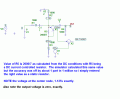
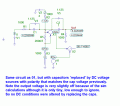
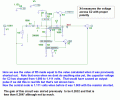
Here are some diagrams to illustrate. I am going to try to upload all pics in one post.
They should be viewed from -01 to -07 in that order.
If needed i could probably put them all in one diagram but it would be a big diagram.

Ignore some of the other things in the schematics which were used as measuring devices.
 

Attachments

LvW

Joined Jun 13, 2013
2,026
MrAl - thank you for the two contributions.
My reply can be rather short.
At first, I assume that we will continue to talk about the role of the element "re" in the T-model of the bipolar transistor, where the symbol "re" is nothing more than an expression for the reciprocal of the transconductance gm (1/gm=re) - a purely differential value.
Therefore, "re" is not a current-controlled two-pole resistor with a static ohm component RE (as you think) - and your 7 diagrams, therefore, have no relevance to the transistor characteristic.
Question: Does your example represent any other realistic circuit?
In addition, your results cannot be confirmed by Spice simulation with a realistic BJT model.
I must admit, I am overwhelmed and still don't understand your claim that the results of a DC analysis should not be used as a starting point for a small signal AC analysis (like Spice simulations).
Perhaps there are other members of this forum who can follow your explanations and assertions.
So, if you have found a new - better and more accurate - method for the analysis of such non-linear circuits with a fixed DC bias point , I am waiting for a publication in an appropriate technical journal.
(I make this suggestion because you have stated before: "Books are behind the times, some say by one year but i think it varies more or less. Books often just repeat information that has been given in the past. When there is new research that comes out after the publication date, it's not in the book of course.")

Regards
LvW
 
Last edited:

Thread Starter

MrAl

Joined Jun 17, 2014
13,702
MrAl - thank you for the two contributions.
My reply can be rather short.
At first, I assume that we will continue to talk about the role of the element "re" in the T-model of the bipolar transistor, where the symbol "re" is nothing more than an expression for the reciprocal of the transconductance gm (1/gm=re) - a purely differential value.
Therefore, "re" is not a current-controlled two-pole resistor with a static ohm component RE (as you think) - and your 7 diagrams, therefore, have no relevance to the transistor characteristic.
Question: Does your example represent any other realistic circuit?
In addition, your results cannot be confirmed by Spice simulation with a realistic BJT model.
I must admit, I am overwhelmed and still don't understand your claim that the results of a DC analysis should not be used as a starting point for a small signal AC analysis (like Spice simulations).
Perhaps there are other members of this forum who can follow your explanations and assertions.
So, if you have found a new - better and more accurate - method for the analysis of such non-linear circuits with a fixed DC bias point , I am waiting for a publication in an appropriate technical journal.
(I make this suggestion because you have stated before: "Books are behind the times, some say by one year but i think it varies more or less. Books often just repeat information that has been given in the past. When there is new research that comes out after the publication date, it's not in the book of course.")

Regards
LvW

Hello again,

The 'resistor' Re or 're' is used in that way in various texts. If you can use it that way in so many problems you can certainly call it current controlled. People have been doing this for years and you even do it, yet you dont understand how to take it one step further so that puzzles me. I dont understand why you keep referring to a different way to interpret the circuit using 'gm' when clearly using 're' is an accepted way to do it and Jony did it that way too. We've all done it that way so it makes no sense to reject that.

Also, if you compare the 'new' method with the 'old' method, you will see THERE IS VERY LITTLE DIFFERENCE. So rejecting it makes no sense on that basis either. It appears you just dont want to accept anything you have not done before. That's entirely up to you however and i know we sometimes have our favorite ways of doing things, so i am going to continue to do it the 'new' way, thanks.
Most people would say, "Well there is very little difference in the results, so do it whatever way you want to do it". By rejecting that, you indicated a bias that has nothing to do with general circuit analysis. Ask two different engineers if gains that are different by a factor of 171/170 (which is around 0.5 percent) and see if they say that one way of doing it is terribly wrong. They wont. Two unbiased opinions will say that they are close enough so that either method can be used, at the very least.

You have not addressed the variable +Vcc problem circuit however. How do you intend to handle that case when that is clearly variable?
Perhaps you've got an idea how to do that, holding 're' constant as before. If you reject 're' completely then you are indicating that you just dont like doing it this way even if you use the 'old' way.

{LATER}
I was thinking about it a little more and maybe you just dont like using this kind of method at all and that's perfectly fine. You have come to know and depend on a method that you believe in that i know that gives you more confidence when you do the analysis. So if you dont want to pursue this topic that's ok too.
Also, if you would like to comment on the +Vcc variable DC circuit that would be good, but if not that's ok too. I feel this thread has become a burden to you and i dont want that because we could have other interesting discussions in the future where we agree much more :)
 
Last edited:

WBahn

Joined Mar 31, 2012
32,823
Hello again,

To your question, YES. The reason for this becomes apparent when you look at slightly different parameters or ways of analyzing the circuit.
Also, you must realize by now that doing it the 'old' way is because of the linearized model which is an APPROXIMATION.
No one is saying that the linearized model is not an approximation to the real circuit -- but I assume that you understand that the approach you are advocating is also an approximation.

No one is saying that the linearized model always yields results that are "good enough" for the application at hand. You should only use it in situations where you believe that it is. I assume that you understand that the exact same thing applies to the approach you are advocating.

There are better methods that yield more accurate solutions to nonlinear systems. We generally try to design circuits so that the linear methods are "good enough" precisely so that we can avoid using the nonlinear methods because they are significantly more complicated, time-consuming, and error-prone.

Where is the boundary where your approach stops being "good enough"? Let's assume that it is beyond the boundary where the linearized approach has ceased to be so -- how far beyond that boundary is it?

The real question here is whether the results using your approach are sufficiently better so as to warrant the additional effort and complexity. For all of cases where the linearized approach is good enough, the answer is clearly no -- why? Because the linearized approach is good enough.

So the real question then becomes one of just how large is the problem space where the linearized approach is NOT good enough, but your approach IS? After all, in situations in which neither approach is "good enough", then the distinction is moot.

My guess -- and it's only a guess -- is that this space is pretty small. That doesn't mean that espousing your approach serves no purpose -- please don't take it to imply that.

Of course, today we often just jump straight to a circuit simulator but, in doing so, we are faced with exactly the same issues -- are the device models we are using "good enough" to adequately solve the problem at hand. I've worked with device models that, to achieve that status, consisted of a 300+ component subcircuit for each transistor (talk about slow simulation times!). There is even the question of whether the basic simulator is "good enough" -- and many are not. This is often the case with digital and mixed-signal simulators because there are a lot of digital simulation engines out there and many of them are pretty simplistic. Analog simulators often use the same underlying SPICE engine (at least up to whatever device model level they support) and so the differences aren't as pronounced. But current simulators and device models are generally not charge conserving. For most purposes they are close enough for this not to be a critical factor, but there are circuits for this this very much IS a critical issue and it can take rather herculean efforts to get adequate design validation as a result.
 
Top