Facebook
 Google
 GitHub
 Linkedin

Mornin' Guys. New member here so don't trash me too bad on my first day. 
I'm a retired military electronics technician but it's been many years since I've been actively engaged in electronics. Nonetheless, I still understand the theory, at least up until the mid-1980s when all of the new and amazing technology started showing up! In a nutshell, my electronics education and experience ranges from vacuum tubes to CMOS digital ICs.
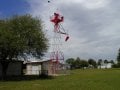
The reason why I'm here is because I need a cheap obstacle ("ob") light flasher for a 40ft tower about a quarter mile away from a small private runway. However, "flasher" would be a misnomer in this case since ob lights don't really flash anymore (at least not at night anyway) but, instead, exhibit a slow rise and fall as if fed by a very low frequency sine wave of about 1 cycle every four or five seconds. I'm looking for a circuit capable of driving a pair of common 60W incandescent bulbs in parallel. My electronics design skills, being as rusty as they are, have me thinking along the lines of a circuit based around a sine wave-controlled triac.
Of course, if inexpensive ob light flashers are already available for the amateur radio market, that would save me a lot of trouble (but also deny me a bit of fun).
Your opinions are solicited.
Many thanks!
Harvey
I'm a retired military electronics technician but it's been many years since I've been actively engaged in electronics. Nonetheless, I still understand the theory, at least up until the mid-1980s when all of the new and amazing technology started showing up! In a nutshell, my electronics education and experience ranges from vacuum tubes to CMOS digital ICs.
The reason why I'm here is because I need a cheap obstacle ("ob") light flasher for a 40ft tower about a quarter mile away from a small private runway. However, "flasher" would be a misnomer in this case since ob lights don't really flash anymore (at least not at night anyway) but, instead, exhibit a slow rise and fall as if fed by a very low frequency sine wave of about 1 cycle every four or five seconds. I'm looking for a circuit capable of driving a pair of common 60W incandescent bulbs in parallel. My electronics design skills, being as rusty as they are, have me thinking along the lines of a circuit based around a sine wave-controlled triac.
Of course, if inexpensive ob light flashers are already available for the amateur radio market, that would save me a lot of trouble (but also deny me a bit of fun).
Your opinions are solicited.
Many thanks!
Harvey
Last edited: