Sorry for the start, English is not my first language.
I made an oscillator, but the lower half is flattened and I don't know why and how to rectify it.
I'm adding some photos for details.
I have to do a lot to the circuit but i want this to be better.
Thank you for the help in advance!!!!!
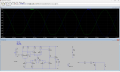
Q8 and Q9 don't provide a symmetrical output. Try adding another 2k resistor in series with R7 and drive the base of Q10 from the junction of the two resistors.
Is R6 connected the right place?
it appears to be connected to ground, so the collector of Q4 cannot swing below ground. As Q9 is common-collector, the output can only get 0.7V below the collector of Q4.
Or should Q9 be an common-emitter PNP?
In the first image, R5 and R14 form a voltage divider between GND and the -14 V rail. Because the output stage is an NPN emitter follower, it cannot pull the output below this node voltage, approx. -3.5 V. When Q8 pulls the Q10 base below approx. -2.8 V, Q10 turns off and the output clips.
What happens when you break the connection to R14?
Also, If Q8 can pull the Q10 base all the way down to -14 V, The Q10 base-emitter junction is reverse-biased by over 10 V. Even with R14 as a current limiter, this can damage the transistor.
Is this an exercise is designing with only NPN transistors?
If so, you find that the lowest available output voltage increases after each stage.
It‘s the same problem you get designing with valves, but a few volts higher at each stage hardly matters when everything is capacitively coupled and there is a 300V power supply.