hi,
If you mean the two 0.01uF caps, that are used for decoupling the OPA power supply rails, ceramic will be OK.
Ensure that they are located close to the OPA, keep the cap leads as short as possible.
E
hi,
If you mean the two 0.01uF caps, that are used for decoupling the OPA power supply rails, ceramic will be OK.
Ensure that they are located close to the OPA, keep the cap leads as short as possible.
E
Guys, I'm at the lab and apparently the OPA691 is oscillating by itself.
I have a cable connected from the lab function generator to the input pin of the signal amplifier. If I disconnect only the function generator side end of the cable, I still get a signal at the output of the signal amplifier! And this signal is not being overruled by the function generator signal that I'm trying to input to the signal amplifier. I set the lab function generator to 5.6Mhz (max it can output) and 200mVpp and even if I try to change the amplitude on the lab function generator, the output of the signal amplifier is not even changing!
Any idea of what might be happening?
Note: I still haven't swapped the film caps by the ceramic caps but I'll do it probably tomorrow!
Guys, I'm at the lab and apparently the OPA691 is oscillating by itself.
Note: I still haven't swapped the film caps by the ceramic caps but I'll do it probably tomorrow!
Those film caps have a lot of inductance. This makes for a bad high frequency power supply bypass.
Don't forget that you must have very short leads on the bypass caps. *Never* more than 5mm.
Oh, do you have a ground plane? If not, you should. It is hard to get good power supply bypass without one.
Note that the amplifier can oscillate with only a few pF of load on the output unless there is a series resistor. See the graphs of Recommended Rs vs Capacitive Load.
From the data sheet:
DRIVING CAPACITIVE LOADS
One of the most demanding and yet very common load
conditions for an op amp is capacitive loading. Often, the
capacitive load is the input of an ADC—including additional
external capacitance which may be recommended to improve
ADC linearity. A high-speed, high open-loop gain
amplifier like the OPA691 can be very susceptible to decreased
stability and closed-loop response peaking when a
capacitive load is placed directly on the output pin. When the
amplifier’s open-loop output resistance is considered, this
capacitive load introduces an additional pole in the signal
path that can decrease the phase margin. Several external
solutions to this problem have been suggested. When the
primary considerations are frequency response flatness, pulse
response fidelity, and/or distortion, the simplest and most
effective solution is to isolate the capacitive load from the
feedback loop by inserting a series isolation resistor between
the amplifier output and the capacitive load. This does not
eliminate the pole from the loop response, but rather shifts it
and adds a zero at a higher frequency. The additional zero
acts to cancel the phase lag from the capacitive load pole,
thus increasing the phase margin and improving stability.
The Typical Characteristics show the recommended RS versus
Capacitive Load and the resulting frequency response at
the load. Parasitic capacitive loads greater than 2pF can
begin to degrade the performance of the OPA691. Long PC
board traces, unmatched cables, and connections to multiple
devices can easily cause this value to be exceeded. Always
consider this effect carefully, and add the recommended
series resistor as close as possible to the OPA691 output pin
(see Board Layout Guidelines).
Ok, guys. I ended up damaging one pad of the pcb so I had to remove all components and solder them onto a new pcb (I have 5, minimum manufacturers usually accept).
I have replaced the film caps by 10nF ceramic ones. I also added the 100nF capacitor from opamp +Input to -Input as the datasheet suggests. Finally I added that 50Ω resistor to the opamp output pin. Then I connected another 50Ω resistor in series with this one to simulate a 50Ω load.
But I'm not sure results are the expected ones. I fed the opamp with the +5V and -5V and with the 50Ω resistor suggested in datasheet at the opamp output pin and a 50Ω load in series with this one, and no input signal at the amplifier input pin, I'm reading in scope an voltage across the load resistor of 1.76V. If I measure the voltage at the input pin of the amplifier, scope show -4.48V.
Is this correct somehow? Or what is happening here? I was expecting maybe some noise at the amplifier input pin and some more noise at the load resistor!
Ok, I had a wrong connection on my OPA691 and I might have damaged it. So I replaced it with the 2nd and last unit I had available. Now it's my ebay DDS module that is not oscillating. Tomorrow I'll come back to work!
Ok, I'm back to work and my DDS module is working.
I'm going to explain the stage I'm at, at the moment.
I connected my DDS module to the signal amplifier and used a dummy 50Ω resistor as a load in series with the 50Ω resistor suggested by the datasheet to help keeping the OPA691 stable. And the thing, apparently worked. But then I replaced this dummy 50Ω load resistor by the VSWR circuit itself and what I got at the signal amplifier output is a DC voltage of the same magnitude of the AC voltage measured with the dummy 50Ω load resistor!
Any ideas why when I replace the dummy 50Ω load resistor by the circuit that is going to measure the VSWR, the amplifier no longer keeps the AC voltage. Somehow it converts it to a DC voltage. At the input pin of this signal amplifier, the signal coming from the DDS module is still there!
Use resistors of a smaller value in the feedback scheme. Theoretically, if the signal source (ideal) in the input impedance is loaded onto a resistor equal in magnitude to the input impedance, then the voltage will be reduced by half with respect to the case without load.
apparently I'm running into many noise and instability issues due to the many floating wires I was using (by floating I mean wires in the air going from one point of the circuit to the next). All those wires were acting like antennas and adding a lot of trouble to the signals. My teacher told me to remove as much wires as I could and use resistor leads to solder the various parts of the whole circuit all on top of each other and that these resistor leads shouldn't be more than 2 or 3 cm long. So I did and things improved a little. But he also suggested me to start a new design for this amplifier including SMA connectors so that we can use 50 ohm impedance cables instead of wires and/or resistor leads to put "the pieces" together! That's what I'm doing now.
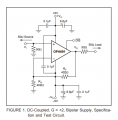
But I have a question about the amplifier circuit. The datasheet of the opamp we used, suggests this circuit but with a small (or not that small) difference.
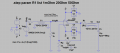
That input resistor is 50Ω at the non-inverting input pin. In the circuit Mr. @Bordodynov designed in LTSpice, a 1k Ω resistor was used.
Why he chose this value instead of the 50Ω? And what impact would it have if a 50 Ω resistor was used?
I tried to change that resistor in LTSpice but I just noticed a drop in the final gain! Which is the opposite of what I need!
apparently I'm running into many noise and instability issues due to the many floating wires I was using (by floating I mean wires in the air going from one point of the circuit to the next). All those wires were acting like antennas and adding a lot of trouble to the signals. My teacher told me to remove as much wires as I could and use resistor leads to solder the various parts of the whole circuit all on top of each other and that these resistor leads shouldn't be more than 2 or 3 cm long. So I did and things improved a little. But he also suggested me to start a new design for this amplifier including SMA connectors so that we can use 50 ohm impedance cables instead of wires and/or resistor leads to put "the pieces" together! That's what I'm doing now.
But I have a question about the amplifier circuit. The datasheet of the opamp we used, suggests this circuit but with a small (or not that small) difference.
View attachment 159984
That input resistor is 50Ω at the non-inverting input pin. In the circuit Mr. @Bordodynov designed in LTSpice, a 1k Ω resistor was used.
Why he chose this value instead of the 50Ω? And what impact would it have if a 50 Ω resistor was used?
I tried to change that resistor in LTSpice but I just noticed a drop in the final gain! Which is the opposite of what I need!
The signal source always has its resistance. I assumed it was 50 Ohm. If you use a 50Ω resistor at the input, you get a voltage divider by 2. When using 1 kΩ, the signal attenuation is 1050/1000, i.e. loss of 5%. With such a resistor, a small voltage shift is obtained due to the input current. Of course, when using 50 Ohm the system is more stable because less affected by parasitic, capacitive, positive, feedback. If you make wiring not with wires, but with printed circuit board conductors, the parasitic capacitance will be small. Coaxial cable can only be coordinated on one side. The use of a serial resistance of 50 ohms at the output makes the load resistance (in reasonable side-lands) not critical.
The signal source always has its resistance. I assumed it was 50 Ohm. If you use a 50Ω resistor at the input, you get a voltage divider by 2. When using 1 kΩ, the signal attenuation is 1050/1000, i.e. loss of 5%. With such a resistor, a small voltage shift is obtained due to the input current. Of course, when using 50 Ohm the system is more stable because less affected by parasitic, capacitive, positive, feedback. If you make wiring not with wires, but with printed circuit board conductors, the parasitic capacitance will be small. Coaxial cable can only be coordinated on one side. The use of a serial resistance of 50 ohms at the output makes the load resistance (in reasonable side-lands) not critical.
Ok, I think I understood your explanation but what I didn't understood is when you say that with 50Ω resistor at the input the system is more stable and less susceptible to parasitic influences such as capacitance, and if you also say with 1k Ω there is voltage shift due to input current, why you used the 1k Ω resistor? Is that loss of 1050/1000 greater or lower than with the 50Ω input resistor as in the datasheet?
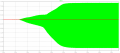
I added a generator cable and an oscilloscope cable.I also greatly reduced the input signal.With a small series resistance (1 mΩ), an oscillation is observed at the output, and at 20Ω and 50Ω there is no oscillation.
See
Nice. That explains the role of that series resistor at the output of the opamp. But my question is rather about the 1kΩ resistor at the opamp input!
Also, why you to greatly decrease input signal amplitude?
And if I add a 50 Ω load resistor in parallel with that C5, I just get a negative small DC voltage!

 Facebook
 Google
 GitHub
 Linkedin