Amplify high frequency signal

Thread Starter

PsySc0rpi0n

Joined Mar 4, 2014
1,786
Hello.

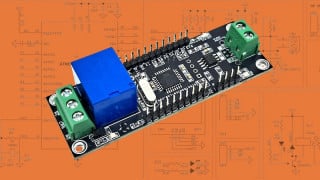
I need to amplify the amplitude of the output signal of this ebay module.
This AD9850 module outputs about 1.1Vpp. I'm using a frequency of 27 MHz and I need at least 2V or 3V of output signal amplitude. What would be a suitable OpAmp or transistor (BJT, FET, MOSFET, whatever) for this application and what would be the setup needed to make it work smoothly?

Thanks
Psy
 

ericgibbs

Joined Jan 29, 2010
21,421
hi,
I am assuming that you just want to amplify the 1.1Vppk, 27MHz sine wave, not the the square wave.??
If so I would check out the opa832 video amp.

If you want to amplify the square wave at 27MHz, what edge rise/fall times are you requiring.?

E
EDIT:
Rechecking that opa832, thats not going to be suitable at 2Vout.... at 27MHZ

Could you say why you want to amplify that signal.??
 
Last edited:

Thread Starter

PsySc0rpi0n

Joined Mar 4, 2014
1,786
hi,
I am assuming that you just want to amplify the 1.1Vppk, 27MHz sine wave, not the the square wave.??
If so I would check out the opa832 video amp.

If you want to amplify the square wave at 27MHz, what edge rise/fall times are you requiring.?

E
EDIT:
Rechecking that opa832, thats not going to be suitable at 2Vout.... at 27MHZ

Could you say why you want to amplify that signal.??
I'm sorry if I wasn't clear at 1st post.
I'm using this module to feed my project circuit but 1.1Vpp of amplitude is not enough. I need at least about 2.5Vpp or 3Vpp. It can bee a bit higher if this helps.

And I'm only looking for to amplify the Sine Wave that the module outputs! No Square wave needed!

Hello,

The shown DDS can work upto 40 Mhz. To amplify the signal 3 times, you would need a GBW of at least 3 X 40 Mhz = 120 Mhz.
The attached spreadsheet shows you a couple of opamps that will be fast enough.

Bertus
I have no knowledge about this but amplifying the amplitude makes the frequency value also to be amplified?
Can't I just get like 3Vpp and the same 27Mhz out of the amplifier we are discussing?

hi J,
This one has Gain of 2 at 120MHz.
E
I've also seen that PDF yesterday. I'm not sure I can use it in this case! Hope I can!

But by amplifying the amplitude I'm going to be working also with higher frequencies? If so, I'm not sure I can use this module, because I'm not sure how much dependency the project circuit elements will distort their behaviour under much higher frequencies!

I also need to take into account that this 1.1Vpp I spoke in 1st post is in open circuit scenario. When I attach the load (circuit project) to it, it will drop of some amount! Not sure how much but is still considerable!
 

ericgibbs

Joined Jan 29, 2010
21,421
hi J,
When designing circuits for 27MHz high level signals the layout and screening are very important.
There are PDF's covering the requirements.

E
 

Thread Starter

PsySc0rpi0n

Joined Mar 4, 2014
1,786
Ok, now I need a small shop where to buy it and learn how to build the circuit around it to fulfil my request.

hi J,
When designing circuits for 27MHz high level signals the layout and screening are very important.
There are PDF's covering the requirements.

E
What you mean by layout? Packaging type?
And what you mean by screening?
 

ericgibbs

Joined Jan 29, 2010
21,421
hi,
Layout is the position the different components are located on a PCB relative to each other and the copper tracks.

Screening is to ensure that high level electrical signals on wiring/copper track, do not radiate into space and so cause interference to your or other users circuits.
 

Janis59

Joined Aug 21, 2017
1,894
if smaller power, the ultimate nice results may be gained by 2222, the 2N548 is very good too, even the russian retro-megahit kT315 as well the kT3107 may work with that and even in push-pull cascades, but if really the larger power be wanted, the IRF510 may be hardly helpful. However, if serious indeed power is demanded, there are no still better alternatives as IXFH42N60 or this year wunderkinder APT638, and one shelf lower the Infineon DE150 and DE275. All them has F(T) between 150 and 300 MHz.
 

Thread Starter

PsySc0rpi0n

Joined Mar 4, 2014
1,786
hi,
Layout is the position the different components are located on a PCB relative to each other and the copper tracks.

Screening is to ensure that high level electrical signals on wiring/copper track, do not radiate into space and so cause interference to your or other users circuits.
Ok, thanks for the terms explanations!

if smaller power, the ultimate nice results may be gained by 2222, the 2N548 is very good too, even the russian retro-megahit kT315 as well the kT3107 may work with that and even in push-pull cascades, but if really the larger power be wanted, the IRF510 may be hardly helpful. However, if serious indeed power is demanded, there are no still better alternatives as IXFH42N60 or this year wunderkinder APT638, and one shelf lower the Infineon DE150 and DE275. All them has F(T) between 150 and 300 MHz.
I'll try to stick with those LMH6xxx series. I found a shop near me that have at least the LMH6612. I found it on their site. But they have a lot more in store than in site so they might have the LMH6655 or the LMH6654.

I still would appreciate some explanations from the datasheet.
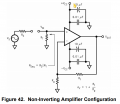
Is the configuration I should be looking for the one from Figure 42, page 17 of this datasheet?
upload_2018-7-24_20-45-40.png

Although they talk about Bias Current cancellation here in this figure, would this be the configuration for my purpose?
 

Thread Starter

PsySc0rpi0n

Joined Mar 4, 2014
1,786
Well, I tried a simulation with LTSpice to get about 3Vpp at the output but results were not the ones I was expecting.
Following the datasheet page 17, Figure 42 I had to know the following parameters:

Rs = Source Impedance -> My DDS module from ebay. I assuemd 50Ω
Rt = I chose to be 1kΩ. No specific reason. I just picked up an integer and easy value.
Rseq = Rs // Rt = 47.6 Ω

Then as this DDS module outputs about a 1.1Vpp (open circuit, no load) and I wanted a value of about 3Vpp, I evaluated the gain as:
Av = Vamplified / VDDS Module = 3 / 1.1 = 2.73

Then using datasheet formulas I evaluated Rf and Rg as:
Rf = Av * Rseq = 2.73 * 47.6Ω = 130Ω
Rg = Rf / (Av-1) = 130 / (1.73) = 75.14Ω

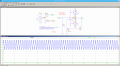
I was expecting a sine wave of the same frequency of about 3Vpp but instead this is what I got:
RF-amplifier-output-waveform.png
A DC negative voltage of about 3.8V. :s

Edited;
I have downloaded this LMH6654 subcircuit from TI site:
http://www.ti.com/lit/zip/snom141
I have extracted the file and used it in LTSpice.

Edited 1;
R4 should be named Rs to match datasheet resistor names. I'm sorry!
 

Attachments

Last edited:

RichardO

Joined May 4, 2013
2,270
It looks like your op-amp is oscillating at about 50 MHz. Try putting a small cap across Rf. Start with about 5pf and see what happens.

Note that the LMH6654 only has a GBW product of about 250 MHz. That does not give much "excess" gain at 27 MHz.

If I were doing it I would use a current feedback op-amp. An Lt1227 might be good enough. (Note: Do *not* put a cap across Rf when using a current feedback op-amp.)
 

ebp

Joined Feb 8, 2018
2,332
It seems to be behaving like the positive power supply isn't getting to the amp, making me wonder if the power pin signs are wrong on the symbol. I'd try connecting the neg. supply to the + pin & vice versa. The good thing about sims is no smoke, no matter what.

You could also leave it as-is and look at the currents in the supplies to see if they are reasonable approximations of the datasheet values. Try this with the non-inverting input to circuit common.

[EDIT] - might be reversal of inverting and non-inverting inputs
 
Last edited:

Thread Starter

PsySc0rpi0n

Joined Mar 4, 2014
1,786
Hello.
Well, indeed. Now I just need to check if math adds up to LTSpice simulation. I think I also made a mistake setting up Vsig amplitude. I said 1.1Vpp but I set it to 2.2Vpp. So only later today I can fix it to make it 1.1Vpp. You guys think this approach is good enough to make this work smoothly?
 

ericgibbs

Joined Jan 29, 2010
21,421
Morning Jose'.
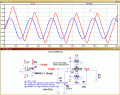
This image is using Bordodynov's OPA model, its working OK, but I would say the Vout waveform is not acceptable.
E

Update:
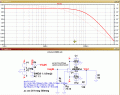
Checking the LMH6654 datasheet suggests it should reproduce the 27MHz sine wave with a Gain of *2.
I believe that the the lmh6654.sub needs 'tweaking', @Bordodynov is the best guy to do that.

E
 

Attachments

Last edited:
Top