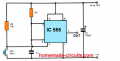
The pulse should be no longer than you would press the button. You can't use the output directly to switch it, you need to use a transistor that is turned on by the 555's output.
I think perhaps using a small relay that will operate on 5V would be easier. It would eliminate a bit of complexity and troubleshooting. Something like this: https://www.amazon.com/dp/B09KKPNQFK/
That way it is a direct duplication of the switch itself, and it won't require working out the details of the underlying circuit.
okay, sorry for me being such a beginner, but how do I connect that kind of relay?
Is it possible for you to draw me some kind of image of the circuit and what I might need?
I've never worked with either a relay or a 555 IC timer.
What would happen if I just desoldered the on-off button and connected a wire between? Would I still have the same problem as in the beginning with the amplifier turning itself on and off?
I am the wrong person to do that, but some members greatly enjoy creating schematics and simulations I am hoping that one of them might step in and give a hand.
What would happen if I just desoldered the on-off button and connected a wire between? Would I still have the same problem as in the beginning with the amplifier turning itself on and off?
You would have exactly the same trouble. The switch effectively does not exist as long as you are not pressing it. Nothing about it can influence circuit when it is open.
- disconnect the on-off button by soldering a cable between the poles
- adding longer wires to the diode so that the led could be attached a bit from the amplifier
Hey, Eric. We've done the troubleshooting on this. Your surmise is correct: the switch turns it on, and then if held down, turns it off after a few seconds.
There was a suggestion of soldering a cap across the switch, which sounded very promising but didn't work.
We are left with a one shot (the 555 seemed most appropriate) and I figured using a relay would ensure there were no odd problems with the interface to the switch pads.
What he needs now is a schematic for the interface between the 555 one shot and the relay. I linked the AAC page for the 555 calculator to get the values he needs, and has a basic schematic for it, but the relay connections are a mystery to the TS.
I am not the right person to create a usable schematic unfortunately. So, the call for assistance. Thanks for answering it.
I have very little experience of how these things work and would really apprechiate some kind of schematics of how the circuit would look and how to connect it to the on-off button I have today.
I've been doing my "homework" and read about these things but I really think it would help me tons if I could get some kind of circuit. Thanks!
I have very little experience of how these things work and would really apprechiate some kind of schematics of how the circuit would look and how to connect it to the on-off button I have today.
I've been doing my "homework" and read about these things but I really think it would help me tons if I could get some kind of circuit. Thanks!
Sorry for the assumption but as you can imagine female forum members are the exception rather than the rule. Noted, however.
This project is complicated for a neophyte but entirely reasonable for you to complete. My advice is to take your time, and try to understand why you are doing different things. The more you really understand the more you will be able to work out yourself.
Take things a piece at a time then connect them together. If you try to understand the whole thing, you will miss important details. There is always an answer to “why is this bit connected to that one?”, and it eventually always relates back to the entire circuit or system.
It is also worth the effort, if you haven’t already done it, to look into Ohm’s Law and learn the basics fo how to calculate each of the things it covers. It has enormous utility both in application (choosing resistor values, for example) and in reasoning about circuits (e.g.: “that resistor limits the current to the base of that transistor so if I increase it…”)
Don’t let yourself become overwhelmed with the amount of information you will find as you learn. It will take a while to build your mental toolkit but it will happen over time if you persist, and I hope you do!
As I mentioned earlier ............
I personally think that creating a new Amplifier is actually less complicated than
trying to create a "Rube-Goldberg-Device" Circuit to automatically switch-on an Amplifier
that was probably not designed to be "DIY-Hobbyist-Friendly" in the first place.
If there were detailed pictures of the Board and Switch in question, it would help tremendously.
Does the TS have a cheap Multi-Meter and know how to use it ?,
It probably doesn't matter,
it's not likely that the Power-Switch-Input would be damaged by connection directly to Hot or Ground,
so it's simply a matter of making a Circuit which can handle either scenario.
What is the available Power-Supply Voltage ?,
( I can't bring myself to actually recommend a Mechanical-Relay )
.
.
.
I assumed you mean that the link between the on-off button is the wire I soldered there.
If I remove that wire the button would still be there and it would work as before, meaning that I would have to use the button to turn the amplifier on and off. But no, it wont turn on and off all the time.
As I mentioned earlier ............
I personally think that creating a new Amplifier is actually less complicated than
trying to create a "Rube-Goldberg-Device" Circuit to automatically switch-on an Amplifier
that was probably not designed to be "DIY-Hobbyist-Friendly" in the first place.
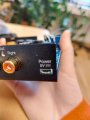
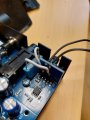
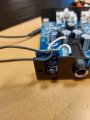
If there were detailed pictures of the Board and Switch in question, it would help tremendously.
Does the TS have a cheap Multi-Meter and know how to use it ?,
It probably doesn't matter,
it's not likely that the Power-Switch-Input would be damaged by connection directly to Hot or Ground,
so it's simply a matter of making a Circuit which can handle either scenario.
What is the available Power-Supply Voltage ?,
( I can't bring myself to actually recommend a Mechanical-Relay )
.
.
.
The reason for the mechanical relay was to avoid the potential confusion of troubleshooting issues with the switch contacts, but if it works out that’s not a problem I would also delete the relay.
I see @LowQCab ... The thing is that I already bought this amplifier for some money so I would really perfer if I could use it. At least it would be nice to try a solution with a 555 timer or so before creating a new amplifier.
I'm going to try to take some pictures now so you can see what it looks like.
I have a multimeter and know how to use it.
The power supply is a 5 V power bank which I charge.
If I remove that wire the button would still be there and it would work as before, meaning that I would have to use the button to turn the amplifier on and off. But no, it wont turn on and off all the time.
hi martin,
I know what you are wishing to do, BUT I want to ensure that the power on circuitry has not been damaged by your modifications, before suggesting a circuit.
Also, is the amplifier powered by mains or battery.??
E
It works just as before, also when I removed the capacitor now.
It is powered by a battery, 5 V. It's the battery I have soldered a new switch to. Because the battery gives power to other things too, and I want everything to turn on at the same time by just hitting one button. That's why I want to try to avoid the button on the amplifier.
Thanks!
The circuit is designed to turn on when the switch is closed, then turn off if it is held down. If you continuously hold down the switch, it will first turn on, then after the time it takes to turn off, it will. Once off, it turns on again because the switch is still closed.
Your shorting link is the same as taping down the button. It cycles on and off because it "thinks" it is being told to do that.

 Facebook
 Google
 GitHub
 Linkedin