AC Polarity swapping circuit

Thread Starter

m_alizd

Joined Oct 1, 2019
25
Hi Folks!

I'm quite excited to join here today.
I'm new to power electronics and out of interest working on a simulation on a 32Vac line driving a low power load (less than 30W). I'd like to control negative and positive sinewave cycles going to the load and chose what cycle to go next. For example I might have 10 full normal cycles going, and then at some point choose to send 2 negative cycles in a row. Ideally I'd like to have full control over pattern. Only requirements is this to happen in zero crossing and the switching time to be no more than 1ms, ideally in microseconds scale.
I looked at it as if I am multiplexing an AC source line and swapped polarity version of it onto the load with some magical AC line multiplexer.
I'm wondering:
1. Is there anything fundamentally wrong with switching polarities to any load?
2. What's the best and cheapest way to implement this?
2. Assuming use of TRIACs there any circuit which achieves the same job?

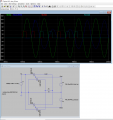
Here is the most simplified simulation in LtSpice I could come up with to have a go:


Though it's not working as I expect:


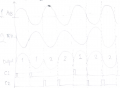
versus something similar to expected output trace:


I appreciate if anyone with more insight shed a light and point me in right direction to follow or any component that makes this happen. I've attached simulation and data if anyone wants to have a look.

Cheers,
Matt
 

Attachments

Sensacell

Joined Jun 19, 2012
3,784
Your photos are not showing up.

Theoretically, you can use a micro-controller to phase control a triac to accomplish this with microsecond timing.
In practice, the tricky part is getting a really clean and stable zero-crossing signal to base all your timing from.

What is the load? what is the purpose of changing polarity?
 

Thread Starter

m_alizd

Joined Oct 1, 2019
25
Your photos are not showing up.
Thatnks Sensacell, I have attached to my reply. Did simulation files open, in case you have LTspice?

What is the load? what is the purpose of changing polarity?
Load is LED controller which is switch mode power supply and feeds after full rectified bridge from AC input.
 

Attachments

Thread Starter

m_alizd

Joined Oct 1, 2019
25
Any specific component, app note or reference design link I can follow?

BTW, Is there H-bridge for AC loads possibly based on SCRs or TRIACs?
Because my quick search returns results with H-Bridge based on MOSFETs to control DC motor.
 
Last edited:

Thread Starter

m_alizd

Joined Oct 1, 2019
25
The zero crossing circuit is appealing, I'll check it out. It will help create a better gate signal for switches close to zero crossing point.
However, the main problem is still H-Bridges apparently work on DC systems not AC.

I think what is needed here is an equivalent to H-Brdige circuit which is designed either based on SCRs or TRIACs or a combination.
Any thoughts?
 

Alec_t

Joined Sep 17, 2013
15,117
Changing polarity will trigger some action when sensed by the load.
If the load is a LED controller I'd be surprised if you notice any difference, since (a) the AC frequency is high enough to prevent noticeable flicker for most people and (b) if the controller is a switch-mode type its input stage probably rectifies the AC into a DC supply for the switching stage. Can you post a link to the controller?
 

MrChips

Joined Oct 2, 2009
34,807
Use the output of the zero-crossing detector (or analog comparator) to determine both the phase and polarity.
Use a full-wave rectifier to convert the AC to unipolar wave. Select the wave you want with the H-bridge.

You will need some way of counting the waves, either with HW or SW.
 

Thread Starter

m_alizd

Joined Oct 1, 2019
25
Use a full-wave rectifier to convert the AC to unipolar wave. Select the wave you want with the H-bridge.
If we use a fullwave rectifier then there is no negative and positive cycle anymore, hence no polarity swap which is the aim. Please note the goal and requirement is to generate (in anyway possible) the "output" trace in the attachment "Polarity switch.png" provided in my 2nd message above.
 

Alec_t

Joined Sep 17, 2013
15,117
Is there anything fundamentally wrong with switching polarities to any load?
Yes, if the load is the controller in the post #12 link. That requires a positive-only input. Moreover, that input should be relatively constant because the controller IC has an under-voltage cut-out.
What are you hoping to achieve with this polarity-switching?
 

Thread Starter

m_alizd

Joined Oct 1, 2019
25
Yes, if the load is the controller in the post #12 link. That requires a positive-only input.
Because that load has a built in full rectifier in front of the chip, it will definitely have positive-only input no matter input sinewave cycles are as normal positive/negative every second half cycle or any arbitrary pattern.
 

Alec_t

Joined Sep 17, 2013
15,117
I'm hoping the load senses the polarity has swapped and acts differently based on that.
How would it do the sensing, given the full-wave rectification (plus the usual smoothing with a fat capacitor)?
What 'act' difference are you expecting/wanting?

Edit: If you want to modulate the LED current, the controller IC already has a DC/PWM input pin for that. Why would you want to mess with the AC supply?
 
Last edited:

Thread Starter

m_alizd

Joined Oct 1, 2019
25
There might be a lot of ways to do these things. I just don't want to mess with the load as I don't have much flexibility there. However, I can do much at AC power supply side. That's why I'm trying to formulate a solution in this end.
 

MrChips

Joined Oct 2, 2009
34,807
The zero-crossing/phase detector will indicate which phase you're at.
Then switch the direction with the H-bridge.
 
Top