AC fuses in a DC circuit. Melting!

panic mode

Joined Oct 10, 2011
5,153
i see no picture... or part number... on fuse, fuse holder, wire etc. so i am going to guess that fuse holder was something like this:

1776687813012.png

choosing parts that are used at their spec limits (or beyond) is as bad as the construction method. in fact what was the construction method (other that sealing the case with foam)?

how were the wires attached to fuse holder? solder directly to terminals? crimp to spade terminals? did you electrically insulate connections? because what is see looks like carnage of arcing. that suggests that at least the fuse holder connections were botched. bad solder, cold joint, incorrectly stripped wire (cut into the copper)... whatever it was, it looks like connection failed. so the wire became free and it was moving, touching one or both terminals... resulting in arcing. which would explain copper deposits and melting. so rather than blaming fuse holder for "bad quality", maybe take some responsibility. how about convincing us that you read the specs, sized parts correctly, connected them properly? if soldered, post the picture of solder joints before malfunction. did you use flux? what kind? were the joints cleaned and insulated.
not everyone is good at soldering which is why other connection methods are popular, specially in tough environments (crimping to name one) where reliability is top requirement.

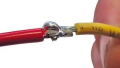
extremely poor solder job:
1776690282094.png

for more soldering tips, check this. even there, i disagree that joint "A" in "Wire soldering to terminal" is good. solder is not shiny, suggesting poor connection. also the joint is not yet individually insulated.

1776690795104.png

this is better:
1776690944225.png

one option is to use spade terminals but... they too need to be chosen correctly because different sizes exist (not just different tab width but also tab thickness), for different wire sizes, they can be insulated and non-insulated, type of insulation differs too some are quite soft, and melt easily, others are tough and very hard to cut. if insulated terminal was to get disconnected, and starts floating around, there is a good chance that nothing bad would happen.

1776689710323.png
terminal made for larger wire will not crimp well on smaller wire. and if wire is too large, trimming "excess" strands to "make it fit" is not a solution.
another thing is that soldering job should be cleaned. flux is important for soldering but it is mildly corrosive. that means over time joints may fail but... this corrosive effect is much stronger in presence of heat. yes, it gets activated by soldering, as well as heat from failing joint (accelerating failure). many cleaning chemicals (solvents) exist so i do not recommend diesel fuel... (imagine that failure). for electrical connection isopropyl alcohol and a brush do miracles as alcohol is not conductive, evaporates quickly and leaves no residue.

also, notice how clear images are that i posted? can you please share clear images of your parts before failure, and how you connected them?
 
Last edited:

MisterBill2

Joined Jan 23, 2018
27,976
My thinking is that the fuse holder was not at all similar, nor in the same "quality range" as what is shown in post#21!
It was obviously an "inline" fuse holder of the three-piece construction: That is, a thin, flexible, molded poly, plastic case, and two crimp-on clips that slip onto the ends of a glass cartridge fuse. The plastic case snaps around the installed fuse and the wires to prevent electrical contact with anything, and to hold the crimp-on clips onto the fuse. I have not seen this style of fuse holders in electrical distributor catalogs, probably because they refuse to sell them.

There do exist varieties of inline fuses of much better quality, but those are not part of this discussion.

Until we can see the other end of the assembly we are only guessing. Consider that in the photo there is only visible heat damage of the insulation close to the failed connection. THAT there is no aparent heat damage or discoloring of any oter insulation shows that it was not the wire's conductor overheating.

Consider also that normally the solder in an electrical connection is not the main current carrying portion.
 

ericgibbs

Joined Jan 29, 2010
21,527
hi
I recently received a batch of 20mm inline fuse holders, they had a voltage drop across the holder, using a 1A fuse, of 1V when carrying a 0.2Amp current!!
This I suspect was due to the poor quality wire crimping and low quality metal fuse end contacts..

E
 

Thread Starter

jc0r

Joined Oct 15, 2013
23
Hi all.

The fuse holders in question are these very high quality ones :oops:

LINK

I made up a test rig today with the same components except in open air. The 1.5mm cable was passed through the terminal hole and soldered directly to the terminals as in the battery pack I had made.

In open air (ambient temp 11c) after 30 minutes with a 10amp load @ 24.2v, with an infrared temp sensor, i recorded the hottest point being at the soldered terminal with a temperature of 52.8c. I can only guess how much hotter this would have been in the exandable foam.

Whilst I do not know the exact failing point, whether it was the solder, poor quality holder, poor quality fuses or a combination of all 3, I have decided to take the advice regarding automotive fuses. Whilst I am nowhere qualified in this area, please be aware this is only a hobby project where i'm learning as I go. I've read how "DC arc is not self-extinguishing like the AC one is at the zero crossing". Whilst I don't yet full understand this, it would appear using AC fuses in a DC circuit is not the best idea.

My plan now is to use the following and without using any expandable foam. Littelfuse seem to be a reliable manufacturer and having read the datasheets for both, at 24VDC, i think this will make a marked improvement?

https://cpc.farnell.com/littelfuse/...a-32v-wire-leaded/dp/FF03990?CMP=TREML007-004

https://cpc.farnell.com/littelfuse/0287015-pxcn/fuse-atof-blade-15a/dp/FF02739?CMP=TREML007-004
 

MisterBill2

Joined Jan 23, 2018
27,976
hi
I recently received a batch of 20mm inline fuse holders, they had a voltage drop across the holder, using a 1A fuse, of 1V when carrying a 0.2Amp current!!
This I suspect was due to the poor quality wire crimping and low quality metal fuse end contacts..

E
That could be caused by any of a number of things. Some fuses do have a higher resistance, if they are high voltage fuses. It could also be caused by corrosion, either on the fuse or the holder. Bessides that, the actual terminals in the fuse hoder might be steel, not any copper alloy.
 

meth

Joined May 21, 2016
304
In open air (ambient temp 11c) after 30 minutes with a 10amp load @ 24.2v, with an infrared temp sensor, i recorded the hottest point being at the soldered terminal with a temperature of 52.8c. I can only guess how much hotter this would have been in the exandable foam.
I would say it is a cocktail of bad situations, the high current, the heat, the foam and possibly the terminals of the fuse holder <- not the fuse holder itself but how you soldered the wires to the terminals.
 

MisterBill2

Joined Jan 23, 2018
27,976
I would say it is a cocktail of bad situations, the high current, the heat, the foam and possibly the terminals of the fuse holder <- not the fuse holder itself but how you soldered the wires to the terminals.
Based on what looks to me like quite a bit of solder that had melted again, I question the quality of the solder connection prior to the melt-down. SO, once again, I ask to see a photo of the other solder connection. AND, if there are multiple fuse holders of that same kind, a photo of another fuse holder that has not been damaged.
 

drjohsmith

Joined Dec 13, 2021
1,630
Based on what looks to me like quite a bit of solder that had melted again, I question the quality of the solder connection prior to the melt-down. SO, once again, I ask to see a photo of the other solder connection. AND, if there are multiple fuse holders of that same kind, a photo of another fuse holder that has not been damaged.
when you say "looks to me like quiet a bit of solder " , which post are you refering too ?
 

MisterBill2

Joined Jan 23, 2018
27,976
when you say "looks to me like quiet a bit of solder " , which post are you refering too ?
There is only one: The photo of the failed portion in POST#1. It looks like a blob of solder has melted and flowed. Or else it was never an adequate solder connection. Given that we do not see very much,it is a challenge to understand.
 

drjohsmith

Joined Dec 13, 2021
1,630
There is only one: The photo of the failed portion in POST#1. It looks like a blob of solder has melted and flowed. Or else it was never an adequate solder connection. Given that we do not see very much,it is a challenge to understand.
was wondering
yes first picture does seem to be lot of burnt wires / insulation, and looks like plating of the connector has gone .
 

MisterBill2

Joined Jan 23, 2018
27,976
was wondering
yes first picture does seem to be lot of burnt wires / insulation, and looks like plating of the connector has gone .
I see only one wire with discolored insulation, in the area with the damaged looking white foam. There is quite a bit of what appears to be heat damaged foam. My impression is that the fuse holder melted, because what I presume is the single end clip amidst all that foam, is from the fuse holder that melted. I have never seen what I would call a "good quality fuse holder" made of ANY TYPE OF THERMOPLASTIC. Not EVER!! I recall that the UL rules prohibit the use of thermoplastic materials for fuse holders and circuit breakers in general. THAT is a rule that makes perfect sense.
 

drjohsmith

Joined Dec 13, 2021
1,630
I see only one wire with discolored insulation, in the area with the damaged looking white foam. There is quite a bit of what appears to be heat damaged foam. My impression is that the fuse holder melted, because what I presume is the single end clip amidst all that foam, is from the fuse holder that melted. I have never seen what I would call a "good quality fuse holder" made of ANY TYPE OF THERMOPLASTIC. Not EVER!! I recall that the UL rules prohibit the use of thermoplastic materials for fuse holders and circuit breakers in general. THAT is a rule that makes perfect sense.
Wonder if the foam is UL rated :) ..
 

MisterBill2

Joined Jan 23, 2018
27,976
Wonder if the foam is UL rated :) ..
I really doubt that it is rated for use in electrical enclosures! The only places that I have seen any sort of foam associated with ELECTRICAL systems is with FIRESTOP types of foam used to seal the openings where electrical wires or conduit penetrate structures intended to stop fires from spreading. Mostly those are structural elements, but they may also be "just walls", for security or climate control. The only place that I have seen foam used with actual electronics is in modules used in high vibration locations, such as engines and aircraft. I am not sure if those modules are considered repairable or not. The one module that I long ago salvaged some expensive transistors out of was rather difficult to remove enough to reach and unsolder them.
 

MisterBill2

Joined Jan 23, 2018
27,976
I recall that the foam is to stop motion from vibrations. But certainly it makes servicing quite difficult, at best. There are other methods that are also suitable for preventing motion from vibration, but allow simple access for service and modifications. They are not as easy as foam, but they allow service and adjustments.
 

drjohsmith

Joined Dec 13, 2021
1,630
I recall that the foam is to stop motion from vibrations. But certainly it makes servicing quite difficult, at best. There are other methods that are also suitable for preventing motion from vibration, but allow simple access for service and modifications. They are not as easy as foam, but they allow service and adjustments.
And hopefully allow the inherent heat of the wires and fuses due to current to disipate..
 

BobTPH

Joined Jun 5, 2013
11,609
Obviously, a 10A fuse cannot just jump in temperature from ambient to melting when it carries 11A. Does anyone know how hot they are likely to get at the rated current, say in free air at 20C?
 

MisterBill2

Joined Jan 23, 2018
27,976
What it looked like to me, based on the one photo, is that the failure was caused by a poor conection at the connection to the fuse.
The TS has stated that the fuse holder was a "good quality" device. And yet we see that the connection to the fuse had melted outof the housing. I find it impossible for a fuse holder that can melt to be any better than A POOR QUALITY DEVICE!! I am quite aware of the polyethylene snap-on iline fuse assemblies, and I regard them as the very poorest example of a product possible.
 
Top