Facebook
 Google
 GitHub
 Linkedin

panic mode
- Joined Oct 10, 2011
- 5,255
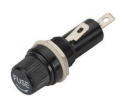
i see no picture... or part number... on fuse, fuse holder, wire etc. so i am going to guess that fuse holder was something like this:
choosing parts that are used at their spec limits (or beyond) is as bad as the construction method. in fact what was the construction method (other that sealing the case with foam)?
how were the wires attached to fuse holder? solder directly to terminals? crimp to spade terminals? did you electrically insulate connections? because what is see looks like carnage of arcing. that suggests that at least the fuse holder connections were botched. bad solder, cold joint, incorrectly stripped wire (cut into the copper)... whatever it was, it looks like connection failed. so the wire became free and it was moving, touching one or both terminals... resulting in arcing. which would explain copper deposits and melting. so rather than blaming fuse holder for "bad quality", maybe take some responsibility. how about convincing us that you read the specs, sized parts correctly, connected them properly? if soldered, post the picture of solder joints before malfunction. did you use flux? what kind? were the joints cleaned and insulated.
not everyone is good at soldering which is why other connection methods are popular, specially in tough environments (crimping to name one) where reliability is top requirement.
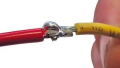
extremely poor solder job:
for more soldering tips, check this. even there, i disagree that joint "A" in "Wire soldering to terminal" is good. solder is not shiny, suggesting poor connection. also the joint is not yet individually insulated.
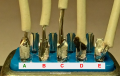
this is better:

one option is to use spade terminals but... they too need to be chosen correctly because different sizes exist (not just different tab width but also tab thickness), for different wire sizes, they can be insulated and non-insulated, type of insulation differs too some are quite soft, and melt easily, others are tough and very hard to cut. if insulated terminal was to get disconnected, and starts floating around, there is a good chance that nothing bad would happen.
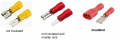
terminal made for larger wire will not crimp well on smaller wire. and if wire is too large, trimming "excess" strands to "make it fit" is not a solution.
another thing is that soldering job should be cleaned. flux is important for soldering but it is mildly corrosive. that means over time joints may fail but... this corrosive effect is much stronger in presence of heat. yes, it gets activated by soldering, as well as heat from failing joint (accelerating failure). many cleaning chemicals (solvents) exist so i do not recommend diesel fuel... (imagine that failure). for electrical connection isopropyl alcohol and a brush do miracles as alcohol is not conductive, evaporates quickly and leaves no residue.
also, notice how clear images are that i posted? can you please share clear images of your parts before failure, and how you connected them?
choosing parts that are used at their spec limits (or beyond) is as bad as the construction method. in fact what was the construction method (other that sealing the case with foam)?
how were the wires attached to fuse holder? solder directly to terminals? crimp to spade terminals? did you electrically insulate connections? because what is see looks like carnage of arcing. that suggests that at least the fuse holder connections were botched. bad solder, cold joint, incorrectly stripped wire (cut into the copper)... whatever it was, it looks like connection failed. so the wire became free and it was moving, touching one or both terminals... resulting in arcing. which would explain copper deposits and melting. so rather than blaming fuse holder for "bad quality", maybe take some responsibility. how about convincing us that you read the specs, sized parts correctly, connected them properly? if soldered, post the picture of solder joints before malfunction. did you use flux? what kind? were the joints cleaned and insulated.
not everyone is good at soldering which is why other connection methods are popular, specially in tough environments (crimping to name one) where reliability is top requirement.
extremely poor solder job:
for more soldering tips, check this. even there, i disagree that joint "A" in "Wire soldering to terminal" is good. solder is not shiny, suggesting poor connection. also the joint is not yet individually insulated.
this is better:
one option is to use spade terminals but... they too need to be chosen correctly because different sizes exist (not just different tab width but also tab thickness), for different wire sizes, they can be insulated and non-insulated, type of insulation differs too some are quite soft, and melt easily, others are tough and very hard to cut. if insulated terminal was to get disconnected, and starts floating around, there is a good chance that nothing bad would happen.
terminal made for larger wire will not crimp well on smaller wire. and if wire is too large, trimming "excess" strands to "make it fit" is not a solution.
another thing is that soldering job should be cleaned. flux is important for soldering but it is mildly corrosive. that means over time joints may fail but... this corrosive effect is much stronger in presence of heat. yes, it gets activated by soldering, as well as heat from failing joint (accelerating failure). many cleaning chemicals (solvents) exist so i do not recommend diesel fuel... (imagine that failure). for electrical connection isopropyl alcohol and a brush do miracles as alcohol is not conductive, evaporates quickly and leaves no residue.
also, notice how clear images are that i posted? can you please share clear images of your parts before failure, and how you connected them?
Last edited: