AC fuses in a DC circuit. Melting!

Thread Starter

jc0r

Joined Oct 15, 2013
23
Hi all,

I made myself a battery pack using a 24v 60ah LiFePO4 cell. The cell supplies 24v DC to 4 x 15a fused XLR sockets (Neutrik).

I have had a problem as you can see below where the fuse holder has melted at 10a along with part of the wire coming off the fuse holder.

I am trying to ascertain the cause of this.

All wiring used is 1.5mm2 heat resistent so i'm struggling to see how its melted.

The fuses and fuse holders are just cheap Amazon non name so my best guess is this would be the culprit. What im trying to figure out is whether its the fuse or the fuse holder at fault? The fuses used are marked F15AL250V. Its only now having searched the internet that there are specific DC fuses. I never gave it a thought as I assumed 250v on a 24v circuit would be fine and that it was the ampere rating that was important. But im starting to read about the differences in AC and DC where the fuse is concerned. This would lead me to believe its the fuse itself and not the holder?

Any help with this would be much appreciated.
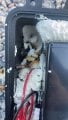
WhatsApp Image 2026-04-18 at 19.26.22.jpeg
 

MisterBill2

Joined Jan 23, 2018
27,283
First, a fuse marked "F15AL250V is a 15 amp fuse intended for AC mains use. My initial guess is that the fuse holder was intended for "three amp max" applications in a 12 volt system. I see no indication of the wire insulation melting, but apparently the fuse holder and fuse were damaged.
IF the wire connections at the fuse holder were not perfect that could have been aproblem. Many cheap, in-line fuse holders are not suitable for application for circuits of over one or two amps/12 volts, fused at three amps.
 

B-JoJo-S

Joined Jan 3, 2026
243
I'd suggest first understanding what the problem is. To keep throwing fuses at a problem will only lead to more damage. From the picture it looks like there has been far more current than the housing could handle (as @MisterBill2 suggested). Before throwing another fuse at it you should troubleshoot the whole circuit to make sure there are no reasons for a fuse to burn up like that. There could be a short circuit somewhere. Perhaps a strand of wire has left the crimp (guessing) and shorted to ground somehow. Or a wire has come loose and inadvertently welded itself to ground. You won't know until you fully diagnose the problem.

Also, a little more clarity at what you have and how it functions will help us help you.
 

drjohsmith

Joined Dec 13, 2021
1,579
Wires and fuses get hot when current flows through them
The wire / fuse rating is specified for a set environment, normally open air.
You seem to have surrounded them by spray foam , a good insulator
QED, the heat has no where to get out, and will accumulate / melt
 

Thread Starter

jc0r

Joined Oct 15, 2013
23
I appreciate all your responses. If it's a combination of poor quality fuses and fuse holders, could anyone suggest a suitable replacement for a 24v DC system with a max rating of 15 amps please? Ive looked at a few data sheets now and they're generally just suggesting 15a but not specifying AC or DC so I assume it's AC?
 

Thread Starter

jc0r

Joined Oct 15, 2013
23
Sorry I responded but didn't see the other replies.

So the expandable foam is in place to protect the cell from shock as it's house in a Pelicase.

The load at the time was 10 amp and you are correct in assuming the fuse did not blow, just everything around it melted!
 

MisterBill2

Joined Jan 23, 2018
27,283
Depending on the actual chance of some "failure" popping the fuse, asopposed to an actual "dead short", an automotive fuse that uses the quarter-inch blade connections may be a better choice. That is BASED ON A GUESS! that the power source has enough capability to pop the fuse , rather just load down to some lower voltage and slowly overheat things. That can happen sometimes.
 

drjohsmith

Joined Dec 13, 2021
1,579
Sorry I responded but didn't see the other replies.

So the expandable foam is in place to protect the cell from shock as it's house in a Pelicase.

The load at the time was 10 amp and you are correct in assuming the fuse did not blow, just everything around it melted!
The foam might solve one problem , but it's insulation property is causing the burn out
All wires and fuses and fuse holders will heat up , covering them in foam will cause them to burn out below their rated load.
 

MisterBill2

Joined Jan 23, 2018
27,283
I doubt that the foam or the wire had much to do with the observed melting problem.
Consider that there is no mention of the quality of the connection to the wire in the fuse holder, nor the material that the metal portion of the fuse holder is made of, at all. Those in-line fuse holders are commonly CRIMPED onto the wire rather than being soldered onto the conductor. So there is certainly a question of how the connection was made! There is a great deal of missing information here!!

Consider that when a glass fuse fails the fuse link INSIDE the glass tube parts and all of the metal element particles are safely contained within the glass tube.

What it appears to be the melted metal portion would be solder, and at that point it leads to my conclusion that the connection between the fuse holder terminal and the wire was not close to adequate. In addition, that appears to be quite a lot of solder that was melted! Much more than would be used in a soldered connection to a crimp-on fuse holder terminal.

Could we see a view of the other end connection in the fuse holder??
 
Last edited:

drjohsmith

Joined Dec 13, 2021
1,579
I doubt that the foam or the wire had much to do with the observed melting problem.
Consider that there is no mention of the quality of the connection to the wire in the fuse holder, nor the material that the metal portion of the fuse holder is made of, at all. Those in-line fuse holders are commonly CRIMPED onto the wire rather than being soldered onto the conductor. So there is certainly a question of how the connection was made! There is a great deal of missing information here!!

Consider that when a glass fuse fails the fuse link INSIDE the glass tube parts and all of the metal element particles are safely contained within the glass tube.

What it appears to be the melted metal portion would be solder, and at that point it leads to my conclusion that the connection between the fuse holder terminal and the wire was not close to adequate. In addition, that appears to be quite a lot of solder that was melted! Much more than would be used in a soldered connection to a crimp-on fuse holder terminal.

Could we see a view of the other end connection in the fuse holder??
Can I check , your saying sorrounding the wires / fuses in insulating foam is ok ?
 

drjohsmith

Joined Dec 13, 2021
1,579
No. Nobody is saying that it's OK to surround everything in insulation.
That's what I thought
Just other has said
"I doubt that the foam or the wire had much to do with the observed melting problem"
.which at first reading could be read as it's ok to cover power electronics in foam.
I just want to check that no one really thinks it's ok to cover power electronics in foam..
 
Top