About opamp.

Thread Starter

q12x

Joined Sep 25, 2015
2,227
It had to be done. Just an update. I am thinking on capacitive dropper power supply as well. I have to try it in the near future, but at the moment im concentrated on the actual opamp operations.
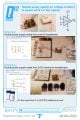
https://www.deviantart.com/q12a/art/q20200928-Double-Power-Supply-Vs-0V-Vs-856530417
q20200928 Double Power Supply  (+Vs 0V -Vs) copy 1.jpg
I wish i can understand more of the [gain] practical usage of an opamp. I presume it has to do with frequencies, but im not completely sure. I hope mister @Audioguru again could help me at this chapter, since it calls itself a guru of all that is audio, and i want to believe he is. So far he explained the most basic functionality of the gain and it was pretty good. I hope he can break the ice once more. What is the most useful thing you use [gain] for? That is my question.
 

Thread Starter

q12x

Joined Sep 25, 2015
2,227
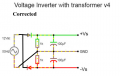
Thank you mister @bertus , I change it.
For some reason the old version worked as well. I didnt measure its current but i guess it was lower than the corrected version.
This corrected version have a double voltage. And I should measure its current as well, but in the future.
Here it is, and dont hesitate to correct me on anything you see weird because im still learning these things as you know me already.
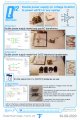
https://www.deviantart.com/q12a/art/q20200928-Double-Power-Supply-Vs-0V-Vs-856530417
q20200930 Double Power Supply  (+Vs 0V -Vs) v2 copy 1.jpg
 
Last edited:

Thread Starter

q12x

Joined Sep 25, 2015
2,227
Are the voltages from the simulator?
I would expect + and - 16 Volts for +Vs and -Vs.
Indeed, sorry, I forget to mention, in reality, i get +14V and -14V. The double voltage i mention earlier is indeed from simulator, probably because some ideal capacitors or alternative source without loss (unlike my real transformer), though the simulator is quite realist.
Ive tested again the 555 invertor source,(you can see it in my new artpage) (last time it was on the damaged IC), now in on the good IC. And it worked. But I could sense the opamp was on the very limit of functionality, in the sense that it was not dimming the leds anymore (like more powerful sources) when rotating the pots, but switching on/off and a tiny bit of dimming, but way too short. I explained as best as I could. My conclusion is that is working ...somehow, but not very recommended. Only if i have good measuring tools like the little osciloscope im about to buy.
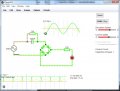
Im also thinking (in the future) on powering it to a capacitive dropper circuit, like this:
Screenshot_9.jpg
 

bertus

Joined Apr 5, 2008
22,924
Hello,

I would never use a capacitive voltage dropper.
It is unsafe to use as it still is directly connected to the mains.
Always use a transformer for isolation.

Bertus
 

Audioguru again

Joined Oct 21, 2019
6,826
1) Your "Voltage inverter with 555" produces a very low output current because the 555 is old (designed 48 or 49 years ago) and uses an old TTL logic design. Its datasheet shows that with a 5V supply, its output high is only +3.0V typically at a current of 2mA when one of the inverter diodes is included, and its output low is 0.8V with its diode included. Then the output voltage is typically only 3V-0.8V= -2.2V but 555 ICs with minimum spec's produce much less. I think your "simulation" software never looked at the spec's of a 555.
An ICL7660 is a newer "Voltage inverter" IC and would produce an output of -4.8V at 2mA. Maxim produces a more powerful one.

2) I use voltage gain in an audio circuit that has a microphone because the output level from a microphone is only 0.01V when you speak to it in a normal conversational level at a distance of only 10cm. Most consumer power amplifiers need an input level of 0.316V for full output power so the minimum gain is 31.6 times and an additional gain of 10 times is allowed to make faint or distant sounds louder so the actual gain of a mic preamp is 316 times. A power amplifier also has voltage gain (50W into 8 ohms is a voltage of 20V) but an opamp is rarely used in a power amplifier.
 

Attachments

Thread Starter

q12x

Joined Sep 25, 2015
2,227
Excelent answer mister @Audioguru again . You answered exactly on what i asked.
I looked into ICL7660 that you present here. It is interesting to see there are chips dedicated to this thing specifically. Very good indeed. Ill put it in my folder. Very nice alternative.
 

Thread Starter

q12x

Joined Sep 25, 2015
2,227
... so the actual gain of a mic preamp is 316 times...
So,my interpretation ... voltage gain with an opamp, is basically to FINE-TUNE the voltage to a required value (between rails), especially when you have some precise voltage input requirements from a device or circuit (though the current will be very low). And i think the same goes in fine-tuning the current as well.
 

Audioguru again

Joined Oct 21, 2019
6,826
So, my interpretation ... voltage gain with an opamp, is basically to FINE-TUNE the voltage to a required value (between rails).
No. A fine-tune gain is a very small increase or decrease in level. A preamp gain of 316 times is a massive increase.

... especially when you have some precise voltage input requirements from a device or circuit (though the current will be very low).
A DC voltage reference IC can produce a precise voltage but an opamp also can if it has accurate resistor values in a voltage divider.
AC audio levels do not need to be precise because their level varies a lot and there is always a volume control to adjust the average levels.
 
Last edited:

Thread Starter

q12x

Joined Sep 25, 2015
2,227
No. A fine-tune gain is a very small increase or decrease in level. A preamp gain of 316 times is a massive increase.
How im seeing it: because the voltage goes from rail to rail, the output voltage is fine-tuned because of the gain. For example, from a -5 to 5V rail, represents small voltage that is dealt in the first place, and increasing from 3V to 3.573548V, it means a fine tuning of this voltage to exactly this value. In other words, you find the gain until it fits that specific output voltage. If fine-tuning is not the right word, then you compare it with something else, and dont dare say "gain". :] My goal here is to deeply understand it. Thanks to you, I will. Im sure.
 

Audioguru again

Joined Oct 21, 2019
6,826
How im seeing it: because the voltage goes from rail to rail, the output voltage is fine-tuned because of the gain. For example, from a -5 to 5V rail, represents small voltage that is dealt in the first place, and increasing from 3V to 3.573548V, it means a fine tuning of this voltage to exactly this value. In other words, you find the gain until it fits that specific output voltage. If fine-tuning is not the right word, then you compare it with something else, and dont dare say "gain". :] My goal here is to deeply understand it. Thanks to you, I will. Im sure.
An opamp can attenuate (why bother, use 2 resistors) an AC or DC voltage or it can increase it.
"Rail-to-rail" is a new type of opamp that has inputs that work well as high as the rails (+5V and -5V) and an output that goes as high as a rail voltage when there is a very high load resistance. You do not have a rail-to-rail opamp.
Why bother amplifying a 3V signal a tiny more to only 3.57V? 3V should be high enough.
 
Kinda wierd and it may not make any sense at this point, who knows.
An OP amp takes (A(+ input)-B(- input))*(big number

That BIG NUMBER is called the open loop gain. That's all it does except it has shortcomings because it's not ideal.

look at the right hand side of figure 2 on this http://www.physics.udel.edu/~nowak/phys645/The_operational_amplifier.htm page.

it's drawn differently, but in a way that makes sense.

Note that the output has an "obvious" voltage divider attached to it.

In this configuration, the OP amp will try really hard to make it's inputs agree or have the same value.

if the voltage divider divides by 2, then the input will be 2x the output or it will have a gain of 2.

That's the BASIC deal of the non-inverting amplifier.

Another tidbit is the GBW or gain bandwidth product. That's a constant. if the bandwidth of the op amp is 10 MHz and you set a gain of 2, the bandwidth of the resulting amplifier is 5 MHz.

OP-amps are getting really close to ideal now, but the non-idealness you have to account for.
 

Thread Starter

q12x

Joined Sep 25, 2015
2,227
Very interesting question :
Is there any other IC that is a comparator, but NOT an opamp?
That is not having an opamp arhitecture or design?
That is working on completely other internal circuit/architecture than an opamp?
(Excluded the actual Comparator IC that internally have also an opamp)
I have the impression that opamp (architecture) is the ONLY comparator IC created by man.
- I am right?
Also I am aware of the basic versions of an opamp, made only from transistors like the long tailed pair excelent article btw , or even more basic, from vacuum-tubes (1953) . Pobably used in V2 rocket models, but I also know it was more a mechanical thing than electric/electronic.
Also I am aware how internally a (modern or classic) opamp transistors circuit is made. So this type of circuit is also excluded as example.
My question is : - There is something ELSE other than opamp used as a comparator? (comparing 2 or more inputs)
Ive also came across some weird but very interesting/beautiful models of opamps, only in theory, not in reality, that have 3 inputs and 2 outputs !!! Basically taking full range V+ 0V V- inputs and Vo+ and Vo- as outputs. Quite interesting.
...
There is another way of comparators, and absolutly different structure internally, the PIC = programable IC. But let's make abstraction of them since we are all aware of them. I am more interested about on chip(independent) devices. I dont remember if a PIC mcu actually contains an opamp inside, it may surely do have some. But they mostly rely on programming the output pins and they can compare and calculate way more than a simple opamp could do by itself.
 
Last edited:
Top