About opamp.

dl324

Joined Mar 30, 2015
18,328
i think is very important to have in an osciloscope. And i am not sure if some very basic functions (like the peak one) are available in those little handheld osciloscopes like the sample you show.
$20 isn't much. I bought one and it's good enough for what you're trying to do. It will display useless information to 3 decimal places. You just need to know what's relevant and what isn't.

There's no point in spending hundreds of dollars on something that you don't need. I did electronics as a hobby for decades without having an oscilloscope. I picked up a dozen 10-15 years ago when used test equipment was cheap.

But if you're not going to do the homework and understand the limitations of the components you're going to use, no amount of test equipment is going to be helpful.
 

dl324

Joined Mar 30, 2015
18,328
I will probably, as you say, lower the voltage sources to 4V from 7V.
The valid input and output voltage ranges depend on supply voltage. If you decrease supply voltages, you'll shrink the valid input and output ranges.

If you're going to experiment with uA741, use +/-15V supplies and use known good parts. Troubleshooting with bad components is something that takes knowledge and experience.
 

Thread Starter

q12x

Joined Sep 25, 2015
2,227
Im sure they are good because i made some tests some time ago, with +5V and gnd (instead of -5V) and they did something in the right direction.
I plan to make a tester circuit in the same safe direction using gnd.
What i have now, the -7V thing, is more advanced than simple 0V/gnd way.
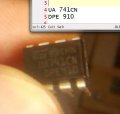
exact model i have: (from ebay)

Screenshot_4.jpg
 

Thread Starter

q12x

Joined Sep 25, 2015
2,227
@dl324 Do you know what will be awesome? But im afraid we will split way too much from the subject here.
If you can make me a very short and to the point characteristics/functions of an osciloscope to have, i mean the very most used ones, im not after the exotic stuff. And even compare it with the cheap ones and the expensive ones. I have somewhat idea of some functions... but i bet you know better so thats why im asking. When you can and if you can. Super short like 12345 or something. The #1 for me is to retain peak values. Its the most practical part that i get from everything i watched.
 

dl324

Joined Mar 30, 2015
18,328
exact model i have: (from ebay)
If you got them from eBay and the seller was in China, you don't know what you have.

The picture isn't sharp enough to make out marking details and the state of the leads. Counterfeit parts usually have the original part number sanded away; this causes the shoulders of the leads to be pitted (they should be smooth). The texture of the top of the package should be the same as the bottom and the pin 1 mold mark (if any) should be distinct.
 

dl324

Joined Mar 30, 2015
18,328
If you can make me a very short and to the point characteristics/functions of an osciloscope to have, i mean the very most used ones, im not after the exotic stuff.
The one I posted (DSO138) should be more than adequate for your needs. It's only good for up to 100kHz 200kHz and doesn't come with a 10:1 probe. You need a 10:1 probe when circuit loading could be an issue. As I said, I've stopped using my more expensive Tektronix analog CRT scopes in favor of this $20 toy scope.

https://www.aliexpress.com/item/32778225027.html?spm=a2g0s.9042311.0.0.27424c4dd4mUkj

EDIT: correct scope bandwidth.
 
Last edited:

Audioguru again

Joined Oct 21, 2019
6,826
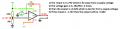
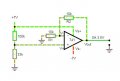
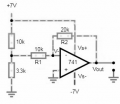
Why don't you understand that GROUND is 0V in your circuit. The power supply is +7V, 0V and -7V, but you do not show the 0V and again you do not show the opamp part number.

The measurements are always taken with 0V (ground) as the meter reference. Then you will measure the supply as +7V and -7V.
Many opamps like an antique 741 have inputs that do not work within a few volts from a supply voltage like the +input of your opamp which is at the supply voltage of -7V.

Your +input is at -7V and an opamp will try to make its -input the same. But since the -input has a 10k resistor to +7V and another 10k resistor to the output then the opamp will try to make its output be -21V which is impossible. So the opamp output goes as low as it can which is -5.8V.

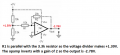
I changed you circuit a little by using a voltage divider to make the +input at +1.74V:
 

Attachments

Last edited:

Thread Starter

q12x

Joined Sep 25, 2015
2,227
@Audioguru again
I see... I think what you are trying to say is to always choose circuits with opamp that are involving only ground ?
Correct? Me, by choosing only +7V and -7V, without gnd in there is not correct? Is it what you are saying?
Then say it so! :]
Thank you for the redrawing, that helped me understand you better (i hope).
Then, as a rule of the thumb, i will always use gnd in circuits with opamp! Maybe im jumping too high, by avoiding gnd into circuit. How my logic works and why i did it, is because there are special circumstances that require these values, even without gnd. And also i choose this circuit specifically for the -V that it is creating on the output. Im after it to obtain it! But im not obtaining it in reality. Only in simulator.
You should draw me a opamp mode that is creating a -V on its output. When I will see that happening in reality, then I will be at peace. Because it is important to get all the ranges this thing should have. Is how i think.
 

Thread Starter

q12x

Joined Sep 25, 2015
2,227
@Audioguru again
I tested your new circuit and it works fine both in sim and reality.
Screenshot_4.jpg
The IC on the board who took a lot of testing, is working but wrong. For this circuit it showed me -7V between output and gnd.
I changed it with a virgin one and it is showing me +2.4V between output and gnd.
It was definitely damaged the first one. It took a lot of testing though, and with lots of brutality. He is barely alive now.
I will test the other opamp modes with the new one.
Definetly some progress on today !
Thank you all, you did great.
 

Audioguru again

Joined Oct 21, 2019
6,826
That is correct, you do not have only +7V and -7V which is a 14V supply, instead you have two supplies, one is +7V and ground and the other is -7V and ground. The input and output are each 2 wires, one of the 2 wires is ground (0V).

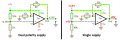
With a single supply then do it like this:
 

Attachments

Thread Starter

q12x

Joined Sep 25, 2015
2,227
@Audioguru again and @dl324 1601111706762.png
I did your circuits and all are a success now !!! Both in simulator and in reality.
And all the values, from inputs and outputs are exactly as you specified. So I confirm your data.
Excelent !!! That is what i wanted.
Thank you so much, you really helped me, and most of all, understood me and had patience.
It's hard, but it pays off. I think it supposed to be hard...hmmm :]
...
I think I understand your point now, to be careful with the gnd in the circuit, to add it every time. And -xV is only added on VS- !!! I was treated -xV as a ground as well. But you dont.
This -Voltage is new to me, in practice I mean. One is to read about it and I was aware of its existence, but i never put in practice my hands on it, like we did here. I thought is fascinating to work with it. I still do, since i barely smell it with these tests.
My plan for now is to test every circuit i can put my hands on, and in all this time i gathered a bunch of opamp pdf's and some images with circuits from internet. I will try to do all, or as much as i can.
Another goal is to make a simple tester, for different outputs and inputs, with some switches between them.
But i must be aware of how many opamp modes are first. Then the tester.
So that is the direction.
- You are very welcome to contribute to my quest here, with the most important opamp modes that you feel and know!
By opamp mode im refering to : [inverting amplifier mode] or [Voltage folower mode] [etc] . Because its like a mode or type of circuit an opamp is operating! If there is a specific word for it, and not a general one as "the circuit", illuminate me. Its my funny way of understanding things. Im a funny person. :]
Thank you very much !
 

Audioguru again

Joined Oct 21, 2019
6,826
q12x, I am glad that you understand more about opamps.

I rarely amplify DC voltages, instead since I deal with AC audio signals then almost all my opamp circuits amplify AC.
I showed before that a voltage follower has a voltage gain of 1 since it uses a piece of wire or a single resistor from its output to its -input and has a very high input resistance (very low current) and has a very low output resistance (much more output current than its input current).
An opamp for AC signals usually has its +input biased to a voltage that is half the supply voltage so that its output can swing equally up and down, and has input, output and feedback-to-ground coupling capacitors.

I recently showed an opamp with voltage gain since the gain is the ratio of the feedback resistor (output to -input) to the resistor to ground.

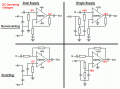
Here are circuits of AC amplifying opamps with inverting, non-inverting, single polarity and dual polarity supplies and all the capacitors that are needed for them:
 

Attachments

Thread Starter

q12x

Joined Sep 25, 2015
2,227
Here are circuits of AC amplifying opamps with inverting, non-inverting, single polarity and dual polarity supplies and all the capacitors that are needed for them:
Until this part I understand all, no problem.
But I had to re-read this last phrase and look on the pictures like 5 times to get it. And i think i get it. What you mean is that we must add capacitors to filter the input signals and the output signals, to not get spikes or other rebel fluctuations. I remember something from my videos i watched with the oscilloscopes, but they were explaining something else. I think this is what you are saying, right? Oh, and that you mostly use the opamps with AC input signals rather than DC as i do here. I do it here like this just to test the modes, and i didnt even begin yet.
Today i am building the secondary (double) power supply made from those 2 wall plugs electronic transformers boards. I hope they will not get boom in my face. I can easily concentrate to your instructions if you have them.
Oh, and mister @dl324 can you draw me the full circuit for your box with transformers? Include every detail there.
 
Last edited:

MrChips

Joined Oct 2, 2009
34,812
No!

Capacitors are placed in circuits, DC and AC, for particular reasons, just like op-amps are placed in a circuit for particular reasons. Op-amps are used in DC and AC circuits as well.

Capacitors have different functions:

1) Reservoir capacitors - to hold charge (basically as a high pass filter to ground)
2) Filters - low-pass, high-pass
3) DC blocking - high-pass filter
4) Noise filters - high-pass shunt to ground
5) Integrators - high-pass shunt to ground
6) Differentiators - high-pass filter
7) Frequency compensation
8) Power Factor compensation
9) Tuned circuits
10) Oscillators
11) Delay circuits
12) Timing circuits
 

dl324

Joined Mar 30, 2015
18,328
can you draw me the full circuit for your box with transformers? Include every detail there.
This is how I remember wiring it. If you decide to implement the rectifier portion, make sure you check the wiring:
clipimage.jpg
There are only two filter caps (1300uF 50V - and can't be used with the 48V transformer). I used a switch to wire them in parallel or series and make connections to the R, N, and B jacks, depending on whether I was going to make a bipolar supply or not.

The red and black banana jacks are always positive and ground, respectively. When the caps were in series, the neutral colored would be negative. In the latter case, it was up to me to remember to ground the center tap. I'll probably change the order so I can use a dual banana plug for a single supply.

Jumpers were to be used to make the appropriate connections to the transformer secondaries. I used color coded banana jacks with the intention being to indicate polarity if I wanted to put secondaries in series (I never got around to checking polarities, so stacking is by trial and error now; I'll fix that when I make the other change).

The front panel has jacks for another transformer and rectifier that were never installed.
 

Thread Starter

q12x

Joined Sep 25, 2015
2,227
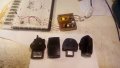
I managed to make and succesfully finish the (double) power supply made from 2 wall plugs electronic transformers.
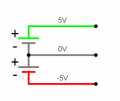
I used this simple DC Power Sources in Series circuit.
- On the table you can see the wall plugs dismantled. I made a new case from cardboard for each electronic board and then glue them together. I think if you click on the image you can see it at greater rezolution. The red = +5V, black= gnd, yellow= -5V. The tricky part was to link the 220VAC one to the other. It looks clean now.
- In conclusion, it is working perfectly. This is another way if no AC transformer is around. I like to be thorough. Even on these (apparent) simple circuits, I still got some hops to get over. I know, it looks deceavable simple until you have to poke your fingers between 220V, then you start doubt how good its your circuit. :] Haha, it happens.

1601142287303.pngIMG_20200926_205055.jpg
 

Thread Starter

q12x

Joined Sep 25, 2015
2,227
@dl324
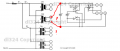
I wanted the entire thing, not on modules. Don't be lazy. And a simple "Made by mister dl324" in a corner is more professional, serious and normal. Trust me... you are lucky if others will see it (besides us here). Im curious about it because sometimes people with experience include some interesting things that I never thought of.
Also, include the wiring from each transformer to Each jack. Put even the leds too. make it full complete, without interpretations.
Thanks for the circuit so far.
1601143751119.png
 

bertus

Joined Apr 5, 2008
22,925
Hello,

@q12x , No, your red connections are not correct. You can not connect the transformer directly to an electrolitic capacitor.
When I look at the schematic of @dl324 , the C - C connections on the right top are the AC inputs from the transformer.

Bertus
 
Top