About opamp.

dl324

Joined Mar 30, 2015
18,326
So you are saying it must have Only 22V, or else will fail? Is true,
No. Absolute maximum are ratings which must not be exceeded; even for a brief time. Another thing about absolute maximum ratings is that a caveat is sometimes included that says the device might not even survive the absolute maximum spec.

You pick the power supply voltages based on the voltage range you want on the inputs. If you want 0-5V with a uA741, you need to use power supplies of 8V (or more) and -3V (or less).
Then... when is the [voltage follower] used? In what situation? If it's not amplifying anything? If it's only passing the voltage from its inputs to its output?
A voltage follower is used when you require buffering, but it has many other useful applications.

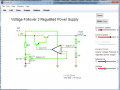
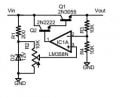
Here's a follower type circuit that's a regulated power supply:
clipimage.jpg
In this case, the opamp tries to maintain a "zero voltage differential" between the two inputs. Since R3 and R4 form a voltage divider and only feed back 50% of the output voltage, the effect is that the output voltage will be twice what the pot is set to. Q1 has a low beta, so Q2 acts as a current multiplier to avoid any issues with the opamp only being able to source about 25mA.
 

dl324

Joined Mar 30, 2015
18,326
I imagine is a teaching circuit, but not a practical one. I mean, what is a practical usage of it?
The voltage follower is so useful that manufacturers made an opamp that was configured to only be a voltage follower. The LM310.
Im thinking now, a possibility might be a 8 bit circuit, like this:
An R2R network is easier (only 2 resistor values) and more efficient way to make a DAC.
 

Attachments

Thread Starter

q12x

Joined Sep 25, 2015
2,227
This circuit is Very interesting, and I immediately made it in my simulator.
And is working excelent !
1599510527855.png
It is exactly how you said it, Vout is double as the voltage from pot is set. Fantastic.
I still dont understand opamp as a buffer what really means. A buffer for me, is like a printer buffer, where it accumulates the data coming from PC, and then transmitting it to the head printer. It helps with speed of the printer, especially from the days when conection from pc was very slow. So that buffer was waiting to fill up, and after that, send the command to print. That is a buffer for me. And when i hear the word buffer, i immediately go to this reference i have in my head.
I am obsessed now to understand how this buffer bizniz is working. Can you exemplify it for me to understand it better, please? Especially after this awesome circuit sample you give me ! Congratulations , i love it, thats why i build it so fast in my simulator.
///
I see your pdf now.
 
Last edited:

dl324

Joined Mar 30, 2015
18,326
This circuit is Very interesting, and I immediately made it in my simulator.
And is working excelent !
You're using a 9.1V power supply and that could cause problems. The opamp output needs to be 2 diode drops above the output voltage and an LM358 is only guaranteed to get within 3V of the supply when lightly loaded and 4V when more heavily loaded.

Some parts might work, but a conservative design would specify a minimum supply voltage of about 11V for your 6.6V power supply. This will guarantee that it will work for all LM358 over the full temperature range.

You really need to read the datasheet so you understand the limitations of the devices you use.
I still dont understand opamp as a buffer what really means.
https://en.wikipedia.org/wiki/Buffer_amplifier

In the voltage regulator circuit, the two transistors buffer the output of the opamp. Otherwise, the power supply would only source about 25mA.
 
Last edited:

Thread Starter

q12x

Joined Sep 25, 2015
2,227
"You're using a 9.1V power supply "
That is a variable power supply that I used. Unfortunately this simulator im using, is having only 1 type of zener diode in it and is fixed too, i can not change it. So I give it a go with what i have. And it worked. But i hear your point, by reading and understanding better these optimal values that you are clearly so used to them. Im an artist, who likes to test things until I understand them. :] I really appreciate your dedication, you are awesome.
Yes, Im using wikipedia as well for most of my electronic problems. I'll read that soon.
 

MrChips

Joined Oct 2, 2009
34,809
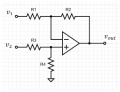
If you would like to understand and design with op-amps, memorize this circuit configuration.

1599514640866.png

For starters, make R1 = R3 and R2 = R4.

v1 = inverting input
v2 = non-inverting input

vout = -(v1-v2) x voltage gain

voltage gain = R2 / R1 = R4 / R3

(v1-v2) is called the differential input

If you want single-ended input, connect either one of v1 or v2 to a reference voltage (for example, 0V when using dual power supply or Vcc/2 when using single supply).

If input is on v1 then this is an inverting amplifier.
If input is on v2 and voltage gain = 1, this is known as a non-inverting buffer.

R2 provides negative feedback by sending a signal from the output back to the inverting input. This is essential for the operation of an opamp.
The output voltage is fed back into the inverting input so that the voltage at the -ve pin is always equal to the voltage at the +ve pin. In other words, the voltage difference between the -ve pin and the +ve pin is always zero.
 

Thread Starter

q12x

Joined Sep 25, 2015
2,227
oh, hello mister @MrChips , very straight forward, just as I like it. Thank you !
From the first look, this basic circuit uses 2 voltage dividers on its imputs, that 1 is drainig to Vout and other to Gnd.
Interesting explanations, i'll have to play with it to understand it fully. Many thanks.
I was just reading the wikipedia buffer page now. Im starting to crack it a bit. The header i get from that until now, a buffer can be a current or a voltage amplifier , exactly as @Audioguru again said before. And also it is like a door between 2 circuits, separating from over currents one side to the other. If on output are some over currents from an inductive load, it will protect the more sensitive circuit from the input. Interesting so far, but i have to dig it some more + your circuit as well. So a buffer is used as a protective circuit.
And yes, my intention is to understand and design with op-amps, as you said, thank you for your perfect understanding.
 
Last edited:

Thread Starter

q12x

Joined Sep 25, 2015
2,227
@Audioguru again check this out: As a confirmation of your graphic earlier.
I am reading the buffer page from wikipedia and in it i find this very in depth argument of why the gain/amplification/impedance(current) is dropping with the increase of the frequency. Very interesting.
1599519439352.png
 
Last edited:

MrChips

Joined Oct 2, 2009
34,809
In the context of an op-amp, a buffer is a circuit which can drive voltage or current without impacting on the input signal. In other words, a buffer isolates the input from adverse effects at the output.

The desirable characteristic of a buffer is that it should have high input impedance, i.e. it does not present too much of a load on the input signal (it takes very little current).

In the op-amp circuit configuration as I have shown in post #26, the non-inverting input presents the higher input impedance of the two inputs. Eliminate R4 and the circuit will have the highest input impedance as given in the manufacturer's device datasheet.
 

MrChips

Joined Oct 2, 2009
34,809
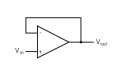
Following everything I have written so far, this circuit is your classic non-inverting unity-gain buffer.
1599523196699.png

-ve pin follows Vout.
The opamp has to do whatever is necessary to make -ve pin the same voltage as +ve pin.
Hence, Vout = Vin

This is your ideal unity-gain buffer.
The input impedance is very high as given in the device datasheet, especially if it is a JFET input opamp.
The output impedance is relatively low, as given in the device datasheet.

For example, TL071 JFET op-amp has input resistance of 10^12 Ω, that's 1,000,000,000,000Ω.
Output resistance is 300Ω.
 

Audioguru again

Joined Oct 21, 2019
6,826
An opamp has a very low input current and a much higher output current. Therefore it can be a buffer.

An opamp is almost never used open-loop (very high DC and low frequency gain without negative feedback).
A real opamp has an input voltage offset of about 5mV. Then if it has no negative feedback with a voltage gain of 300,000 it amplifies the 5mV to saturation at the positive or negative supply. It cannot amplify when its output is saturated.
Adding negative feedback reduces the input offset voltage.

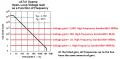
Adding negative feedback reduces the gain but increases the high frequency bandwidth like this:
 

Attachments

Thread Starter

q12x

Joined Sep 25, 2015
2,227
@Audioguru again so basically, the lower the voltage i put on inputs, the higher the frequency it creates at its output?
So you say, what i should take from this, is that the amplification is about the frequency and not the voltage or current on the output? I understand you right?
 

dl324

Joined Mar 30, 2015
18,326
so basically, the lower the voltage i put on inputs, the higher the frequency it creates at its output?
It's not the voltage on the inputs; it's the amplifier gain.

From the graph, at a gain of 1000, the bandwidth is 800Hz. For a gain of 10, bandwidth is 80kHz.
 

Thread Starter

q12x

Joined Sep 25, 2015
2,227
Is there a website that contains a lot of (practical) circuits with opamp, all different functionalities and uses?
I am already looking into theoretical circuits right now, more closely than before (i did it but faster, to acknowledge them).
Like this very sketchy website: https://www.arrow.com/en/research-and-events/articles/fundamentals-of-op-amp-circuits
But i want some practical ones, too. Im a practical guy, what can I say. :]
Thanks.
 
Last edited:

Thread Starter

q12x

Joined Sep 25, 2015
2,227
Its working with a gnd and with a -VS as well, the problem was that it has a 1.1V constant, and if i get around it, it is showing the diference in Vout. My mistake. Sorry. I had to move more energetically those input voltage scrolls. Thank you mister @Audioguru again
 
I'll add. GBW or Gain-Bandwidth-product is usually a constant.

A buffer is needed a lot. Why? Because, say if your using a summer and the output Z is 1K and the summing resistors are 10K, that's an 11K resistor and the circuit won't work.

The offset gets amplified too.

You can think of an OP-amp as (A-B)*<some big number>
Called the open loop gain.

Op-amps are not ideal.

You learn the hard way sometimes. A few uV across a few milliohms is a lot of current.
So 1uV across 1m-ohm is 1 amp. it can be an oops.
Decoupling caps are required close to the OP-amp.
Ib or the input bias current has to have a place to go.
In general (not all the time) but Vin is usually specifed as -0.3 less than the most negative supply and 0.3 above the most positive voltage. So what? When the device is unpowered the power supply voltage is ZERO. it could mean the op amp is toast if a voltage is applied to it's inputs when the power is off.
 
real world example - sort of

An embedded system would power up fine with a switching power supply. When a linear supply was used, it didn't reset sometimes. Fix was to change the POW circuit to use an inverter with a schmidt trigger. The edge was important.
 
Top