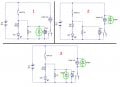
I did a search and found this post...but if I can continue instead of starting a new post..
I am curious; I want to build a very simple circuit... a 12v pump controlled by an on/off switch in which the pump is turned on by a relay.
I am a bit unsure of flyback diodes and where they should be. I am aware that they should be in parallel with the motor/coil,
but in this situation should I have just one or two diodes and where should they be placed?
See photo... which circuit is correct... 1, 2 or 3 ?
Hi,
your diagram is also correct now, but if you parallel it to the coil is more better.
Can you give the transistor part number to get more details spec to review
I set up an experiment and you are right. The pulse current was less than the relay energizing current. For some reason I had it in my head that the kick back current was significantly larger than the energizing current.
If we model a relay coil as an inductor (which is a pretty good model) we can say the current in an inductor cannot change instantaneously. Therefor the current just before we open the transistor switch is equal to the current just after we open the switch.
Same same. Starts with the same relay current, then decays. If we take the inductance formula V = L dI/dt you may notice the V is the diode drop during turn off, so the current decays linearly, for the most part until it gets very small anyway and practical effects enter into the picture.
A company I once worked for made diode supressors bought by relay manufacturers to use inside the can. These consisted of a 1N4000- whatever (1,000 volt PIV) and a 36 volt Zener.
Why both? Because if the coil dumps out into a higher voltage it decays moi rapido.

 Facebook
 Google
 GitHub
 Linkedin