A problem with a Slayer Exciter circuit.

Thread Starter

goopygoober

Joined Dec 5, 2023
10
So a month ago Idecided to make this mini project in order to get my other classmates more interested into researching electrotechnics, and I've chosen a Tesla Coil to be a very cool example of how electrotechnics can be cool and interesting.

I decided to go with a Slayer Exciter circuit since it's similar enough to an actual Tesla Coil , but it's simpler to make, explain how works and economically more viable due to there being less components present.

I searched up some designs and circuits and came across this schematic on this youtube tutorial.
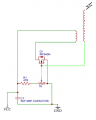
1701887915944.png
After building it, (350-400~ secondary turns and 1 primary turn) I came across a problem, there was no spark coming out of the secondary winding, and neither did it power any small lightbulbs and LEDs I put on it. For context, it's powered by two 9 V batteries connected in a series, making them 18 V.Although there is still current going through the circuit, as evident by the transistor heating up while turning the potentiometer to the left. At first I thought the problem was in the primary winding due to it being poorly insulated, and therefore having high resistance. I confirmed that with measuring the resistance with a multimeter on the primary. So I've changed the primary wire to a better insulated one, but the problem still remains, although now the multimeter reads nothing on the primary wire.

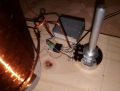
This is how I connected the parts:
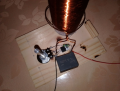
1701888227555.png
1701888254552.png
1701888273505.png

The parts used are:
IRF640 MOSFET
47 Ohm Resistor
1k Ohm Potentiometer
2.2UF MKP Capacitor

I would very much so appreciate help, I'm quite new to building these kinds of circuits and I'd like to inspire my other classmates to try dipping into these fields of science further, thank you!
 

MisterBill2

Joined Jan 23, 2018
27,186
The "Slayer" circuit is what used to be called a "Blooper" in polite terms. Try to trace out the feedback loop that is needed for oscillation and you will find it rather challenging.
The function of the circuit is very much dependent on just how the parts are physically arranged, as well as the internal resistance of the battery.

The circuit has been the subject of many posts on this forum, usually with complaints that it does not work. Operation does depend greatly on luck. I do not recommend the circuit at all, nor the posters of that youtube cartoon demonstration.
 

Thread Starter

goopygoober

Joined Dec 5, 2023
10
Oh welp that sucks lol, I'll try today to switch the primary 180 degrees so maybe it works. But if most propably not, is there any kind of Slayer circuit or perhaps a more sophisticated Tesla Coil circuit that you would reccomend?
 

nsaspook

Joined Aug 27, 2009
16,252
Oh welp that sucks lol, I'll try today to switch the primary 180 degrees so maybe it works. But if most propably not, is there any kind of Slayer circuit or perhaps a more sophisticated Tesla Coil circuit that you would reccomend?
I personally wouldn't recommended Slayer circuits or Tesla Coils in general because they are mainly useless as practical teaching devices. Yes, they can make pretty lights but that's all.
 

MisterBill2

Joined Jan 23, 2018
27,186
Try this: connect the secondary bottom end to the supply negative (ground). add a feedback coil between the gate and the center of a variable resistor so you can adjust the gate bias, The top ofthe resistor gets a 10K resistor to the battery positive. Then what you have is a traditional tickler feedback oscillator, although you may need to reverse the polarity of the tickler coil connections.
At least that is what I was trying to describe, a tickler feedback oscillator with adjustable gate bias.
 

jjpollock

Joined Aug 11, 2023
1
So a month ago Idecided to make this mini project in order to get my other classmates more interested into researching electrotechnics, and I've chosen a Tesla Coil to be a very cool example of how electrotechnics can be cool and interesting.

I decided to go with a Slayer Exciter circuit since it's similar enough to an actual Tesla Coil , but it's simpler to make, explain how works and economically more viable due to there being less components present.

I searched up some designs and circuits and came across this schematic on this youtube tutorial.
View attachment 309286
After building it, (350-400~ secondary turns and 1 primary turn) I came across a problem, there was no spark coming out of the secondary winding, and neither did it power any small lightbulbs and LEDs I put on it. For context, it's powered by two 9 V batteries connected in a series, making them 18 V.Although there is still current going through the circuit, as evident by the transistor heating up while turning the potentiometer to the left. At first I thought the problem was in the primary winding due to it being poorly insulated, and therefore having high resistance. I confirmed that with measuring the resistance with a multimeter on the primary. So I've changed the primary wire to a better insulated one, but the problem still remains, although now the multimeter reads nothing on the primary wire.

This is how I connected the parts:
View attachment 309288
View attachment 309289
View attachment 309291

The parts used are:
IRF640 MOSFET
47 Ohm Resistor
1k Ohm Potentiometer
2.2UF MKP Capacitor

I would very much so appreciate help, I'm quite new to building these kinds of circuits and I'd like to inspire my other classmates to try dipping into these fields of science further, thank you!
Looks like to me from your pics that you have your drain pin also connected to the ground pin all together on your third pin of the pot. That will cause a short and no oscillation ! Make sure the drain is only connected to one of the primary wires!
So a month ago Idecided to make this mini project in order to get my other classmates more interested into researching electrotechnics, and I've chosen a Tesla Coil to be a very cool example of how electrotechnics can be cool and interesting.

I decided to go with a Slayer Exciter circuit since it's similar enough to an actual Tesla Coil , but it's simpler to make, explain how works and economically more viable due to there being less components present.

I searched up some designs and circuits and came across this schematic on this youtube tutorial.
View attachment 309286
After building it, (350-400~ secondary turns and 1 primary turn) I came across a problem, there was no spark coming out of the secondary winding, and neither did it power any small lightbulbs and LEDs I put on it. For context, it's powered by two 9 V batteries connected in a series, making them 18 V.Although there is still current going through the circuit, as evident by the transistor heating up while turning the potentiometer to the left. At first I thought the problem was in the primary winding due to it being poorly insulated, and therefore having high resistance. I confirmed that with measuring the resistance with a multimeter on the primary. So I've changed the primary wire to a better insulated one, but the problem still remains, although now the multimeter reads nothing on the primary wire.

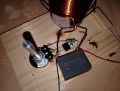
This is how I connected the parts:
View attachment 309288
View attachment 309289
View attachment 309291

The parts used are:
IRF640 MOSFET
47 Ohm Resistor
1k Ohm Potentiometer
2.2UF MKP Capacitor

I would very much so appreciate help, I'm quite new to building these kinds of circuits and I'd like to inspire my other classmates to try dipping into these fields of science further, thank you!
Is your primary wire, magnet wire? If it is not then twisting the primary wire like that will just prevent the current from traveling around the loop as of course electricity takes the easiest path. So if the wire is just bare copper the twist basically just makes a bypass to the primary winding.
 

Danko

Joined Nov 22, 2017
2,136
I decided to go with a Slayer Exciter circuit since it's similar enough to an actual Tesla Coil,
but it's simpler to make, explain how works and economically more viable due to there being less components present.
Why, oh why, do you people keep calling these, Slayer coils, Tesla coils???
While they may make a high voltage output they are NOT Tesla coils.
They are self exciting induction coils.
Slayer Exciter exactly is Tesla coil.

1715149789377.png
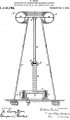
According to patent US1119732A:

"source of currents G, which may be an alternator or condenser,
the important requirement being that the resonant condition is established,
that is to say, that the terminal D is charged to the maximum pressure developed in the circuit"


In Slayer Exciter, transistor connects DC source to primary winding,
synchronous with current changes in secondary winding,
that provides resonant condition, required in patent.
 

Attachments

Last edited:

MisterBill2

Joined Jan 23, 2018
27,186
Looks like to me from your pics that you have your drain pin also connected to the ground pin all together on your third pin of the pot. That will cause a short and no oscillation ! Make sure the drain is only connected to one of the primary wires!

Is your primary wire, magnet wire? If it is not then twisting the primary wire like that will just prevent the current from traveling around the loop as of course electricity takes the easiest path. So if the wire is just bare copper the twist basically just makes a bypass to the primary winding.
It would be interesting to read an accurate description of exactly how the "slayer" circuit functions, including the explanation of the various coupling conditions that are provided by the way that the assembly parts are positioned relative to each other. The explanation about the unspecified capacitive coupling would be especially interesting to see explained in terms that a beginner could understand.
 
Top