89ND generator NGT switch

Thread Starter

Ubaid Ansari

Joined Oct 10, 2022
7
Hi everyone,
It will be great help if i get the clarification on the point listed as.
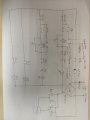
There is switch operated by 220V dc motor for open and close. Input supply is 230V AC and converted to DC using SSD KBPC3510. And DC output 220vdc is taken for the control circuit. I am getting dc voltage of 420V at my switch open indication lamp terminals at switch opened. And same voltage across my switch close indication lamp terminals as switch is closed. How is it possible against the 220VDC. When i measured the voltage across the SSD DC terminals after removing output wires i m getting 220VDC. But if wires are connected i m getting 420 vdc. It would be a really highly appreciated for someone who puts some light on this. Thanks a lot
 

Ya’akov

Joined Jan 27, 2019
10,235
Welcome to AAC.

If you are measuring 220V RMS you have ~311V p-p, if you rectify that you will get 1.414 x 311, or ~435.4V DC.

The RMS voltage is .7071 x peak-to-peak voltage. Rectification doesn't care about RMS, it involves the p-p.
 

MrChips

Joined Oct 2, 2009
34,812
Welcome to AAC.

If you are measuring 220V RMS you have ~311V p-p, if you rectify that you will get 1.414 x 311, or ~435.4V DC.

The RMS voltage is .7071 x peak-to-peak voltage. Rectification doesn't care about RMS, it involves the p-p.
You have done something wrong. You have multiplied by √2 twice, i.e. multiplied by 2.
 

Ya’akov

Joined Jan 27, 2019
10,235
You have done something wrong. You have multiplied by √2 twice, i.e. multiplied by 2.
Hmm. Well, ignore that my answer until I can spot what I got wrong and correct it. Probably not the best (for me anyway) idea to answer questions involving math on ~5 hours sleep. :)
 

LesJones

Joined Jan 8, 2017
4,511
I agree with MrChips. You have multiplied the RMS value by √2 to get the P-P value of 311 volts. That will be the rectified voltage at the peaks of any ripple.
Regards the original question. I think that you need to post the full schematic between the 220 volt AC supply and the DC motor to help us come up with an explanation.

Les.
 
Last edited:

Thread Starter

Ubaid Ansari

Joined Oct 10, 2022
7
Hi everyone,
It will be great help if i get the clarification on the point listed as.
There is switch operated by 220V dc motor for open and close. Input supply is 230V AC and converted to DC using SSD KBPC3510. And DC output 220vdc is taken for the control circuit. I am getting dc voltage of 420V at my switch open indication lamp terminals at switch opened. And same voltage across my switch close indication lamp terminals as switch is closed. How is it possible against the 220VDC. When i measured the voltage across the SSD DC terminals after removing output wires i m getting 220VDC. But if wires are connected i m getting 420 vdc. It would be a really highly appreciated for someone who puts some light on this. Thanks a lot
In continuation of above trouble shooting, we zeroed the two wires extended to the potential free contact (PFC) of the control card so that the switch can be operated remotely. one wire carrying -ve 110VDC is extended to control room PFC of control card and the return wire in local panel it is measuring 313VDC. Actually around 200VDC is getting added. How is this happening? Thanks for the reply. Please do let me know of sketch if further required will share.
 

LesJones

Joined Jan 8, 2017
4,511
On your schematic there is a comment about the wires going to the remote control about 110 volts DC and with respect to ground. I would expect the wires to the remote control to just terminate in a set of relay contacts or a switch. There should be no external power applied to the remote control wires. Can you explain EXACTLY what is at the end of the pair of wires to the remote control. I am suspecting that you are adding 110 volts DC to the 300 volts DC from rectifying the 220 volts AC.
Another point is that as you have no smoothing capacitors after the rectifier I would not expect your meter to read as high as 300 volts as it will be reading the average of the rectified DC rather than the peak value of the waveform.

Les.
 
Top