Facebook
 Google
 GitHub
 Linkedin

cmartinez:
Several comments on your circuit...
For 75 volts at 100 ma, the output power is 7.5 watts. If we assume a conversion efficiency of 80% then the input power will be over 9 watts -- lets assume 10 watts for a safety margin. 10 watts at 12 volts is 0.833 amps. This is the average current that flows through the inductor. In this type of circuit, the peak current of the inductor is about 4 times the average current. This means that the inductor needs to be rated at more than 3.3 amps.
I would use a 4 to 5 amp inductor with a series resistance of less than 0.050 ohms. Expect this inductor will be large: something like 1/2 inch in diameter and an inch long. To get this current, the inductance has to be smaller in your circuit. I would use 33 uH.
The IRF740 MOS-FET has way to high an on resistance -- as much as 0.55 ohms. At 3.3 amps it will drop almost 2 volts!
You want a MOS-FET with a maximum on resistance of 0.050 ohms. You can use a MOS-FET with a drain-source breakdown voltage of less than the 400 volts of the IRF740. I would go for about 150 volts.
The connection of the potentiometer is wrong. When it is adjusted to one end the output voltage is unregulated and can go to hundreds if not thousands of volts destroying the MOS-FET. I would put a 1K resistor in series with the ground leg of the pot.
You need to use a fast rectifier diode. The UF4004 is a fast diode with a reverse recovery time of about 50 nS.
Do _not_ use a 1N4001 series diode because the reverse recovery time is much slower at about 2 uS.
(A 1N4148 switching diode is fast enough but will not withstand the high currents in the circuit).
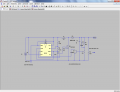
See my version of the circuit...
Several comments on your circuit...
For 75 volts at 100 ma, the output power is 7.5 watts. If we assume a conversion efficiency of 80% then the input power will be over 9 watts -- lets assume 10 watts for a safety margin. 10 watts at 12 volts is 0.833 amps. This is the average current that flows through the inductor. In this type of circuit, the peak current of the inductor is about 4 times the average current. This means that the inductor needs to be rated at more than 3.3 amps.
I would use a 4 to 5 amp inductor with a series resistance of less than 0.050 ohms. Expect this inductor will be large: something like 1/2 inch in diameter and an inch long. To get this current, the inductance has to be smaller in your circuit. I would use 33 uH.
The IRF740 MOS-FET has way to high an on resistance -- as much as 0.55 ohms. At 3.3 amps it will drop almost 2 volts!
You want a MOS-FET with a maximum on resistance of 0.050 ohms. You can use a MOS-FET with a drain-source breakdown voltage of less than the 400 volts of the IRF740. I would go for about 150 volts.
The connection of the potentiometer is wrong. When it is adjusted to one end the output voltage is unregulated and can go to hundreds if not thousands of volts destroying the MOS-FET. I would put a 1K resistor in series with the ground leg of the pot.
You need to use a fast rectifier diode. The UF4004 is a fast diode with a reverse recovery time of about 50 nS.
Do _not_ use a 1N4001 series diode because the reverse recovery time is much slower at about 2 uS.
(A 1N4148 switching diode is fast enough but will not withstand the high currents in the circuit).
See my version of the circuit...
Attachments
-
2.8 KB Views: 34
-
658 bytes Views: 13
-
184 bytes Views: 13


 .
.