555 voltage booster

Thread Starter

Wendy

Joined Mar 24, 2008
23,798
I really like with the potential drive the logic level mosfets would give a CMOS 555. I may use this for other configurations.
 

Papabravo

Joined Feb 24, 2006
22,082
So I have been researching logic level mosfets, I probably already have them at home. If I were to have to buy them I'm probably get them from here and here. They are a bit pricey but I believe they would work very well.
The IRLZ44N is a good logic level performer. Vgs(th) is between 1 and 2 volts and it is fully on at 5V.
The IRF4905, not so much. The Vgs(th) is between -2 and -4 Volts, but it is not fully on until Vgs = -10V. That is the point where rds(on) is supposed to be at a minimum. If it was me I would keep looking, but the number of N-channel varieties far exceeds the number of P-channel parts.
 

Papabravo

Joined Feb 24, 2006
22,082
Of course I am always open to suggestions.
I don't have any off the top of my head, but given your situation I might spend some time looking for one on Digi-Key or Mouser especially if it also has a simulation model.
EDIT 1: Maybe the IRF4905 will be OK. Since the device can handle more current that you will likely be using, it might be OK for drain currents of less than 1A. It is certainly better than the BSS84.
EDIT 2:Just as a double check, here is the previous simulation with your chosen parts. This looks much better than the previous examples since the IRF4905 model has a much more acceptable ON-resistance than the previous example. I'll be interested to see if the models correspond to reality. Watch this space.
1658349207430.png
 
Last edited:

Thread Starter

Wendy

Joined Mar 24, 2008
23,798
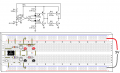
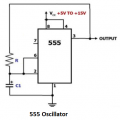
After taking a break on this project I tried these two oscillators:

R-R 555 OscProto #4.png

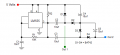
555 5V-15V converter.png

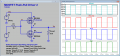
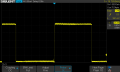
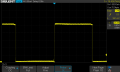
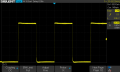
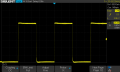
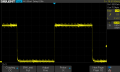
between the two of them I prefer the first one more because it actually needs fewer parts to generate a rail to rail square wave. I built the second one as a proof of concept. It worked OK and surprisingly made it past seven bolts on the power supply before unduly stressing the diodes. I took these square waves on this design just as part of a show and tell, R3 and R4 are not necessary I removed them with no degradation in the performance of the square wave has shown it by the 2nd oscope image.

SDS00001.png . SDS00002.png
 

Thread Starter

Wendy

Joined Mar 24, 2008
23,798
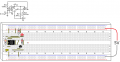
So I tried this design next:

555 5V-15V converter #2.png

and I got this wave form which was no surprise more posts will follow:

SDS00001.png
 

richbrune

Joined Oct 28, 2005
126
Below is the LTspice simulation of your second circuit.
As you can see, there are significant current spikes during the signal transition, as well as current through the transistors when high, since the 555 only goes to about 1.5V below the supply voltage.

View attachment 267770
I don't see a connection to pin 7 in Wendy's original "second circuit". Is there a way to make a 555 oscillator without discharge?
 

crutschow

Joined Mar 14, 2008
38,512
Note that driving a logic-level P-MOSFET from a standard 555 could be problematic, since the 555 output only goes to within less that a volt of Vcc, and may not fully turn off the MOSFET.
A pull-up resistor at the 555 output should help that.
 

Thread Starter

Wendy

Joined Mar 24, 2008
23,798
I don't see a connection to pin 7 in Wendy's original "second circuit". Is there a way to make a 555 oscillator without discharge?
It's there:
temp.png
As for not using the discharge pin:
555 Hysteretic Oscillator
this design produces a 50% duty cycle. Which is why I'm using it. It is hard to get a 50% duty cycle using 5 volts as the power supply.
You can always copy the image and then enlarge it specifically to look at the area you have questions about I do this pretty much automatically when I am drawing it.
 

Thread Starter

Wendy

Joined Mar 24, 2008
23,798
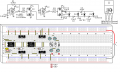
So I got it to work, sort of. It didn't do what I wanted it to do. here is the circuit I used:

555 5V-15V converter #2.png
tweaking the power supply voltage with the DVM to exactly 5 volts as measured I got the following numbers:
9.67V,19.32V,28.93V
loading the outputs with a 1.0KΩ resistor I got the following numbers:
3.428,5.373V
changing the resistor to a 10KΩ I got these numbers:
9.16V,10.42V,10.52V

obviously you're not going to get much in the way of a drive out of these multipliers though the theory does check out. I'm not quite through with this experiment yet, But the bulk of it is done.
 
Last edited:

sghioto

Joined Dec 31, 2017
8,634
So I got it to work, sort of. It didn't do what I wanted it to do. here is the circuit I used:
Do you really need those transistors?
These are my results with the classic doubler-tripler circuit
No Load:
Out 1 = 9.8v,
Out 2 = 14.5v
1K Load:
Out 1 = 6.2v
Out 2 = 6.9v
10K Load
Out 1 = 8.2v
Out 2 = 11.2 v
1688769703855.png
 

Thread Starter

Wendy

Joined Mar 24, 2008
23,798
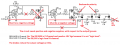
The goal was to create true peak to peak square waves which I did. It may have been overkill but I wanted to give this circuit every chance. It also made the square wave a true 50% duty cycle. Similar to this:
temp1.png
 
Last edited:

Thread Starter

Wendy

Joined Mar 24, 2008
23,798
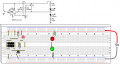
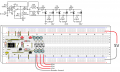
I went back and revisited an old design, interesting discoveries. 10µF capacitors just do not work very well instead use 200µF or larger which worked much better. I suspect 1000µF would not be a bad choice.

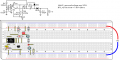
5V Converter.png

SDS00001.png

I believe this would make a fairly decent 9 Volt battery replacement from 5 volts DC (a phone power cube). Up to now I have been making the waveform as ideal as I can, I am using 21kHz with a 50% duty cycle square wave. I will try using fewer components eliminating the transistor drivers which create this perfect square wave and post the results.
 
Last edited:
Top