480V Rotary Phase Converter

shortbus

Joined Sep 30, 2009
10,049
Just my thoughts on this. Unless you are needing the 3PH every day or even every week, owning something and then having to keep it up seems kind of a waste. If only needing the high power 3PH once a month or less, wouldn't it make more sense to rent a portable gen set when needed? The cost could then be offset by, 1. charging the customer, and 2. writing it off your taxes at the end of the year as a necessary expense. The every day testing of the single phase control system could be run from the available mains. With the 3PH part being controlled by a smaller RPC, at reduced loads.

More information on the different RPCs store bought and DIY than you will ever need. It even has the origins of the so called miller system, before there was a miller system. The RPC he copied. http://www.practicalmachinist.com/vb/transformers-phase-converters-and-vfd/
 

Thread Starter

strantor

Joined Oct 3, 2010
6,875
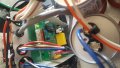
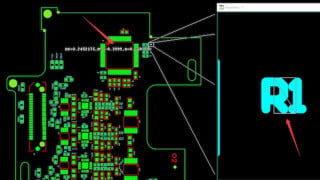
A straight on picture of the board might be more useful.
And its underlying traces...
I was only asking in jest. Implied, this RPC is topper top secret than top secret. I am a bit curious what the PCB is for, maybe I'll pull it out some day and put it under a microscope. But for now the priority is getting 3ph power up and running. If you guys really want to know what's on the board I'll try to snap some better pics when I hook it up, just let me know.
 

Thread Starter

strantor

Joined Oct 3, 2010
6,875
I have designed and had built over a hundred control panels and none of the controls used 3-phase power. The motors and heaters controlled by the panels did use 3-phase, but nothing on the panels. So my guess is that you are choosing to check every wire and fuse and contact in the whole design. It sounds like you just got a deal on the actual rotary converter, I wish you success on that. Real 480/ 3phase can be very exciting if anything goes wrong.
I was going to suggest an inverter to get three phase, but at that power level they get expensive to even build yourself. They can be powered from the 240 lines and a good rectifier setup, but the transformers get big.

The care and feeding of 3-phase stuff is always "interesting." I did work at one place that had the "funny" 3-phase 240 volts. Two of the legs were 120V to neutral, the third leg was 220 to neutral, and the meter read 240 between any two legs. I was never able to figure out exactly how it was created, fortunately I did not need to know that.
So it will be interesting to see what you wind up with, please give us a report when you have it all set up.
In the short term (what's really got me scrambling right now) I'm building a big conveyor panel with 12VFDs in it. I'll be bringing some of the conveyor sections back to my shop for testing/tuning, and I'll be hiring a part time helper who I envision doing most of the panel build while I focus on programming. I would not risk powering up a panel for the first time in front of the customer, especially if some someone other than myself built it. So that's why I need 3ph right now.

In the future, I will need 3ph for all kinds of things. My plan for when I'm not engaged in a design project or doing field service, is to refurbish CNC/machine tools in my shop.
 

Thread Starter

strantor

Joined Oct 3, 2010
6,875
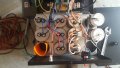
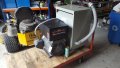
Well today was a success. The RPC was in pristine condition. I haven't applied power yet, but I will be very surprised if anything is wrong with it. I bought it from a lady who owned a pasta shop. She was using it to run a 3ph pasta dryer for two years, and then she shut down the business. I looked at the equiment she was running on it, and it was way oversized for her needs. I bet it's never been anywhere near its FLA.

The transformer was a dud. I put my DMM across the secondary and read open circuit. Took the cover off to find that two legs had melted off the lugs. Walked away from that and drove to a parking lot where I sat for over an hour doing more online shopping for a transformer. I drove 45mi north to the big city and didn't want to go home empty handed. I found a guy another 45mi north, who said he had a huge selection of 3 phase transformers from 2kVA up to 200kVA, and several for me to choose from that fit my requirements. I get there and find that, while he does have a huge selection, but he doesn't know the first thing about them. He is newly in the business of buying up forelosed business assets. All the transformers he shortlisted for me were single phase, and he didn't know the difference. Among his treasures I found a 30kVA 3ph 480v>Y208/120. I decided to take it off his hands after doing the math; it has HV taps all the way down to 432V, which if back-fed with 240V, should give me 498V, well within the 10% spec of the service provider for 480V. And if the voltage droops under high load, maybe it will settle at a comfy 460-480V. He only charged me $280 for the transformer.


20180606_153339.jpg 20180606_142440.jpg
 

MisterBill2

Joined Jan 23, 2018
27,649
Probably you should HiPot check the transformer before connecting it to any real power. But it does seem like you did very well on the rotary converter system. Good luck with the projects that need it. Perhaps you can post some pictures of the project in the completed projects section of this site. Folks would learn that not all projects are small hobby-type ones. You could inspire kids that way.
 

Thread Starter

strantor

Joined Oct 3, 2010
6,875
Probably you should HiPot check the transformer before connecting it to any real power. But it does seem like you did very well on the rotary converter system. Good luck with the projects that need it. Perhaps you can post some pictures of the project in the completed projects section of this site. Folks would learn that not all projects are small hobby-type ones. You could inspire kids that way.
I performed a 1000V megger check on it before I wrote the check. I don't have a working HiPot device but the megger check is "good enough" for me. I will definitely post the completed project.
 

cmartinez

Joined Jan 17, 2007
8,783
I performed a 1000V megger check on it before I wrote the check. I don't have a working HiPot device but the megger check is "good enough" for me. I will definitely post the completed project.
I know nothing about transformers. Would you mind explaining what both tests are about?
 

Thread Starter

strantor

Joined Oct 3, 2010
6,875
I know nothing about transformers. Would you mind explaining what both tests are about?
Megger and HiPot are both insulation resistance/current leakage tests.
Megger is a HV (typ. 500V - 1000V) DC test. It is a gentle check which gives electrons the opportunity to leak out, if there is an existing avenue for them to do so.
HiPot is a HV (typ. 1000V - 3,000V) AC test. It is more of a torture test which encourages electrons to break through any weak spots in the insulation.
Megger is typically used in the field to check. HiPot is typically used in QA at the manufacturer to prove (before sending out brand new product).
 

Thread Starter

strantor

Joined Oct 3, 2010
6,875
I presume you know that a 3ph transformer is made from 3 single phase versions?.;)
You can easily make one from 3 descrete 1ph ones if needed and at the right price.!
https://www.electronics-tutorials.ws/transformer/three-phase-transformer.html
Max.
Yes, and I have done so. But in that moment, where I was and who I was talking to, this wouldn't have helped. He was asking the same price for single phase transformers and 3phase transformers. I could buy 1 or 3. I chose 1.
 

MaxHeadRoom

Joined Jul 18, 2013
30,686
There are also two versions of a 'Megger' the hi-volt 'insulation' tester and the low resistance scale version, we used to use the latter to measure the earth ground resistance from an installation back to the star point ground of a service transformer (UK).
Max.
 

Thread Starter

strantor

Joined Oct 3, 2010
6,875
I know nothing about transformers. Would you mind explaining what both tests are about?
Megger and HiPot are both insulation resistance/current leakage tests.
Megger is a HV (typ. 500V - 1000V) DC test. It is a gentle check which gives electrons the opportunity to leak out, if there is an existing avenue for them to do so.
HiPot is a HV (typ. 1000V - 3,000V) AC test. It is more of a torture test which encourages electrons to break through any weak spots in the insulation.
Megger is typically used in the field to check. HiPot is typically used in QA at the manufacturer to prove (before sending out brand new product).
After posting my answer I started to second-guess myself, so I decided to check if google agreed with my explanation. I was maybe a bit off on the voltage numbers (the test voltages really depend on the conductor voltage ratings) but I was amused to find me answering myself (or, myself answering me?)... from 5 years in the past through the internet.

meggerhipt.PNG

https://forum.allaboutcircuits.com/threads/megger-vs-hipot.81930/#post-584389
 

cmartinez

Joined Jan 17, 2007
8,783
After posting my answer I started to second-guess myself, so I decided to check if google agreed with my explanation. I was maybe a bit off on the voltage numbers (the test voltages really depend on the conductor voltage ratings) but I was amused to find me answering myself (or, myself answering me?)... from 5 years in the past through the internet.

View attachment 153892

https://forum.allaboutcircuits.com/threads/megger-vs-hipot.81930/#post-584389
Ha! ... same thing happened to me a few days ago ... and I had to re-read my own answer several times, because I was wondering "what was I thinking at the moment?"
 

Thread Starter

strantor

Joined Oct 3, 2010
6,875
I set up my new gear and made a video of some testing. Some might find it illuminating. Some might find it an opportunity to illuminate me. But if you find it nothing else, I hope you find it entertaining.

 
Last edited:
Top