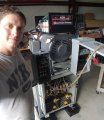
Per NFPA 70E, Table 130.7(C)(15)(a), this falls under arc flash PPE category 1, Fire Retardant pants and shirt. I wasn't wearing that, but I will be tomorrow. And safety glasses and rubber gloves wouldn't hurt either. Thanks for the reminder.
EDIT: let me rephrase before I get called out... I have analyzed the maximum potential fault current and determined that this falls under arc flash category 1, which Per NFPA 70E, Table 130.7(C)(15)(a), calls for Fire Retardant pants and shirt.
I guess I have an update. I was going to hold the update until I get it 100% the way I want it, but this is starting to feel like one of those projects that's never really finished, just perpetually evolving.
I want to build a panel for it with Volt and Amp meters for each leg of 240V and 480V 3ph, as well as the 240V single phase input, power factor meters, flashy lights, and displays for a wealth of other unimportant data to confound anyone who didn't build it (and probably myself, years later). I also want it to have an automatic startup sequence: power on, start the idler, once at speed, switch on the transformer, then apply power to onboard 240V and 480V outlets. Breakers on 240V and 480V power. Overload alarm, imbalance alarm, phase rotation switch, etc. Any bell/whistle that could be thought of.
I have received a bulk shipment of 50micro-amp analog meter movements from which to make all the displays. I have received a bulk shipment of CTs to measure the amps. I have received some rather large contactors to automate the startup sequence; they should make a rather startling cacophony of awesomeness upon power-up. and breakers, and other misc crap. It's all sitting in a pile collecting dust and will probably remain there for a while.
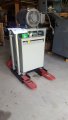
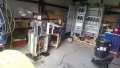
Until then, I just had to make the thing presentable; well, actually make it "a thing," period. It was just a collection of related items sitting on a pushcart and haphazardly wired together not per any code or accepted industry practice in any country except Bangladesh. So all I've done is build a skid for it and assemble what I had on the cart into a single unit, wired more-or-less properly. I needed it to look minimally legit, as I will have customers coming to witness the panel I'm building, and I didn't want that dangerous noodle cart to be an example of my work. If it's going to distract from the paid project, it had better be in a good way.
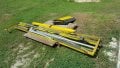
I started with a pile of scrap metal.
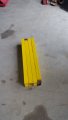
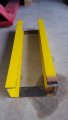
Cut approx 2ft sections of heavy 4" channel for forklift/pallet jack fork pockets.
Pocket size and spread were determined by my pallet jack.
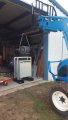
I have been TIG welding all my fab projects for the past couple years and it's been fine. But I recently took on a rather extensive welding modification to a friend's trailer and what should have taken a couple of hours, took all day. So I decided to start incorporating some stick welding into my regimen, since it's a simple affair to attach a stick electrode holder to my TIG machine. This fork pocket skid was my very first stick welding project. It was hideous. That's why I spray painted it gloss black immediately, before it was even fully cool from welding. Apart from this pic below, there is zero photographic evidence of what it looked like before painting.
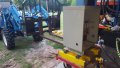
Oh yeah, I bought a tractor last month. It's the first brand new vehicle I've ever purchased and also the most expensive vehicle I've ever purchased. Also it's the handiest damned thing ever. I would encourage anyone who doesn't live in an apartment to get one. But don't buy a brand new one like I did. That was stupid. Get a used one for $5k or less.
Back on topic... I decided to quit the stick welding for this project since I need it to look acceptable, so I opted to finish the rest of the structure with unistrut. Bad call. The unistrut took even longer than TIG welding would have, and it isn't as strong.
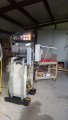
It took a lot of bracing and heavy duty hardware to keep that 385lb motor steady up there. But the up-side of the unistrut is that now it's a blank canvas for anything I want to hang off of it in the future (probably a lot). For now I just hung the two disconnects off if it.
I installed the proper size of breakers/fuses and wire/cables between everything and put compression glands where previously had just been cord stuffed through a jagged hole.
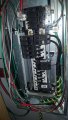
Wired it directly into my shop breaker panel via some janky "cable" that I made by bundling (3) 1AWG THHN wires and wrapping with spiral wrap. I just couldn't find any 1AWG SO-cord, or a 150A plug/receptacle combo for under $500. This is the one part I'm still not proud of. I need to find a better way to do this.
All that other crap coiled in the breaker panel is my electrician's work-in-progress. He's really taking his friggin time. I still don't even have lighting in my shop.
But anyway, here it is, doing what it was born to do. Currently powering a panel of (11) 480V 3HP Toshiba VFDs.
Thanks for the update on a monumental project. But I think it would have been better to put that large motor closer to the floor. The reason is that if a motor is spinning and then becomes short circuited the whole motor wants to roll. That is quite exciting enough with a 5HP device, something that I can lift. Thus a loose wire could cause a lot of grief if it short circuited a winding while the motor was spun up. Be sure and adequately document the project with as built drawings, because in five years, when you want to build another one, you may not recall all of the details. That happened to me! I built a tester machine and it was run 24/7 for several years until things all wore out. So the customer came back and ordered another one, AND THEN sent the first one back for repairs. They loved the machine! Because the drawings were good enough I did not need to help with the econd machine, saving my employer several dollars, I am sure.
Thanks for the update on a monumental project. But I think it would have been better to put that large motor closer to the floor. The reason is that if a motor is spinning and then becomes short circuited the whole motor wants to roll. That is quite exciting enough with a 5HP device, something that I can lift. Thus a loose wire could cause a lot of grief if it short circuited a winding while the motor was spun up. Be sure and adequately document the project with as built drawings, because in five years, when you want to build another one, you may not recall all of the details. That happened to me! I built a tester machine and it was run 24/7 for several years until things all wore out. So the customer came back and ordered another one, AND THEN sent the first one back for repairs. They loved the machine! Because the drawings were good enough I did not need to help with the econd machine, saving my employer several dollars, I am sure.
Good advice all around, thank you. Yeah I should mention, if anyone down the road draws inspiration from this for their own build, definitely put the motor on bottom. The transformer and motor are both way too heavy for me to lift, so I didn't have a "feel" for which was heavier. I went with my gut instead looking up the numbers, and my gut was wrong. The motor weighs more than the transformer by a good margin, and should be on the bottom based on that alone; not to mention the braking action @MisterBill2 highlighted. I really should rearrange it, and I might still. I'm not 100% pleased with the unistrut either. If adding the control panel to it later proves difficult in this configuration, I am going to rewind a few steps and put the motor on bottom, transformer on top, and make a welded steel frame. That will allow me to recoup probably >$100 worth of hardware too!

 Facebook
 Google
 GitHub
 Linkedin