480V Rotary Phase Converter

Thread Starter

strantor

Joined Oct 3, 2010
6,875
I'm finally getting my workshop set up! I have an electrician installing a 200A breaker panel and lighting/power outlets as I type, and the power company will be running power (120V/240V 1ph) to it in the coming weeks (or days, hopefully). As soon as I get power, I will need 480V 3ph. I need this for testing industrial control panels that I build, and I am about to start building a panel before I even get the building powered up. So this will be important sooner than later.

I've never had any experience with RPCs before, which is odd, even to me; as a motor controls guy, if anyone on this forum should have this kind of experience, I should be one of them. But so far everything I encounter in my line of work is in facilities that have existing 3ph service, and all my machine tools at home with 3ph motors are 230V small motors that I power from single phase input VFDs. I've never needed a RPC, or even seen one first hand.

I want my 480V 3ph power to have good voltage/current balance across a wide range of loads since this won't be set up to power just the same single load all the time. I would like to utilize as many compenents as possible that I already have laying around. Here's some of what I have:
  • 15KVA 240V/480V single phase transformer
  • assortment of single phase input VFDs up to 3hp
  • loads of relays & contactors, all kinds of coil voltages and amp ratings, including time delay & misc special purpose
  • Misc chokes/inductors/high power resistors
  • Loads of 2pole and 3pole breakers and fuses
  • micro/brick PLCs
Ideally I would want to make a 230V RPC and feed that to a 3ph transformer to get 480V. That way I have access to 230V and 480V 3ph at the same time. But my only big transformer is single phase, so if I'm going to utilize it to step 230V up to 480V, then I need to build a 480V RPC, not a 230V RPC. Offhand that seems problematic since the typical start/run caps normally utilized for RPCs (from what I can tell) are all for 120V or 230V motors. Ever seen a 460V single phase motor? Me neither, so why would anybody bother to make caps for that purpose? And even if they exist, they don't exist within my personal cache so that's a good reason not to use them.

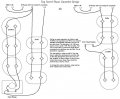
So what I'm thinking is to make a capacitor-free design; get a grossly oversized 230/460V motor (ex: like this) to use as an idler configured for 230V, and use one of my single phase input VFDs to get it started. I would be using probably a 1hp VFD on a 50+hp motor, but the motor will be unloaded, and maybe if I put some inductors and/or resistors in-line with the VFD output it won't explode. Once it's up to speed on 230V power, the VFD output to the motor is disconnected and a cluster of relays switches the motor leads around from 230V configuration to 460V configuration. Then single phase 480V power from the transformer is applied to the motor. Now my 480V idler is running off 480V single phase and generating 480V 3 phase, and I can energize the output contactor. A brick PLC can coordinate the multiple steps of the sequence to finally arrive at 3ph 480V, and it can be all automatic from the push of a single button.

Because the idler motor is grossly oversized (50HP/480V/60A) and I'll be using no more than 15-20A, the load should not experience much (if any) voltage/current imbalance, despite the lack of run caps. Or at least that is my theory. Please affirm or refute the theory.

Any input or other suggestions welcome. Thanks!
 

BR-549

Joined Sep 22, 2013
4,928
"I want my 480V 3ph power to have good voltage/current balance across a wide range of loads since this won't be set up to power just the same single load all the time."

I have repaired hundreds of 480 drives. Forget RPC. You need 3 phase power from pole.

We coupled two....25hp motors together. One motor had a 25hp regenerative drive on it. The VFD under test is connected to the other motor. This drive and two motors served as variable load for any midsize drive. It is easy to test a regenerative drive with this setup too.

That was 20 years ago. Regenerative drives are much more common now. These drives need to supply(dump) into a 480 grid.

This is a twenty year old opinion.
 

Thread Starter

strantor

Joined Oct 3, 2010
6,875
I have repaired hundreds of 480 drives. [...]

We coupled two....25hp motors together. One motor had a 25hp regenerative drive on it. The VFD under test is connected to the other motor. This drive and two motors served as variable load for any midsize drive. It is easy to test a regenerative drive with this setup too.

That was 20 years ago. Regenerative drives are much more common now. These drives need to supply(dump) into a 480 grid.

This is a twenty year old opinion.
I'm not sure I understand the context here. Is this a quote from somewhere else? I'm not in the VFD repair business so I don't (currently) plan on load testing Regen drives. I need to test brand new panels with drives in them, but I don't foresee regen being part of the picture.

Forget RPC. You need 3 phase power from pole.
I don't have 3ph pole power option. I live out in the country and the closest 3ph is miles away. If I ever get into the currently unforeseen situation where a RPC absolutely cannot fulfill my needs, then I'll be looking at moving into the city or renting a 3ph generator, depending on the severity and duration of that situation. But I'm currently only worried about the foreseen situation, in which I think a RPC will suffice.
 

BR-549

Joined Sep 22, 2013
4,928
All of my comments were directed to the quoted statement. The common shaft setup will result in a balanced, variable, 480 3 PH load. Even for regenerative devices.

That's all. Sorry it didn't help.
 

Thread Starter

strantor

Joined Oct 3, 2010
6,875
All of my comments were directed to the quoted statement. The common shaft setup will result in a balanced, variable, 480 3 PH load[*]. Even for regenerative devices.

That's all. Sorry it didn't help.
Sorry I feel like I'm still not picking up 100% of what you're laying down. Are you suggesting a coupled motor/generator, or what? If so, how is the regen drive involved?

*Maybe I have identified a misunderstanding. I'm not looking for a 3ph load. I'm looking for a 3ph source.
 

BR-549

Joined Sep 22, 2013
4,928
Oh...okay...sorry.

After we would repair a drive.....we would warranty it to manufacture spec. That meant testing a variety of drives.......both 480 and 240.....at different hp.

Two 25 hp motors are shaft connected. A 25 hp regenerative drive controls motor number one.

Motor number two.....can be wired for 240 or 480, depending on the test drive voltage. The test drive will be wired to either a 240 or 480 supply, depending on drive voltage.

Turn test drive on and bring #2 motor up to speed. Now turn #1 drive on. #2 drive is turning the shaft in one direction and #1 drive is now trying to turn it in the other. We use one drive's opposition to bring the other drive up to full current. This way we can safely test over current and over temp protection circuits. We probably tested them harder than the manf. The tech of a warranted comeback drive.....payed the bar tab.
 

Hymie

Joined Mar 30, 2018
1,347
While you have plans to construct your own converter – here is an example from a UK supplier (slightly under powered for what you want)

https://www.ebay.co.uk/itm/TRANSWAV...820026?hash=item25f5cfb47a:g:gwwAAOSwj2Za8WM-

No doubt there are manufacturers in Texas who could supply something similar for a comparable price.

For all the grief in building a converter (that actually works), I think it would be a wise decision to buy an off-the-shelf solution.
 

BR-549

Joined Sep 22, 2013
4,928
I believe the proper name of the setup is Dynamometer Test Bed Table. Or something of that nature.

Now one can do a lot more with this thing....but we used it for testing drives. Ours was home built.
 

Reloadron

Joined Jan 15, 2015
7,857
Your best bet would be if you could find an industrial surplus unit like an old KATO. The downside is my memory of these beast, and they are beast is a 25 KVA unit 3 phase 480 Volt 60 Hz will likely use a 240/480 VAC 40 HP motor so running the motor on 240 volts you can figure about 85 amps. You can find KATO and other used online but ideally a large industrial surplus parts house would likely be your best and least expensive route. A Google of KATO Motor Generators should bring up some hits and again I only mention KATO as they were an industry leader decades ago. These things are brutes and I mean they literally eat heavy loads and last forever. Obviously if you want less power you can likely find an old 12 KVA unit which with a 240 volt motor will get you down around 40 to 45 amps and a 20 HP motor.

Also depending on where you find one getting it to you won't be cheap as you are looking at freight based on weight and I hope you have a tow motor to place the thing.

Ron
 

Thread Starter

strantor

Joined Oct 3, 2010
6,875
While you have plans to construct your own converter – here is an example from a UK supplier (slightly under powered for what you want)

https://www.ebay.co.uk/itm/TRANSWAV...820026?hash=item25f5cfb47a:g:gwwAAOSwj2Za8WM-

No doubt there are manufacturers in Texas who could supply something similar for a comparable price.

For all the grief in building a converter (that actually works), I think it would be a wise decision to buy an off-the-shelf solution.
The problem with that unit is that it's a static phase converter and gets set up and tuned for a specific piece of equipment. It's no good for variable loads or a different load every day, the way I intend to use it.
 

Thread Starter

strantor

Joined Oct 3, 2010
6,875
Your best bet would be if you could find an industrial surplus unit like an old KATO. The downside is my memory of these beast, and they are beast is a 25 KVA unit 3 phase 480 Volt 60 Hz will likely use a 240/480 VAC 40 HP motor so running the motor on 240 volts you can figure about 85 amps. You can find KATO and other used online but ideally a large industrial surplus parts house would likely be your best and least expensive route. A Google of KATO Motor Generators should bring up some hits and again I only mention KATO as they were an industry leader decades ago. These things are brutes and I mean they literally eat heavy loads and last forever. Obviously if you want less power you can likely find an old 12 KVA unit which with a 240 volt motor will get you down around 40 to 45 amps and a 20 HP motor.

Also depending on where you find one getting it to you won't be cheap as you are looking at freight based on weight and I hope you have a tow motor to place the thing.

Ron
This looks like the perfect solution! If only I could find one...
eBay has one that looks reasonably sized and reasonably price, but it's the wrong voltage. There are a few more results from ebay that are well outside my budget.
But what ebay does have, is generator heads and motors. Perhaps I could build my own wanna-be Kato MG set. More research required...
 

shortbus

Joined Sep 30, 2009
10,050
I may be missing something in this. You want 480V 3PH out but only have 240 1PH in. Wouldn't you need a three phase 480V/240V transformer? Then you could use a 240V VFD to drive the 240V side of the 480/240 3PH transformer. My experience with RPCs is they can't increase output volts and are not very well balanced electrically.
 

Thread Starter

strantor

Joined Oct 3, 2010
6,875
Is there a practical size limit on single phase AC motors? Looking at MG sets, I can't find anything over 5HP input. Looking at motors to roll my own MG set, I can't find single phase motors over 10HP. So I wander back toward the idea of building a "big 'ol RPC" and I concerned about what size 3ph motor I could use as an idler.
I may be missing something in this. You want 480V 3PH out but only have 240 1PH in. Wouldn't you need a three phase 480V/240V transformer? Then you could use a 240V VFD to drive the 240V side of the 480/240 3PH transformer. My experience with RPCs is they can't increase output volts and are not very well balanced electrically.
Have you ever connected a scope and looked at the secondary output of a transformer with a VFD-fed primary? I have, and it's disgusting; even with a sine filter between the VFD and transformer. You would think (or at least, I thought) that the reluctance of the transformer iron and the inductance of the coils would serve to filter out the fast spikes, but I found that the output was just as nasty as the input. I don't want to submit sensitive electronics to that kind of abuse.

I don't have a big 3ph transformer and I'm trying to avoid buying one. But I will do whatever I resolve has to be done, up to and including spending money.
 

Mukkles

Joined Feb 14, 2017
6
I can't give too much insight into this, but it was something I was looking into for my own work a while back. I had found a handful of companies that had a wide range of options (including for sensitive applications) all figured out up to some huge levels of power.

http://www.northamericaphaseconverters.com/
https://www.americanrotary.com/

I would avoid the Static converter and stick to Rotary/Digital honestly, and yes you're correct in not being able to find any motors larger than 3/5HP in single phase. I think the folks here at the rotary phase converters roll their "idlers" differently to allow for their line of work.
 

shortbus

Joined Sep 30, 2009
10,050
Have you ever connected a scope and looked at the secondary output of a transformer with a VFD-fed primary? I have, and it's disgusting; even with a sine filter between the VFD and transformer. You would think (or at least, I thought) that the reluctance of the transformer iron and the inductance of the coils would serve to filter out the fast spikes, but I found that the output was just as nasty as the input. I don't want to submit sensitive electronics to that kind of abuse.
No never did it. But I don't understand something else here. Why are the "sensitive electronics" 3PH? Most all of any of the machine tools I've been around use 1PH in the electronics/controls, with the rest of the machine (motors, etc) 3 PH.
 

Thread Starter

strantor

Joined Oct 3, 2010
6,875
No never did it. But I don't understand something else here. Why are the "sensitive electronics" 3PH? Most all of any of the machine tools I've been around use 1PH in the electronics/controls, with the rest of the machine (motors, etc) 3 PH.
Right, but the single phase typically comes from control transformers inside the panel which are powered from the 3phase. So if fed from a VFD, those circuits would be polluted as well. Even if isolated 24VDC is used as control voltage, I would expect the EMI from all that nasty power everywhere in the cabinet to disrupt fieldbus comms.
 

Thread Starter

strantor

Joined Oct 3, 2010
6,875
I got the trailer hitched up and I'm heading out in the morning to potentially (probably) pick up a couple of good deals I found locally while shopping craigslist/offerUp/Facebook marketplace. I found a 30hp rotary phase converter (American Rotary ADX30) for only 3 digits, as well as a 25kVA 3ph transformer. If these people aren't selling unicorn farts, then it looks like I'll be able to have what I originally wanted (230V 3ph and 480V 3ph) for $1400 altogether, and it should be (*) clean, balanced power, and relatively easy to install. I'll just have a big extra transformer that I have sell or figure out some other use for.

*This ADX line of RPC is advertised to overcome most of the woes commonly suffered by RPC owners (and most likely what @shortbus described) with the help of advanced magic black boxes containing *gasp* electrocomical "semiconductors." I have no idea what's behind the magic curtain but I soon will.
 
Last edited:

MisterBill2

Joined Jan 23, 2018
27,186
I have designed and had built over a hundred control panels and none of the controls used 3-phase power. The motors and heaters controlled by the panels did use 3-phase, but nothing on the panels. So my guess is that you are choosing to check every wire and fuse and contact in the whole design. It sounds like you just got a deal on the actual rotary converter, I wish you success on that. Real 480/ 3phase can be very exciting if anything goes wrong.
I was going to suggest an inverter to get three phase, but at that power level they get expensive to even build yourself. They can be powered from the 240 lines and a good rectifier setup, but the transformers get big.

The care and feeding of 3-phase stuff is always "interesting." I did work at one place that had the "funny" 3-phase 240 volts. Two of the legs were 120V to neutral, the third leg was 220 to neutral, and the meter read 240 between any two legs. I was never able to figure out exactly how it was created, fortunately I did not need to know that.
So it will be interesting to see what you wind up with, please give us a report when you have it all set up.
 
Top