4060 chip for seconds and hours

Thread Starter

Danielpalfrey

Joined Mar 29, 2016
84
Just gotta work on the fail safe now. Going to use a liquid sensor to detect when the water raises to a point where it is safe but I dont want more water. Using this, It will generate power to a relay and through that to a transistor killing power to the pump, I am aslo going to use a 555 ic to set a small delay between water detected and pump off. This is to stop the pump being switched off and on multiple times due to water ripples.

Already have the circuit in mind
 

Thread Starter

Danielpalfrey

Joined Mar 29, 2016
84
I now see what an earlier post meant. I woke up this morning to hear the pump running. But it never turned off. It looks like pin one stays live for a hell of a lot longer than 30 seconds.... trying to dial down to 6 is gonna be a bitch
 

Dodgydave

Joined Jun 22, 2012
11,395
Circuit

Get it to work on pin 7 first, thats 30seconds delay, then see if the relay comes on for 6seconds, if thats right cycling every time, then try your final delay pin1, ....
 

Dodgydave

Joined Jun 22, 2012
11,395
You cant have got it right on pin7, if the relay is staying on then the reset capacitor, latch diodes aren't doing the job.....
 
Last edited:

Thread Starter

Danielpalfrey

Joined Mar 29, 2016
84
I left it running untill morning and it was still working as expected. But now the relay clicks on at the time I expect and then just stays on for what ever length of time. Haven't time it yet
 

GopherT

Joined Nov 23, 2012
8,009
Ok, I now have this circuit working. I cleaned the board up for the third time to be safe and it still wasnt working, so I probed away with the multi meter and found (Due to an early mistake) that I had blown the transistor, I have now swapped this out and it works perfectly. Dialing in the 6 seconds was a little tuff because I unwitingly bought preset resistor that was none linear. Voltage raises fast at begining and hits near max about half way round. but I got it there. Just letting it run for a bit letting it click the relay make sure I am happy, then I can rig up the pump

Well, it only took 120 posts to get there. Not as bad as some - I'm glad you arrived.
 

Thread Starter

Danielpalfrey

Joined Mar 29, 2016
84
Ok, So I put it back to a point where I had it working. and well... it no longer works. everything works fine until the relay energises then it never resets. it just stays on and on and on... I have no idea what could be wrong, I have checked all the tracks and tested most of the parts to no avail. any ideas> ps, the reset capacitor is 16v, could this be an issue?
 

Thread Starter

Danielpalfrey

Joined Mar 29, 2016
84
Diodes all seem fine, I'll double check them and then check the resistors today, but the telay energises and what not but the capacitor doesnt seem to charge but I put a new one in and still nothing
 
Yes, but you will need some decoding.

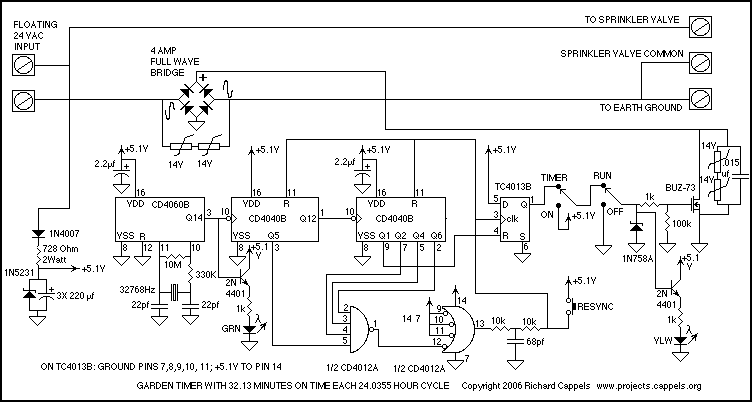
The drip/sprinkler timer below runs for 34 minutes every 24 hours.


Below is a brief description of the circuit.

The Circuit
CMOS 24.055 Hour Timer
The resulting timer circuit is made from a CD4060, includes an oscillator and a 14 stage binary counter, two CD4040's, which are 12 stage binary counters, a CD4012 Dual Nand gate and a CD4013 Dual D Latch.

The CD4060 is connected to a 32768 Hz ECS 3X8 tuning form crystal. The 10 Meg Ohm resistor between CD4060 pins 10 and 11 are to bias the internal inverter into its analog region, and the 330 K resistor in series with the crystal is to limit the power to the crystal. This setup is directly from the ECS data sheet. The output of the 14th flip flop in the CD4060 appears on pin 3, and it is a 2 Hz square wave. A 2N4401 buffer drives a green LED with this square wave. When I see it blinking through the plastic window of the Irrigation System Controller housing, I know that power is on, and that at least the oscillator and first 14 counter stages are working.

The CD4040's that follow the CD40406 divide the 2 Hz pulses to get the 24 hour cycle and the 34 minute watering period. When the counter counts up to 24.0355 hours, as decoded by the CD4012, both of the CD4040's are reset and the output of the CD4013 (pin 1) is set high to turn on the valve solenoid. To get a wide enough pulse to assure that all of the flip-flops inside the CD4040's are reset, the reset pulse from CD4012 pin 13 is passed through a low pass filter made of a 10k resistor and a 6 pf capacitor.

A momentary push button, labeled "Resync" is connected to the output of the 10k and 6 pf low pass filter. When the button is pressed, it pulls the reset inputs of the CD4040's and the clock input of the CD4013 high to start a 24 hour timing cycle. The additional l0k resistor in series with the output of the 10k and 6pf low pass filter it to further limit current from the pushbutton to the input of the CD4012, which normally spends all but a few microseconds each day sitting at ground. I use the Resync button to set the time of day that the watering cycle starts.

The CD4013 latch, the output of which (pin 1) goes high to turn on the valve , is reset 34 minutes after the CD4040's are reset, thus turning off the valve . The pulse to turn off the valve 34 minutes after the watering cycle starts, appears on Q1 of the second CD4040. If I wanted to the watering period to be 68.264 minutes, I would use Q2 (pin 7) of the second CD4040. If I wanted 16 minutes, I would have used Q12 of the first CD4040. Moving the connection to the reset input of the CD4013 (pin 4) one flip-flop to the left in the CD4040 counter chain cuts the watering period in half. Moving the connection to the right one flip-flop doubles the watering period.

Valve Solenoid Power Control

A full-wave bridge rectifier is placed effectively in series with the 24 VAC from the power transformer and the watering valve. The AC signal passes through the AC terminals of the bridge, while the negative terminal is connected to chassis ground and the positive terminal is connected to the drain of a BUZ-73 MOSFET. While the BUZ-73 is off, current does not pass though the valve, and the water is off. When the output of the CD4013 (pin 1) goes high, turning on the BUZ-73, current also passes through the AC terminals of the diode bridge and through the valve solenoid.

The gate of the BUZ73 is connected to the output of the CD4013 (pin 1) through two switches, which allow me set valve solenoid OFF, ON, or connected to the daily watering cycle timer. This last position is the normal operating position. The OFF and ON positions are for maintenance and troubleshooting. The output of the two switches also connects to a 2N4401 buffer, a dropping resistor, and a yellow LED. The yellow LED is on whenever the valve solenoid is on. A 100k resistor connects the gate of the BUZ-73 to chassis ground to keep the gate from floating in case one of the switches does not get slid all the way to one position or another, on in case a switch becomes intermittent. T

There are two series connected 14 VAC metal oxide varistors across the AC terminals of the diode bridge and another pair of series connected 14 VAC metal oxide varistors across the drain and source of the BUZ-73 MOSFET. The purpose of these metal oxide varistors is to protect the diode bridge and the BUZ-73 MOSFET from voltage surges that might appear in either the AC line or the wiring to the valve solenoid. We get a lot of lightning here.

A 1k resistor between the gate of the BUZ-73 MOSFET and the rest of the circuit limits current that might capacitvely couple from a fast rising voltage spike on the drain of the FET to the gate. A zener diode from the gate to ground will limit the gate voltage in the case of such a voltage spike. The .015 mircofarad mylar film capacitor across the drain and source of the BUZ-73 MOSFET is there to reduce the amplitude of induced spikes.


5.1 Volt Zener Power Supply

One end of the 24VAC power transformer secondary connects to chassis ground through one of the diodes in the full wave diode bridge when that end of the transformer secondary swings through the negative half of the power supply line cycle. At the same time, the other end of the secondary swings positive. The voltage on this second end of the transformer secondary is rectified by a 1N4007, and passed through a 728 Ohm 2 Watt resistor to supply current to the sprinkler timer circuit. A zener diode limits the voltage at this point to 5.1 volts. Three 220 microfarad capacitors mounted around the circuit board provide plenty of filtration so that there is negligible ripple on the 5.1 volt power supply.
Hi, would someone be able to send a link to the circuit that @DickCappels describes here? Thank you.
 
Top