4017 and 4060 against a CD4017 and CD4060

Thread Starter

Davy

Joined Oct 2, 2005
9
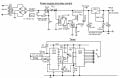
I've built two timers one using CD4060 and 4017 chips, it has 9 ranges and is 'spot on' down to the last second, so I built another using plain old 4060 and 4017.... as I increase the range it seems to add two seconds to every step...! This is to replace a uV mechanical timer in a uV lightbox.... no room for a digital otherwise I would have used one of them.

Both uses the same components, the high value resistors are 1% types and a 5% 1uF timing cap. I can only think it's the plain old chips I used - would I be right? The trip input goes to the rotary switch arm, so when this goes 'high' the thing will trip off . https://www.learningelectronics.net/circuits/egg-timer.html

Take no notice of the 400mA fuse.... far too high, this was a ICP fuse. Thanks, Dave.
 

Attachments

sarahMCML

Joined May 11, 2019
695
I've built two timers one using CD4060 and 4017 chips, it has 9 ranges and is 'spot on' down to the last second, so I built another using plain old 4060 and 4017.... as I increase the range it seems to add two seconds to every step...! This is to replace a uV mechanical timer in a uV lightbox.... no room for a digital otherwise I would have used one of them.

Both uses the same components, the high value resistors are 1% types and a 5% 1uF timing cap. I can only think it's the plain old chips I used - would I be right? The trip input goes to the rotary switch arm, so when this goes 'high' the thing will trip off . https://www.learningelectronics.net/circuits/egg-timer.html

Take no notice of the 400mA fuse.... far too high, this was a ICP fuse. Thanks, Dave.
A 4060 and a 4017 is a 4060 and a 4017, regardless of whether the prefix is CD or MC1 or HCF or HEF. They are just the prefixes of different manufacturers. To get accurate timing you should use the crystal timing circuit instead of the R/C version, although to get a 1Hz output pulse with a 32768 Hz watch crystal you will need to add an extra divide by two flipflop to its output!
 

Thread Starter

Davy

Joined Oct 2, 2005
9
A 4060 and a 4017 is a 4060 and a 4017, regardless of whether the prefix is CD or MC1 or HCF or HEF. They are just the prefixes of different manufacturers. To get accurate timing you should use the crystal timing circuit instead of the R/C version, although to get a 1Hz output pulse with a 32768 Hz watch crystal you will need to add an extra divide by two flipflop to its output!
Hi Sarah, many thanks for the reply, ah the numbers after the part number just gives a clue as to where they are made... I did get them from RS (Radio Spares) and they have Mexico stamped on. FYI it's a Mega uV box with a clockwork timer thats a bit dodgy..... to be honest even 8 seconds out is about as accurate as the original clockwork.... not much room for my PIC chip digital, the only answer is to make them SMD, the display would have to be smaller as well.

I appreciate a crystal time base would be far, far superior. I did have the thought of using uV LEDs, I didn't want to do that as it belonged to a renowned radio ham who is now a 'silent key', I want to try and keep it as it is. The two PCBs I made for this just about fits in, broblem is the chokes takes a fair bit of space.

Many thanks for the reply, Dave.
 

MisterBill2

Joined Jan 23, 2018
27,164
A 4060 and a 4017 is a 4060 and a 4017, regardless of whether the prefix is CD or MC1 or HCF or HEF. They are just the prefixes of different manufacturers. To get accurate timing you should use the crystal timing circuit instead of the R/C version, although to get a 1Hz output pulse with a 32768 Hz watch crystal you will need to add an extra divide by two flipflop to its output!
Sorry to break your bubble folks, but that is not totally correct!
My experience, verified by contacting the manufacturer of the ICs, is that the model characteristics promised in the data sheets ARE THE ONLY ONES PROMISED TO BE WITHIN THOSE LIMITS!! So, especially with the CD 4060, the oscillator properties with the RC oscillator can differ between manufacturers. And even between production runs. I learned that specifically with MC14538 dual monostable multivibrator ICs. Only one brand would work.
So if the ICs are not from the same manufacturer they can be different. So sorry to break the bubble folks, but "equivalent" is not the same as "Identical". Close enough for most applications, but not for EVERY application.
 

Thread Starter

Davy

Joined Oct 2, 2005
9
Sorry to break your bubble folks, but that is not totally correct!
My experience, verified by contacting the manufacturer of the ICs, is that the model characteristics promised in the data sheets ARE THE ONLY ONES PROMISED TO BE WITHIN THOSE LIMITS!! So, especially with the CD 4060, the oscillator properties with the RC oscillator can differ between manufacturers. And even between production runs. I learned that specifically with MC14538 dual monostable multivibrator ICs. Only one brand would work.
So if the ICs are not from the same manufacturer they can be different. So sorry to break the bubble folks, but "equivalent" is not the same as "Identical". Close enough for most applications, but not for EVERY application.

There IS something different about them, I've doubled checked and double checked, the first circuit on all ranges are within the second I built another one exactly the same type of components, using a 5% box type 1uF and all 1% resistors for the 1M and 39K.

The first circuit I calibrated at the 1st 0.5 second setting and it held throught the entire range, the second one I build increases by 2 seconds, range 2 will be 2 seconds out, range three will be 4 seconds out, the error gets worse as we 'up' the range., this indicates to me that it isn't the clock timebase as this remains constant, this must be in the dividers, maybe a triggering issue or something like that., surely at it's worse it can't be as bad as the original clockwork timer..... ain't no seconds on the dial here...! I'm that curious I'm gonna try and get the same chips as the original one I built.... be intersting to calibrate it at the highest setting to see the result.
 

MrChips

Joined Oct 2, 2009
34,628
What do you mean by “entire range”, ”range 2”, “range three”?

If you are referring to the different outputs of the CD4017, then this is not a flaw in the ICs.

I would be looking for problems with signal or power supply quality.
 

AnalogKid

Joined Aug 1, 2013
12,043
There is only one decoupling cap for the two ICs. There should be at least one per IC, and properly located.

Do any of the part numbers have a "B" after the number, such as xx4060Bxx - ?

ak
 

Thread Starter

Davy

Joined Oct 2, 2005
9
There is only one decoupling cap for the two ICs. There should be at least one per IC, and properly located.

Do any of the part numbers have a "B" after the number, such as xx4060Bxx - ?

ak
Yep, CD4060 BEE4 the same with CD4017 BEE4 (RS stock 709-1974 and 732-0691). Yep there are two box type 5mm metalized foil, seemed to have missed one on the schem. By the way these are made in Mexico.
 

Thread Starter

Davy

Joined Oct 2, 2005
9
SORTED...!
Don't ask me I dunno, I changed both chips and now it's OK, and I used exactly the same chips with the BEE4 code.

The way I set it up is by setting 1 minute time out first on range 1, then set the 4 minute time out say, this gives you a rough setting and saves an amount of time... switch to the longer time setting and then keep tweeking the pot on the 8 minute setting..... I got it tripping at 8 minutes plus 1 second, as you go down range the timing gets more accurate, far good enough for my purpose and going to leave it at that, it's far superior to a clockwork timer as I have finer control, you can say 'we are splitting hairs here'.

Thank you all for the input. Best wishes Dave.
 

wraujr

Joined Jun 28, 2022
259
Would be concerned about the clock routing, especially through SW1. You may have a clock line with reflections and other anomalies that is giving you double clocking due to non monotonic rise or fall edges. Would like to see o-scope trace at CD4017 input pin 14.
 
Last edited:

MisterBill2

Joined Jan 23, 2018
27,164
OK, the CD4060 includes an oscillator that really functions as an analog circuit, dancing back and forth between two limits to produce what gets converted into a square wave clock signal. Those limits are subject to variability, both in production and also with temperature and supply voltage. AND there is a response time variability as well.
Besides all of that, if you are using "five percent tolerance" parts, none of them will be within 2% because those parts will have been graded out for the "Two Percent Tolerance" parts bin. That is why you will not find resistors within five percent in a batch of ten-percent marked resistors.
 

wraujr

Joined Jun 28, 2022
259
Also, instead of switching the clock input using sw1, use the reset to hold both in reset and then when switched, reset is removed and timer starts. Since 4060 is free running you may be moving sw1 just before or just after a clock resulting in a variation in timer period.
 

MisterBill2

Joined Jan 23, 2018
27,164
Also, instead of switching the clock input using sw1, use the reset to hold both in reset and then when switched, reset is removed and timer starts. Since 4060 is free running you may be moving sw1 just before or just after a clock resulting in a variation in timer period.
SWitch contact bounce can lead to extra transitions of signals. Just examine the data sheets for the response times of the ICs to understand why. Logic response times are in microseconds or nanoseconds, switch bounce times are given in milliseconds.
 

Thread Starter

Davy

Joined Oct 2, 2005
9
All the switch is doing is switching a DC voltage and not a pulse.... as I see it (rightly or wrongly) a bit like filling bucket's and when it gets full its stays full and then starts filling the next one, as I see it we are just selecting which bucket is full.

For ease of explanation, range 1 goes high on the wiper (times out) range range to is still 'low' until the buckets full. Thats how I see it.

All workng now and the longest range is 8min 01 second, I just left it at that, I could trim that if I'd wanted..... thats far better than a clockwork timer that only has a minute resolution. I've RF counters but they don't do LF, the actual clock is 8.5333 Hz,
 

MisterBill2

Joined Jan 23, 2018
27,164
Sorry, but only switches in simulators are bounce free. And a few more costly ones.
For most switch applications the bouncing "make" does not matter and will not be noticed. But when used with fast logic the contact bounce can have a real affect and be a real problem.
 
Top