4-layer stackup choice

Thread Starter

rpschultz

Joined Nov 23, 2022
808
I've done many 2-layer PCB designs with thru-hole components. I'm learning about designing for SMDA, and hoping to use a 4-layer board. I've read 2 articles on layer stackup, an AAC article here, and a Cadence article here.

My application is analog audio and a digital ESP32-S3-Touch-LCD. A guitar tuner called Q-tune, there's a manual link there too with schematic at the end if you're interested. 9v power in, two separate 5v regulators (one for the screen), one for a separate op amp. I've never been sure this was necessary, but separating the digital screen from the analog audio seemed best to keep the digital noise out of the audio signal.

Converting the 2-layer thru-hole board to a 4-layer SMD board, I need to determine the stackup order. The Cadence article suggests Signal-Ground-Power-Signal, I'm assuming the top and bottom would also have a ground plane. If so, I could have 9v, 5v-1 and 5v-2 in the power layer, and then audio on the top/bottom. But I've also got digital signals, the screen talking to relays, etc. So I need a separate ground layer or would the top/bottom ground plane be sufficient? What about:

Top: Analog signals
Inner1: Digital Signals
Inner2: Power
Bottom: Analog Signals

Suggestions?
 

drjohsmith

Joined Dec 13, 2021
1,548
I've done many 2-layer PCB designs with thru-hole components. I'm learning about designing for SMDA, and hoping to use a 4-layer board. I've read 2 articles on layer stackup, an AAC article here, and a Cadence article here.

My application is analog audio and a digital ESP32-S3-Touch-LCD. A guitar tuner called Q-tune, there's a manual link there too with schematic at the end if you're interested. 9v power in, two separate 5v regulators (one for the screen), one for a separate op amp. I've never been sure this was necessary, but separating the digital screen from the analog audio seemed best to keep the digital noise out of the audio signal.

Converting the 2-layer thru-hole board to a 4-layer SMD board, I need to determine the stackup order. The Cadence article suggests Signal-Ground-Power-Signal, I'm assuming the top and bottom would also have a ground plane. If so, I could have 9v, 5v-1 and 5v-2 in the power layer, and then audio on the top/bottom. But I've also got digital signals, the screen talking to relays, etc. So I need a separate ground layer or would the top/bottom ground plane be sufficient? What about:

Top: Analog signals
Inner1: Digital Signals
Inner2: Power
Bottom: Analog Signals

Suggestions?

layers , dont get to hung up on them.

its good to start with signals on outer layers, then plane
the signal keep close to the plane .
a power plane, with good capacitive coupling to ground plane is as good as the ground at shielding , but

if you have real audio as opposed to digital audio, keep them separate by where you place components on the board.

also keep in mind the return current , classic is runing a track over a split in the power plane, the return current needs to go around the board as it can't cross the gap.
 

Thread Starter

rpschultz

Joined Nov 23, 2022
808
How do vias works with a four layer board? A ground via should connect to the ground layer. But a signal via can’t. Does it know the difference?
 

ronsimpson

Joined Oct 7, 2019
4,645
How do vias works with a four layer board? A ground via should connect to the ground layer. But a signal via can’t. Does it know the difference?
The CAD program knows what to do. The simple answer on VIAs is to have them go through all layers. (default) There is a way to have a VIA from L1 to L2 and not touch L3 or L4 but you can't afford that.
 

ronsimpson

Joined Oct 7, 2019
4,645
Top: Analog signals
Inner1: Digital Signals
Inner2: Power
Bottom: Analog Signals
This drawing is not to scale. Note the "Prepreg" is 8mil while the "Core" is 40 mil. The center layer should be 5x thicker than the top and bottom insulating layers.

I think there will be more crosstalk between TOP and Interlayer1, Also BOTTOM and Interlayer2, because they are 8mil apart.
One option is:
Analog
Analog
Ground
Digital
1757708782231.png
 

Thread Starter

rpschultz

Joined Nov 23, 2022
808
So my digital signals are just analog low/high signals sent to a 555 timer that controls a relay, probably not digital. So maybe I should stick with something like this:

Analog
Ground Plane
Power
Analog

EasyEDA looks like this. It gives the option of PlaneZone or Signal. So in this case the PlaneZone is a GP, and Inner2 would be just for power traces. Right? Does it matter if Power is on Inner1 or Inner2?
1758040237066.png
 

Thread Starter

rpschultz

Joined Nov 23, 2022
808
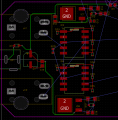
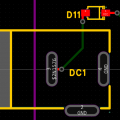
So I'm a rookie when it comes to SMDA. I'm assuming, if there's a power plane, that I manually create vias for each thing that needs to get to that plane?!? Like this? Green trace is Inner2. Red is Top layer with SMD components.

And then notice between C11 and C12 I just connected on the top. Is it really important to create 2 more via's to put that short section on the Inner2 layer? And then the grounds for C11, C12, should I have separate vias for them?

I'm just here to learn... tell me what's the best practice for stuff like this. Thanks!

1758045477100.png
 

ronsimpson

Joined Oct 7, 2019
4,645
With in reason VIAs cost nothing. Use as many as you want.
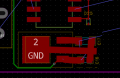
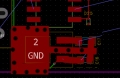
IC8 is a linear regulator. I would move C16 so it's pads line up with IC8's pads. Draw a thick trace from C16 to IC8. Same thing with C17. I try to connect C15 and C17 from pin to pin on the IC. (all ICs) I do not like using VIAs to connect. Some people will VIA the ground end of C16 and VIA IC8-pin2 and connect all together on a internal layer. I want to make a short connection. Then connect somewhere to ground plane. Maybe put several VIAs in the trace from IC8-2 to C16 & C17.

1758046587960.png
IC8 might need a heatsink. That is done by increasing the copper. You can put in a small area fill of GND on the top side. This will run at a lower temp.
1758046958983.png
 

ronsimpson

Joined Oct 7, 2019
4,645
Don't be scared in wide traces. As wide as the pad then connect to. For power use wide traces. I don't care about signal traces.
If a part has power in it, use wide traces to pull heat out of the part.
 

ronsimpson

Joined Oct 7, 2019
4,645
So on the inner power layer, do I put a ground plane?
You can put in planes on any layer. They can be any net. They can fill the entire board or just an area.
examples:
I might have a power plane where there is a 5V area, 3.3V area and 1.8V area. Then there might be a signal trace in there that I just could not get connected another way.
I have made audio amplifiers with many inputs that must not cross talk. The GND covers the entire board but there are slits in the plane so (input amp-1) sits on its ground and (input amp-2) sits on its ground, etc. Then all the grounds are tied together back in the center of the board.

I am probably saying too much, I just want to say you can do what you want. Just have a reason for what you do. If you error, make the GND too strong. No one has ever said "I wish I would have not connected the grounds together less."
 

Thread Starter

rpschultz

Joined Nov 23, 2022
808
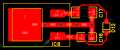
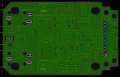
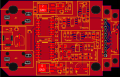
OK. So here's the inner power layer (green), with a ground plane. 2nd picture shows the 4 different voltage regions on the top. I am a novice in this area, but I don't have a good reason NOT to have a GP everywhere.

1758204446936.png

1758204575336.png
 

Thread Starter

rpschultz

Joined Nov 23, 2022
808
That article has an interesting distinction between AC and DC, saying anything below 1 Mhz is DC and above is AC. If that's the case, all audio is DC from a PCB perspective. Even though the human ear can hear up to nearly 20 Hz, practically speaking most audio is well below 10 khz. Highest note on a piano is ~4khz.

This article discusses SIG/PWR/GND/SIG, which for most audio seems appropriate.
Two Alternative 4 Layer PCB Stackups With 50 Ohms Impedance | Blog | Altium
 
Top