If there are multiple receivers they cannot all have one side at a common ground. The receivers need to be isolated from the source and each other to work in all all configurations.
Don't understand the question.
What is "recreation"?
Need to know the signal characteristics.
What is generating the the 4-20mA signal and how is it referenced to the circuit ground?
My circuit shows it going to ground through U2 and R5.
If that doesn't work, then it likely will need some modification.
Edit: It's okay to talk about a 4-20mA signal in the abstract, but to actually detect and use the signal, you need to know how it is generated and related to the local circuit common.
Apologies, working with these analog signals is new to me. The signal will be created by the transmitter on the the valve, which as far as I know shares a common ground with the 24VDC supply elsewhere throughout the circuit. In terms of the generation of the signal I've attached a link to the PDF for clarification,
hi mcox.
My concern if you add a resistive parallel load, to sample the load for your device, you may affect the calibration of the 'down stream' equipment which most likely has a parallel load. May require re-calibration checking and correction.
E
hi mcox.
My concern if you add a resistive parallel load, to sample the load for your device, you may affect the calibration of the 'down stream' equipment which most likely has a parallel load. May require re-calibration checking and correction.
E
Okay I am following I think, because the current source is constant the varying load on my end to calibrate our 1.5V at the programming resistor will change the voltage drop on their end. Have I understood that correctly?
because the current source is constant the varying load on my end to calibrate our 1.5V at the programming resistor will change the voltage drop on their end. Have I understood that correctly?
Basically.
It depends upon the load the other receiver is using.
It would appear then, that the signal needs to be detected for my circuit with a floating (high-side or differential) current detector, not a resistor to ground.
Yes, given the unknown load/voltage that the 4-20mA signal will see from the other receiver, a hall-effect device, such as this, may be needed, to allow measuring the current without adversely affecting the signal.
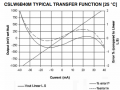
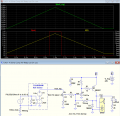
The output of that device is about 500mV above/below it's nominal 2.5V quiescent null output with 20mA current (below), so that could be used to trigger a comparator circuit driving a relay. (Example using my modified circuit below):
Note that the Hall device needs a 5-10V DC supply for operation. That could be generated by a 7805 regulator (or other such as an LM317) from the 24V supply.
Yes, given the unknown load/voltage that the 4-20mA signal will see from the other receiver, a hall-effect device, such as this, may be needed, to allow measuring the current without adversely affecting the signal.
The output of that device is about 200mV above/below it's nominal 2.5V quiescent null output with 20mA current (below), so that could be used to trigger a comparator circuit driving a relay. (Example using my modified circuit below):
Note that the Hall device needs a 5-10V DC supply for operation. That could be generated by a 7805 regulator (or other such as an LM317) from the 24V supply.
That device (post #29) is for detecting a magnetic field.
That would need an added coil to carry the signal current and generate the needed magnetic field level, and then calibrated to switch at the desired low signal current level, so I am not proposing to use that.
The Hall effect device I referenced, and emulated in my schematic, includes the needed coil and is designed to detect that low signal current.
I explained how that device needs to be powered in my post.
If you want to use eric's proposed device (which is conceptually simple since it's a switch) then he (or someone else) will need to help you with that.
My magnetic field knowledge is meager at best, and determination of the coil design needed to control that Hall device is beyond my pay grade.
Perhaps some small electromagnet coil would work, but I don't know.
That device (post #29) is for detecting magnetic fields, which would need an added magnetic coil to carry the signal current and generate the needed magnetic field level, and then mechanically calibrated (by moving the device in the coil field) to switch at the desired low signal current level, so I am not proposing to use that.
The Hall effect device I referenced, and emulated in my schematic, includes the needed coil and is designed to detect that low signal current.
I explained how that device needs to be powered in my post.
If you want to use eric's proposed device (which is conceptually simple since it's a switch) then he (or someone else) will need to help you with that.
My magnetic field knowledge is meager at best, and determination of the coil design needed to control that Hall device is beyond my pay grade.
Okay yeah sorry, that makes more sense. I was staring at that pinout for longer than Id like to admit. Okay I will do some reading into the device you shared. Thank you again

 Facebook
 Google
 GitHub
 Linkedin