Design for a current source for transducers with 0/4-20mA output.

Thread Starter

Raj Iyer

Joined Jan 6, 2022
7
Here's a design that works, using LM324/LM358 Op-Amps for converting a 0-10V input signal to a 4-20 or 0-20mA output. This is based on the classic Howland-current pump scheme.

This is powered at 24V. The Op-Amp used is the LM358. It has also been tested using the LM324 which has 4 Op-Amps. The first Op-amp from the left is used to create an offset for the 4-20 mA option. The 2nd Op-Amp is the Howland pump, which is a differential amplifier that uses a measuring resistor. This design is available at the TI-forums and is largely unchanged excepting for the 3rd amplifier which provides a 0-20V output for driving a small cheap voltmeter module.

In the first stage, a 5V reference voltage is split using a resistance voltage divider to convert the 0-10V input to a corresponding 2-10V output. Next this signal is taken as an input to the Howland pump where the Op-Amp's feedback voltage at its -ve input tries to match the input voltage. This is basically the voltage drop in the measuring resistance of 500 Ohms. Finally, the 3rd stage is a differential amplifier that magnifies the voltage across the measuring resistance to double its value for display on a voltmeter.
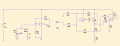


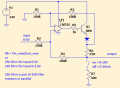
Current-Source circuit.png
 

ericgibbs

Joined Jan 29, 2010
21,390
Hi Raj,
I guess you know that AAC has a Blog section for working projects?

By adding it to a Blog your projects will not be 'buried' in future daily posting traffic, also you will be able to add/update to them as you require.

E
 

Thread Starter

Raj Iyer

Joined Jan 6, 2022
7
Hi Raj,
I guess you know that AAC has a Blog section for working projects?

By adding it to a Blog your projects will not be 'buried' in future daily posting traffic, also you will be able to add/update to them as you require.

E
Thanks Eric. I didn't know that. Today, I have posted one more working circuit on the blog section. There's this "Blog Entry" thing that I haven't fully understood though. Appreciate your suggestions.
 

MisterBill2

Joined Jan 23, 2018
27,164
Usually, for industrial instrumentation applications, that 4-20mA current is converted into a 1-5 DC voltage at the instrument end oof the loop, using a 200.0 ohm resistor. That is a low enough impedance loop to avoid much noise pickup, AND it allows for connecting other instruments in series when that is required.
The very handy secondary benefit is that at the "zero" end of the scale the signal is large enough to make verifying the connection simple. With a voltage loop it can be confusing to see the difference between "Zero" and nothing, when the connection iis failed.
 
Last edited:

panic mode

Joined Oct 10, 2011
4,864
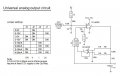
a while ago i stumbled upon this circuit, not sure where.
i tried it and it works pretty well but it needs either rail-to-rail OpAmp or negative supply to actually reach 0V if configured for voltage range.Universal Analog output.jpg
 
Last edited:

AnalogKid

Joined Aug 1, 2013
12,043
The LM358 (and LM324) output stage was way better than its peers at driving a low output voltage very near its negative rail. It did this to be TTL compatible, all the rage at the time. In this circuit it can actually deliver only two of the eight output ranges in the table, 1-5 V and 2-10 V. It cannot go down to 0 V for the other two voltage outputs. For this same reason, it cannot drive the loop down to 0 mA.

The two non-zero minimum current outputs are dependent on the load impedance. For a 1 V output (not unreasonable at 20 mA), the minimum load impedance (including loop wiring resistance) is 50 ohms. Below this, the opamp cannot drive the load correctly.

Disclosure - I've done very little 4-20 mA stuff in the past, and have no real feel for "typical" loop impedances in industry.

Note - Burr-Brown (now a part of TI) makes single-chip 4-20 mA drivers and receivers.

ak
 

MisterBill2

Joined Jan 23, 2018
27,164
My experiences with the application of 4-20 Ma loops has been thatseveral things are important: First, adequate voltage margin matters, second, that adequate isolation from other circuits is vital, and third, that a low level of supply noise is important.
As a matter of course, I only chose transducers with current outputs when the connection distance demanded using a current loop. I NEVER added a current loop output to voltage output transducers! Since both types of transducer outputs were available it simply did not make any sense to add conversion circuits! At least for industrial systems it never made any sense, since both reliability and accuracy were, and still are, always the primary requirements for industrial systems. Hobby level experimentation may be different.
 
Top