4-20ma trigger circuit

Thread Starter

mcox1990

Joined Jul 14, 2023
18
Hello all,

I have an integration question. I'm working within an explosion proof enclosure with very limited space (class 1 environment). I have the option to order an indicator on top of an actuator which rotates with the valve, and outputs a 4-20ma signal depending on the valve position. Here's my inquiry:

I'm looking to control 24VDC relay with the 4-20ma signal and be able to adjust when it is triggered.

ex. A tech working on the valve control system is able to adjust the bias (on say a comparator circuit) so that the 18mA output position triggers the 24VDC relay to be powered, which in turn drives a motor contactor coil to disconnect motor power.

What sort of IC (if available) is capable of this and what would this circuit look like roughly. Also any considerations I might not be aware of.

Very much appreciate the advice

Michael
 

sghioto

Joined Dec 31, 2017
8,633
so that the 18mA output position triggers the 24VDC relay to be powered,
If the current drops below 18ma after the relay is activated should the relay drop out?
Is this 24 volt supply also powering the indicator that puts out the 4-20 ma signal?
 
Last edited:

Reloadron

Joined Jan 15, 2015
7,852
The way this is normally done is using a comparator. You have a 4 to 20 mA loop so placing a resistor in your current loop you get a voltage. Common is a 250 ohm or 500 ohm 1% resistor which will yield 1 to 5 volts or 2 to 10 volts respectively. That voltage is fed into a comparator with a set point level to change states.
What sort of IC (if available) is capable of this and what would this circuit look like roughly. Also any considerations I might not be aware of.
A very common IC would be a LM339 which is a comparator IC. A Google of LM339 comparator circuits should get you some examples. Use the comparator out to drive a MOSFET to drive your relay coil. If you have a link to your relay a circuit can be drawn up.

Ron
 

Jon Chandler

Joined Jun 12, 2008
1,560
Is the comparator, pot and relay outside the haradous area? If not, the pot and relay are problematic. The relay opening or closing could create enough of a spark to generate a problem, as could opening the explosion-proof enclosure to adjust the pot.
 

Thread Starter

mcox1990

Joined Jul 14, 2023
18
If the current drops below 18ma after the relay is activated should the relay drop out?
Is this 24 volt supply also powering the indicator that puts out the 4-20 ma signal?
It is okay if it drops out after it triggers, actually it is favourable because it should just break the latching circuit. So a schmitt trigger or one shot of some kind would work
 

Thread Starter

mcox1990

Joined Jul 14, 2023
18
Is the comparator, pot and relay outside the haradous area? If not, the pot and relay are problematic. The relay opening or closing could create enough of a spark to generate a problem, as could opening the explosion-proof enclosure to adjust the pot.
That is a good point, but ideally we can set the pot without the power on, this would also need to stay in position during vibration of the pipeline. The more i think about it, the temperature could be an issue too. These devices could be located about 6 feet from the valve in an IO ex-proof box.
 

Thread Starter

mcox1990

Joined Jul 14, 2023
18
The way this is normally done is using a comparator. You have a 4 to 20 mA loop so placing a resistor in your current loop you get a voltage. Common is a 250 ohm or 500 ohm 1% resistor which will yield 1 to 5 volts or 2 to 10 volts respectively. That voltage is fed into a comparator with a set point level to change states.

A very common IC would be a LM339 which is a comparator IC. A Google of LM339 comparator circuits should get you some examples. Use the comparator out to drive a MOSFET to drive your relay coil. If you have a link to your relay a circuit can be drawn up.

Ron

Great answer, thank you for that information. Are there military grade versions of these components for temperatures below -40 degrees?
 

Reloadron

Joined Jan 15, 2015
7,852
Are there military grade versions of these components for temperatures below -40 degrees?
Well you got me on that note. Retired 10 years ago after 40 plus years of Mil Spec in my life. :)

When we say -40 degrees are we looking at C or F? I am seeing much newer comparator ICs than the old LM339 I mentioned. Texas Instruments does manufacture a LM339- MIL but I am unsure of operating temperature. Downside to this chip is it actually has four comparators on the single 8 pin DIP and you really only need a single. There is the LM393 family which I see the LM2903, LM2903E have an operating range of −40 to +105 degrees C. This becomes a matter of weeding through what is available and will suit your needs.

Ron
 

crutschow

Joined Mar 14, 2008
38,316
You can use a TL431 programmable reference as a comparator, thus eliminating the need for a separate reference and comparator.
It can be purchased in a military grade version that operates from -40°C to +125°C.

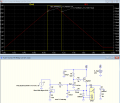
Below is the LTspice sim of an example circuit:

When voltage across pot U2 and R5 from the 4-20mA signal (I1) exceeds the 2.5V TL431 reference voltage, U1 conducts, turning on Q1 and activating the relay.
Pot U2 adjusts the trip point.
R2 and R6 provide a small amount of positive feedback (hysteresis) so the relay doesn't chatter at the trip point.

1689444074969.png
 
Last edited:

Thread Starter

mcox1990

Joined Jul 14, 2023
18
You can use a TL431 programmable reference as a comparator, thus eliminating the need for a separate reference and comparator.
It can be purchased in a military grade version that operates from -40°C to +125°C.

Below is the LTspice sim of an example circuit:

When voltage across pot U2 and R5 from the 4-20mA signal (I1) exceeds the 2.5V TL431 reference voltage, U1 conducts, turning on Q1 and activating the relay.
Pot U2 adjusts the trip point.
R2 and R6 provide a small amount of positive feedback (hysteresis) so the relay doesn't chatter at the trip point.

View attachment 298399
Great I think its worth a shot, maybe I will try to get these components and put it together. If I get to that point I will let you all know how it turns out.

Appreciate all of the information!
 

crutschow

Joined Mar 14, 2008
38,316
Note that the circuit presumes that you can connect the 5-20mA signal to ground through the resistors to get the required 2.5V at the trip point.
Also U3 is a relay with a 24Vdc coil.
 

Thread Starter

mcox1990

Joined Jul 14, 2023
18
Note that the circuit presumes that you can connect the 5-20mA signal to ground through the resistors to get the required 2.5V at the trip point.
Also U3 is a relay with a 24Vdc coil.
Is it okay to do this without an isolator/recreation of the 4-20mA signal? Or would that be dependant on the transmitter supply creating the 4-20mA original signal?
 

crutschow

Joined Mar 14, 2008
38,316
Is it okay to do this without an isolator/recreation of the 4-20mA signal?
Don't understand the question.
What is "recreation"?
Need to know the signal characteristics.
What is generating the the 4-20mA signal and how is it referenced to the circuit ground?

My circuit shows it going to ground through U2 and R5.
If that doesn't work, then it likely will need some modification.

Edit: It's okay to talk about a 4-20mA signal in the abstract, but to actually detect and use the signal, you need to know how it is generated and related to the local circuit common.
 
Last edited:
Top