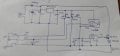
Hello folks, I am a newbie in 4-20ma circuits and passionate in embedded systems design , I really need a help to design the 4-20ma current transmitter . Can you guys please tell me why
"WHY"??? The explanation of "why" 4-20 mA is used is that it is fairly noise resistant, and because the minimum value is not zero, it is possible to verify that the connection is still solid. With any signal format that has "zero" as a valid point, it becomes impossible to detect the difference between zero and nothing.
In addition, for locally powered instrument loops, with 4 mA there is often enough power available to operate the sensor electronics, which reduces the wiring by eliminating a second pair of wires for power.
Also, it is an industrial standard so a great number of sensors etc support it. And it is good for over quite long distances.
I generally set up the ADC that will read it to have a range of 0 to 24mA so as @MisterBill2 mentions, you can test for errors, less than 4mA and greater than 20mA.
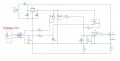
Tomorrow I may try to get a good circuit of what I have posted. It is late here.
From about 7V up, but we made it for 24V. The minimum supply volts will also depend on the load resistor value.
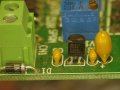
The MIC2950 5V regulator is a pretty good low drop one, a lot better than the old 7085 version.
But it may be obsolete now so look at the MIC2954 version as that is what we ended up using. But it may be that package is no longer in production. I could not find it in the data sheet.
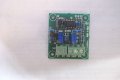
If I was to make more (I have quite a lot of boards in stock) I'd go SMT next time.
Yes, that is so, but these were made for 2 separate jobs that had pots as the variable element, and they have been in service for quite a number of years.
It is just unusual to see it represented like that. Certainly it is a valid scheme, and certainly it works. In this case, it was simply not what I was expecting.
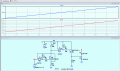
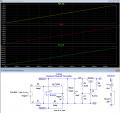
Below is the LTspice sim of a relatively simple 4-20mA receiver-powered (floating) transmitter, using just a single op amp configured as a differential-input Howland type current-pump circuit to generate the current:
The TL431 voltage reference generates a stable, floating 12V supply for the Transmitter circuit using the Receiver power supply.
The TLV9151 is a low-cost CMOS RR op amp with a high output current rating to allow generating the 4-20mA output without a buffer, and with low input offset voltage, bias current, and operating current.
The current gain is Vsignal/Rgain.
The Rgain value shown gives a 4-20mA output (green trace) for a 0-1V Vsignal (yellow trace).
This gives a 1-5V output at the Receiver Rload resistor (red trace).
Vsignal can be from a voltage output sensor, or bridge circuit, powered by the Sensor+ to Sensor- transmitter supply, as long as it takes no more than 2mA power.
The signal common-mode range is from the Out bus to the 12V bus.
Rbias can be adjusted to give the 4mA zero signal current, depending upon the current used by the Vsignal sensor.
The circuit quiescent current is about 2mA.
Rgain and Rbias can be potentiometers to all easy adjustment of gain and offset.

 Facebook
 Google
 GitHub
 Linkedin