24v PSU suddenly outputting 48v?

Thread Starter

Heimerize

Joined Mar 12, 2017
17
Hi all,

Brand new to the forum and from what I've seen, I believe I'm at the right place for this question.

The project I'm working on is a water cooled induction heater for annealing metal. Everything is running(or was) on 24v.

Suddenly today when adding a solenoid for an automated part drop my psu unit seemed to die. I was getting 6v with all attachments connected. After unhooking everything and checking with a meter I'm now showing 48v. My coil heater can handle 48v, but the psu is only rated for 15A. Connecting the coil puts the psu in protect mode, and it goes back down to 6v.

If I unhook the coil, and the psu goes right back to 48v.

Is my unit shot, or is this something I can correct with a new part and a little solder time?

Thanks for any help!
 

recklessrog

Joined May 23, 2013
985
Hi, welcome! We would need some more info such as the details of the power supply, and a schematic of what you were powering when this happened.
 

Thread Starter

Heimerize

Joined Mar 12, 2017
17
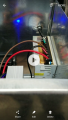
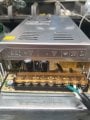
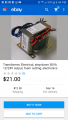
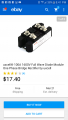
Screenshot_20170312-005549.jpg Screenshot_20170312-005524.jpg Screenshot_20170312-005504.jpg

Also a regular cooling fan. Everything at the time was hooked up direct to the PSU.

Hopefully I've attached these correctly. I also have a video I'll try to attach in my next reply.

Thank you,
 

LesJones

Joined Jan 8, 2017
4,511
You need to provide a full schematic ( As recklessrog has requested.) of the way everything is connected to the power supply together with their current rating. It could be that the addition of the solenoid has exceeded the current rating of the power supply or the back emf when it was disconnected has damaged the power supply. It looks like it is a switched mode power supply from the picture so it will probably be cheaper to buy a new one then trying to repair it. (Unless you have lots of experience repairing switch mode power supplies.)

Les.
 

Thread Starter

Heimerize

Joined Mar 12, 2017
17
I honestly have no idea how a schematic could be more useful than the data I've already provided. Everything has been a direct connection to the psu. Is there an electrical schematic making app I could use?

On the psu:
hot/neutral/gnd/v-/v-/v-/v+/v+/v+

3 items connected directly to each available v+ and v- on the psu. Psu was wired direct to the plug and I was using a surge protector as the switch to turn the assembly on and off.

The solenoid was just jumpered temporarily, and I never actually made the circuit complete because I noticed something was awry when I flipped the switch on.

I'm honestly not sure on the power draws of the pump and fan. Both combined would have to be less than .5A.

The no load draw on the induction driver is 6A at 24v.

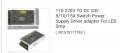
The psu is rated for 24v/15A.

I had nothing loaded in the coil, so it would have been a no load situation.

What has me scratching my head, is that even if there was a short(which I'm sure would have been impossible to miss at 24v!) wouldn't the unit go into protect mode, OR blow the internal fuse?

I've already taken the psu apart and inspected thoroughly, no burns anywhere. Looks and smells brand new.

The unit was cheap, so I suppose at this point I'm mostly curious to know how a 24v PSU can just decide to switch to 48v, without some serious rewiring/rewinding.

I would still be very interested in salvaging this unit if possible, so any useful information on what to check in the pcb would be great.

Thanks again,
 

Thread Starter

Heimerize

Joined Mar 12, 2017
17
Also, it may be worth noting that I have had plenty of "on" time. I let the unit run with load and without for quite some time to gauge how quickly the cooling system heated up and if a fan on the radiator was even necessary. After several minutes of continuous use with and without load the radiator did start to warm up slightly. The heatsink on the induction driver was barely warm to touch, and the psu fan never kicked on - it was room temp.

When this unit is complete it will be running at a 5s on, 2s off, cycle. A fan on the radiator is really/probably not necessary at all, but I felt like tinkering still so I added it.
 

LesJones

Joined Jan 8, 2017
4,511
The current taken by the solenoid would be the same with and without anything inside it. If you measure the resistance of the solenoid we can work out the current it would take with 24 volts across it. You can draw schematics using Eagle software which is free. Most times I want to draw a schematic to post on a forum I just draw it on paper and scan it as a jpg or png file.

Les.
 
Let's say the power supply is toast. What is a possible reason? We don't know your circuit either.

It's possible that the lack of reverse biased diodes on your inductors took out the power supply. It's also possible that the power supply lacks reverse polarity protection (again, a reverse biased diode). It's more likely the latter. Feeding voltages into a power supply that is off will usually kill it. Each of those inductors act like batteries for a very short amount of time.

The current in an inductor can't change instantaneously, so something has to give, The power supply may have to go into current limit.

Another thing to worry about, is that SOME switching power supplies need a minimum load for regulation.

I don;t want to go as far as the 48 V is because of the minimum load requirement and the 6V is the supply going into current limit BECAUSE it should have been apparent earlier.
 

AlbertHall

Joined Jun 4, 2014
12,626
I can't see the markings next to the terminals on the power supply metal case because the wires are in the way. It is just possible that the supply has a remote sensing ability in which case one of the three terminals for each polarity would be a sense terminal. They would be connected to the output terminals by an internal resistor so the output voltage is sensed locally but you could take wires from the sense terminals and connect at the load to use remote sensing. If this is the case, connecting any load directly to the sense terminals will make the power supply very unhappy. Going to a very high voltage would be typical and it may also damage the supply as it is effectively running open loop.

What are the exact markings on the case for the terminals?
 

MaxHeadRoom

Joined Jul 18, 2013
30,680
I am often surprised that most people think they require a SMPS regulated supply for these kind of applications, the linear supply is far more rugged and maybe a little more costly, but very much easier to put together and IF in the eventuality it fails, Very easy to fix.
If a Toroidal transformer is used, it is also very easy to add an overwind for auxiliary voltage etc.
Max.
 
Last edited:

Dodgydave

Joined Jun 22, 2012
11,395
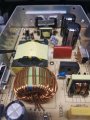
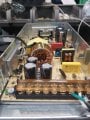
Take the lid off it and post pictures the chips inside, then we can get the datasheet or info from Mr Google......

Most smps units have ovp/uvp protection to shutdown the pwm, it would be cheaper to buy a new one on the Internet than repairing it..
 
Last edited:

Thread Starter

Heimerize

Joined Mar 12, 2017
17
20170312_192242.jpg 20170312_192233.jpg 20170312_192151.jpg

Here are the pics. Max is correct, the unit wasn't expensive. $22 shipped. If it's fixable, fantastic. If not, it's not a big loss.

Mostly I'd like to learn what caused this.

My guess is that wiring the coil driver directly to the PSU was a no-no. I have a relay/timing circuit I will be using, but I figured it was fine for testing during the construction phase. I did read somewhere that loading "slow start" psu's like this with a big load upon power up is not a good thing.

What power supply would you guys recommend? I went this route because it was cheap, had the right specs for amperage, and honestly didn't realize there was a better option/route to go.

Thanks for all the help and knowledge.
 

Thread Starter

Heimerize

Joined Mar 12, 2017
17
Here's a schematic. Hopefully it makes sense. Like stated, everything was individually directly connected to the appropriate terminals on the psu.

I was in the process of connecting the solenoid to test it's function for a door it would actuate. I used a wing nut to connect the - temporarily, and had planned to just touch the 2 +'s together by hand to close the circuit.

When I flipped the switch I noticed my cooling pump didn't turn on, so that was as far as I got.

No sparks or smokeshow, unfortunately.

This is what has me thinking it was the direct connection to the coil driver that did something here.

Thanks again,20170312_194259.jpg
 
Top