Facebook
 Google
 GitHub
 Linkedin

Hello mister Steven ! Nice to see you.I give up, what did you do?
And thank you all for your guesses.
Well, it is very simple. We must keep in mind these are not the "old GaAs" type of leds that we are used from the books and the 80's and 90's commercial market, but they are the new GaN technology. This thing I remember all the time, no problem. What I forget is that they are running at extremly low currents at a very hight brightness. So putting 10k was too high current - for THEM, not for the theory. And It did indeed blow up not one 10k but 3x30k in paralel and also 3x3k in series. The series didnt blow up as FAST as the paralel ones, but they were getting extra hot. I tested every thing was said here. (almost and in reason).
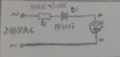
So, the actual circuit is like this:
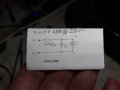
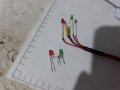
Where the resistor must have a very high value, D1 can be any rectifier diode with reverse voltage bigger than 300V I guess, and the led must be the newer GaN types (not the older GaAs), which work at incredible low currents I was very lucky to grab them, guess from where... mister ebay. Yes, they have wonderful things there, like gold in the mud, if you look closely. I was lucky I guess. I did get SMD 1206, 0806,0603,0402 LEDs in the same GaN technology. I guess its in the same ballpark by my EYE-ometer, since they all are pretty much the same brightness that is blinding if you stare 2 seconds in them with your naked and virgin eye.
Here you can actually read that resistor value of 100k.
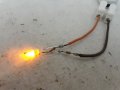
Though in my final circuit I used a much higher resistor, in an attempt to lower the temperature down.
Remember (probably) that I have an interesting tool in my arsenal, " The Digital Thermometer". And I probe the resistor and the pin of the led. I was amazed that the very base of the led on the leg going down toward resistor, was hotter than the resistor. Very interesting detail that I was not really aware. Also if you drag the pin too much, force him, it will rip off from its plastic case, that is very fragile contact in there. I managed to rip one off and if I touch its pin, bring it back to its position, is working as a normal led again, but if Ilet its pin untouched, he dies back. Aaah. I have 100 of them so I dont have problem.
Today I managed to burn 4 leds, aaah. And 1 I broke its pin. So 5 damaged.
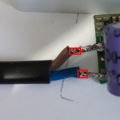
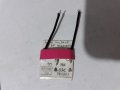
Here is the actual and final circuit on the same input 240V wires as planned in the start:
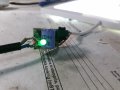

Sorry for the long time delay until I responded (thats why I inaugurated the guess game, haha), but I had to also take some temperature measurements on the resistor itself, exactly in this circuit you see in the picture. Man, how much I stressed those 2 contacts on that green board...ohoa. But I am happy with the results.
Resistor Value Temperature in dgr Celsius (not Fahrenhight)
100k ~90*C
120k ~70*C
220k ~60*C
And the final resistor I used was the 220K.
Pretty much that's it.
I was curious what's the calculation saying for my last values I used here.
V=240V, R=220000R (220k), results I=0.00109 and P=0.261
Hmmm, not quite 1/4 (or 0.250W) for the resistor, but at around 60*C on the resistor, I think is a acceptable heat. I have the same circuit using 100k (at 90*C) running for years. Heh. I'm glad I can measure the temperature now,although a bit inconfortable to use its probe... I dream for a Flir thermocamera...ehee. but not in my life and I know it. Ehhh.
(Editation): Actually its 120V since its half of alternative wave that led is powered. So,
V=120V, R=220000R (220k), results I=0.000545 and P=0.0654
Thats it, thank you all for your help !
Last edited: