Facebook
 Google
 GitHub
 Linkedin

Thank you very much for the explanation!View attachment 279875
When you have 50% duty cycle 4A, it is likely 4A average, 8A peak. So the current is not really reduced.
What happens when you don't have enough drive voltage?
Using the above graph, VGS=1.5V, at near 0A there is near 0VD-S. As you apply more current, the VDS goes up. At about 3A the transistor can not keep "on" and it tears open. The voltage D-S jumps up to 2V at about 3A. Increase the current to 3.01 and it might have your full 24V D-S. This is not a good way to use the transistor.
Look at 20A for a example. AT VGS=1.5 you will never see 20A. At 2V Gate you will have 0.5V VDS. At 2.5V Gate you will have 0.3 VDS. Above 2.5V there is little advantage of more Gate Drive at 20A.
I attach a picture in which I separate the two cases (PWM=100% and PWM=50%) and ask you to confirm if I have found/used Vds, Ids and Vgs correctly.
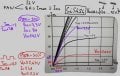
If I had proceeded correctly in the attached photo ... I would have in both cases (pwm=100% and pwm=50%) a Vds of about 0.2V (or perhaps 0.3V).
What does this imply?
Having a 24V fan on the drain and being 24V<Vds(max)=30V using SiS414DN I think the fan turns on normally.
Am I wrong?
Thanks again for the clarification