2 MOSFETs Switch application

Thread Starter

kalemaxon89

Joined Oct 12, 2022
389
View attachment 279875
When you have 50% duty cycle 4A, it is likely 4A average, 8A peak. So the current is not really reduced.
What happens when you don't have enough drive voltage?
Using the above graph, VGS=1.5V, at near 0A there is near 0VD-S. As you apply more current, the VDS goes up. At about 3A the transistor can not keep "on" and it tears open. The voltage D-S jumps up to 2V at about 3A. Increase the current to 3.01 and it might have your full 24V D-S. This is not a good way to use the transistor.

Look at 20A for a example. AT VGS=1.5 you will never see 20A. At 2V Gate you will have 0.5V VDS. At 2.5V Gate you will have 0.3 VDS. Above 2.5V there is little advantage of more Gate Drive at 20A.
Thank you very much for the explanation!

I attach a picture in which I separate the two cases (PWM=100% and PWM=50%) and ask you to confirm if I have found/used Vds, Ids and Vgs correctly.
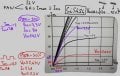
SmartSelect_20221105_163456_Samsung Notes.jpg

If I had proceeded correctly in the attached photo ... I would have in both cases (pwm=100% and pwm=50%) a Vds of about 0.2V (or perhaps 0.3V).
What does this imply?

Having a 24V fan on the drain and being 24V<Vds(max)=30V using SiS414DN I think the fan turns on normally.
Am I wrong?

Thanks again for the clarification
 

Ian0

Joined Aug 7, 2020
13,131
Yes, you are absolutely correct - the average Vgs is 1.65V, but it is a completely pointless piece of information.
The average drain current is not remotely related to the average gate voltage.
The average drain current is the average of the drain current at Vgs=0 and the drain current at Vgs=3.3V. As Ids=0 for Vgs=0, then the average drain current is half the drain current at Vgs=3.3V.
 

Thread Starter

kalemaxon89

Joined Oct 12, 2022
389
Yes, you are absolutely correct - the average Vgs is 1.65V, but it is a completely pointless piece of information.
The average drain current is not remotely related to the average gate voltage.
The average drain current is the average of the drain current at Vgs=0 and the drain current at Vgs=3.3V. As Ids=0 for Vgs=0, then the average drain current is half the drain current at Vgs=3.3V.
So it is wrong to proceed as I did in post #21 where I find Vds using average Vgs (i.e. 1.65V).
Having never used mosfets in the past, I am confused by the question of drain current.
The fan (connected on one side to 24V on the other side to the drain) consumes/needs a current Ids to work .. and it will run faster or slower depending on how much current I give it.
How do I find this Id current?
Using PWM on Vgs I proceed as you indicated:
Ids(average) = [Ids(Vgs=0)+Ids(Vgs=3.3V)] / 2 with:
Ids(Vgs=0) = 0A
Ids(at Vgs=3.3V)=8A ??
(because the mosfet is a "closed" switch and it conducts .. Vgs>Vgs(th))

If this formula/proceedings is correct ... how does Ids vary for example with PWM=20% .. or PWM=70% ?
Does the formula Ids(average) change?
 
Last edited:

Sensacell

Joined Jun 19, 2012
3,785
So it is wrong to proceed as I did in post #21 where I find Vds using average Vgs (i.e. 1.65V).
Having never used mosfets in the past, I am confused by the question of drain current.
The fan (connected on one side to 24V on the other side to the drain) consumes/needs a current Ids to work .. and it will run faster or slower depending on how much current I give it.
How do I find this Id current?
Using PWM on Vgs I proceed as you indicated:
Ids(average) = [Ids(Vgs=0)+Ids(Vgs=3.3V)] / 2 with:
Ids(Vgs=0) = 0A
Ids(at Vgs=3.3V)=8A ??
(because the mosfet is a "closed" switch and it conducts .. Vgs>Vgs(th))

If this formula/proceedings is correct ... how does Ids vary for example with PWM=20% .. or PWM=70% ?
Does the formula Ids(average) change?
Think of it this way- plain and simple:

Use a Vgs value high enough that the FET is fully ON when the PWM output is high - and then FORGET ABOUT IT.

Now assume that the FET just goes from full on to full off. (no in-between, just rapidly switching)
The AVERAGE current is I max (fully on value) X duty cycle.
If the fan draws 1 amp, and the duty cycle is 20%, the AVERAGE current is then about 200 mA.

If you measure the current through the FET it's either 0 or I max, depending the PWM output state.
The fan changes speed slowly, it will average out these pulses to approx 20% speed, assuming the PWM frequency is way faster than the time it takes the motor to change speed.

If the PWM frequency was slowed wayyyyy down, you would just see the fan turning on 100% and then off, at the PWM frequency.
 

Ian0

Joined Aug 7, 2020
13,131
So it is wrong to proceed as I did in post #21 where I find Vds using average Vgs (i.e. 1.65V).
Yes - the gate voltage is never at this value.

The drain current is determined by the load. It is the normal running current of the fan. Did you say it was 74mA?

Then find Vds for the values you have of Vgs (3.3V) and Id.
You then know the voltage drop of the MOSFET. It should be insignificant compared to the fan's operating voltage.
Having found Vds, multiply it by Id.
That give the amount of power that the MOSFET will dissipate. For a TO220 MOSFET, if it is <1W it will manage without a heatsink. If it is >1W you will need to add a heatsink, or use a bigger MOSFET, or two MOSFETs in parallel.

You will then have worked out the worst case power dissipation, for 100% duty cycle, and from that you will know that any other duty cycle will result in less power being dissipated by the MOSFET.
 

Thread Starter

kalemaxon89

Joined Oct 12, 2022
389
Think of it this way- plain and simple:

Use a Vgs value high enough that the FET is fully ON when the PWM output is high - and then FORGET ABOUT IT.

Now assume that the FET just goes from full on to full off. (no in-between, just rapidly switching)
The AVERAGE current is I max (fully on value) X duty cycle.
If the fan draws 1 amp, and the duty cycle is 20%, the AVERAGE current is then about 200 mA.

If you measure the current through the FET it's either 0 or I max, depending the PWM output state.
The fan changes speed slowly, it will average out these pulses to approx 20% speed, assuming the PWM frequency is way faster than the time it takes the motor to change speed.

If the PWM frequency was slowed wayyyyy down, you would just see the fan turning on 100% and then off, at the PWM frequency.
Yes - the gate voltage is never at this value.

The drain current is determined by the load. It is the normal running current of the fan. Did you say it was 74mA?

Then find Vds for the values you have of Vgs (3.3V) and Id.
You then know the voltage drop of the MOSFET. It should be insignificant compared to the fan's operating voltage.
Having found Vds, multiply it by Id.
That give the amount of power that the MOSFET will dissipate. For a TO220 MOSFET, if it is <1W it will manage without a heatsink. If it is >1W you will need to add a heatsink, or use a bigger MOSFET, or two MOSFETs in parallel.

You will then have worked out the worst case power dissipation, for 100% duty cycle, and from that you will know that any other duty cycle will result in less power being dissipated by the MOSFET.
Think of it this way- plain and simple:

Use a Vgs value high enough that the FET is fully ON when the PWM output is high - and then FORGET ABOUT IT.

Now assume that the FET just goes from full on to full off. (no in-between, just rapidly switching)
The AVERAGE current is I max (fully on value) X duty cycle.
If the fan draws 1 amp, and the duty cycle is 20%, the AVERAGE current is then about 200 mA.

If you measure the current through the FET it's either 0 or I max, depending the PWM output state.
The fan changes speed slowly, it will average out these pulses to approx 20% speed, assuming the PWM frequency is way faster than the time it takes the motor to change speed.

If the PWM frequency was slowed wayyyyy down, you would just see the fan turning on 100% and then off, at the PWM frequency.
Yes - the gate voltage is never at this value.

The drain current is determined by the load. It is the normal running current of the fan. Did you say it was 74mA?

Then find Vds for the values you have of Vgs (3.3V) and Id.
You then know the voltage drop of the MOSFET. It should be insignificant compared to the fan's operating voltage.
Having found Vds, multiply it by Id.
That give the amount of power that the MOSFET will dissipate. For a TO220 MOSFET, if it is <1W it will manage without a heatsink. If it is >1W you will need to add a heatsink, or use a bigger MOSFET, or two MOSFETs in parallel.

You will then have worked out the worst case power dissipation, for 100% duty cycle, and from that you will know that any other duty cycle will result in less power being dissipated by the MOSFET.
Thanks!! Everything is now much clearer.

So with an 8A 24V fan, Vgs=[0 .. 3.3V] PWM and assuming working at Ta=25°C ... I looked at the datasheet of the SIS414 mosfet and found in the graph Vds=0.2V<<24V fan.
In the worst case Pdiss=Ifan*Vds=8*0.2=1.6W.
Also I see that 1.6W<Pdiss(max)=3.4W when Ta=25°C so I should have no problem
Can you confirm that these calculations are correct?

There is one complication: I could reach Ta=70°C (room temperature).
I note that the calculations I did to find Vds and Pdiss=1.6W I did by looking at the "Output Characteristics" graph (the one also attached a few posts ago) .. and it is valid with T=25°C.
So I still ask you to guide me to redo the calculation I just did considering Ta=70°C.
I'm in trouble because I see so many graphs containing temperature and it's confusing.
The first thing that comes to my mind is to calculate the power dissipated as Rds(70°C)*Ids^2 .. what would you do?
 

Ian0

Joined Aug 7, 2020
13,131
You're heading into the realms of guesswork!
You are not far from the straight line that represents Vds/Ids=Rds(on), so using the Rds(70°C)*Ids^2 is a pretty good idea.
Rds(on) increases with temperature, but Vgs(th) decreases, so you are likely to be closer to the Rds line than you were before, but that line has got less steep with increasing temperature.
At this point, I'd build it, trying to maximise the amount of copper I can connect the drain, and putting some vias through to an area of copper on the other side of the board. When I've built it, I'd measure the temperature whilst it is running at full power, and try to estimate from that the temperature it would reach in the worst case ambient temperature.
Prototype pcbs are quick and cheap these days!
 

Irving

Joined Jan 30, 2016
5,119
Thanks!! Everything is now much clearer.

So with an 8A 24V fan, Vgs=[0 .. 3.3V] PWM and assuming working at Ta=25°C ... I looked at the datasheet of the SIS414 mosfet and found in the graph Vds=0.2V<<24V fan.
In the worst case Pdiss=Ifan*Vds=8*0.2=1.6W.
Also I see that 1.6W<Pdiss(max)=3.4W when Ta=25°C so I should have no problem
Can you confirm that these calculations are correct?

There is one complication: I could reach Ta=70°C (room temperature).
I note that the calculations I did to find Vds and Pdiss=1.6W I did by looking at the "Output Characteristics" graph (the one also attached a few posts ago) .. and it is valid with T=25°C.
So I still ask you to guide me to redo the calculation I just did considering Ta=70°C.
I'm in trouble because I see so many graphs containing temperature and it's confusing.
The first thing that comes to my mind is to calculate the power dissipated as Rds(70°C)*Ids^2 .. what would you do?
Since Vds at a given Vgs and Id is not definitive,

\( P_d = R_{ds} * I{d}^2 \)​

is the preferable approach.

1667757845883.png

Using the above, the junction temperature is given by

\( T_{junc} = P_d * R_{thJA} +T_{amb} \)​
and
\( T_{case} = T_{junc} - P_d * R_{thJC} \)​
assuming 1" x1" of copper attached to tab & pin 2, or

\( T_{junc} = 1.6 * 36 +30 = 87.6°C \)​

and

\( T_{case} = 87.6 -1.6 * 3.3 = 82.3°C \)​
As @Ian0 suggests, you'd want to maximise the copper attached to the tab. One way to do that is to have a copper pour both sides of the board and some thermal vias between them. However, in some cases a TO-220 package with a small clip-on heatsink can be preferable in terms of board area.
 
Last edited:

Thread Starter

kalemaxon89

Joined Oct 12, 2022
389
You're heading into the realms of guesswork!
You are not far from the straight line that represents Vds/Ids=Rds(on), so using the Rds(70°C)*Ids^2 is a pretty good idea.
Rds(on) increases with temperature, but Vgs(th) decreases, so you are likely to be closer to the Rds line than you were before, but that line has got less steep with increasing temperature.
At this point, I'd build it, trying to maximise the amount of copper I can connect the drain, and putting some vias through to an area of copper on the other side of the board. When I've built it, I'd measure the temperature whilst it is running at full power, and try to estimate from that the temperature it would reach in the worst case ambient temperature.
Prototype pcbs are quick and cheap these days!
Considering Ta=25°C:
in the Id-Rds(on) graph I notice that with 8A and Vgs=3.3V I should have an Rds=0.015ohm .. so Pdiss=0.015*64=0.96W which is almost half the power calculated using Vds*Ids :/
Is this difference normal? Or did I get the parameters wrong from the graphs?

Infact, if I have calculated correctly (in post #29) Pdiss=Vds*Ids .. then I end up with a Rds=Vd/Ids=0.025ohm which is very different from the 0.015ohm I just found in the "On-Resistance vs. Drain Current and Gate Voltage" graph
 

Thread Starter

kalemaxon89

Joined Oct 12, 2022
389
Since Vds at a given Vgs and Id is not definitive,

\( P_d = R_{ds} * I{d}^2 \)​

is the preferable approach.

View attachment 280090

Using the above, the junction temperature is given by

\( T_{junc} = P_d * R_{thJA} +T_{amb} \)​
and
\( T_{case} = T_{junc} - P_d * R_{thJC} \)​
assuming 1" x1" of copper attached to tab & pin 2, or

\( T_{junc} = 1.6 * 36 +30 = 87.6°C \)​

and

\( T_{case} = 87.6 -1.6 * 3.3 = 82.3°C \)​
As @Ian0 suggests, you'd want to maximise the copper attached to the tab. One way to do that is to have a copper pour both sides of the board and some thermal vias between them. However, in some cases a TO-220 package with a small clip-on heatsink can be preferable in terms of board area.
Since Vds at a given Vgs and Id is not definitive,

\( P_d = R_{ds} * I{d}^2 \)​

is the preferable approach.

View attachment 280090

Using the above, the junction temperature is given by

\( T_{junc} = P_d * R_{thJA} +T_{amb} \)​
and
\( T_{case} = T_{junc} - P_d * R_{thJC} \)​
assuming 1" x1" of copper attached to tab & pin 2, or

\( T_{junc} = 1.6 * 36 +30 = 87.6°C \)​

and

\( T_{case} = 87.6 -1.6 * 3.3 = 82.3°C \)​
As @Ian0 suggests, you'd want to maximise the copper attached to the tab. One way to do that is to have a copper pour both sides of the board and some thermal vias between them. However, in some cases a TO-220 package with a small clip-on heatsink can be preferable in terms of board area.
Why did you use Rth(JC)=3.3 ohms and not 4 ohms when calculating Tcase?

I did the calculations using Tamb=70°C and found:
Tjunc=127.6 °C
Tcase=122.3 °C

Not having worked with mosfets, I don't know whether these temperatures I have found are high, low, normal, etc.
So I'm looking on the datasheet to see if it says what Tjunc(max) and Tcase(max) are .. so I can compare them with the ones I found.
(obviously I know that you have to work at low temperatures and that it's not recommended to just find lower values than the maximum ones given in the manual .. but my purpose now is mainly to understand how to read the datasheet)

I found:
"Operating Junction and Storage Temperature Range" = [-55..150]°C .. and several times values are given as a function of Tj=150°C .. so I assume that's the maximum value of Tj (?)

As for Tcase ... I don't know. I have the "Power, Junction-to-Case" graph that goes up to 150°C :/
 

Irving

Joined Jan 30, 2016
5,119
Why did you use Rth(JC)=3.3 ohms and not 4 ohms when calculating Tcase?

I did the calculations using Tamb=70°C and found:
Tjunc=127.6 °C
Tcase=122.3 °C

Not having worked with mosfets, I don't know whether these temperatures I have found are high, low, normal, etc.
So I'm looking on the datasheet to see if it says what Tjunc(max) and Tcase(max) are .. so I can compare them with the ones I found.
(obviously I know that you have to work at low temperatures and that it's not recommended to just find lower values than the maximum ones given in the manual .. but my purpose now is mainly to understand how to read the datasheet)

I found:
"Operating Junction and Storage Temperature Range" = [-55..150]°C .. and several times values are given as a function of Tj=150°C .. so I assume that's the maximum value of Tj (?)

As for Tcase ... I don't know. I have the "Power, Junction-to-Case" graph that goes up to 150°C :/
Ambient of 70C would be pretty unusual, do you seriously expect that? Even so, junction temperatures of 127C are still in spec, just! I generally use 130C as a working limit for Tj(max) of 150C.

I used 3.3 as that gives a higher case temp than 4.0, so arguably more realistic. Having said that, the thermal calcs for SMD are much trickier than thru-hole.. Validating whether you have a meaningful 1" x 1" patch of PCB allowing for all other parts around it, board orientation, air flows, etc. is hard. I've used CHT simulations to assess whether forced cooling is needed in the past. The datasheet caveat: "Note: The channel-to-ambient thermal resistance, Rth(ch-a), and the drain power dissipation, PD, vary according to the board material, board area, board thickness and pad area. When using this device, be sure to take heat dissipation fully into account." is a bit of a joke really as these can be very intangible. Being generous on PCB area is counter-intuitive to SMD design and SMD thrmal design is a bit of a black art...

 
Top