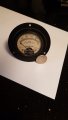
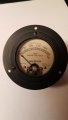
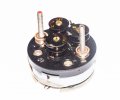
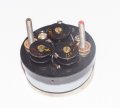
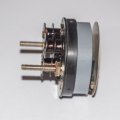
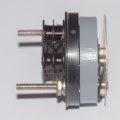
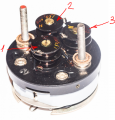
I agree with Bob. It looks as though the meter could be disassembled by removing the two terminal nuts and 3(?) small screws (which may be behind plastic caps).
Yes, the circuit is non-isolated and the voltage is high, THEREFORE it will need to be enclosed in an insulated enclosure, AND the wires to the meter, along with the connections, will also need to be enclosed or very well insulated. Just because careless working with the circuit can be dangerous does not mean that it can not be used safely. Depending on the form of the meter, and how much is visible, it might even work to put the whole circuit on the back of the meter housing.
And, to open the meter case leave the terminals alone, and instead remove the three or 4 flat-head screws that go thru the side of the cylinder just a bit below the back piece. Undoing the terminals will allow the insides to flop around in the case, abd be damaged.
Why is anyone here encouraging this person to build a dangerous non-isolated 400V supply to accomplish something that can be done with a 1.5V battery and a resistor?
I agree with Bob. It looks as though the meter could be disassembled by removing the two terminal nuts and 3(?) small screws (which may be behind plastic caps).
If no reistors are seen, then definitely the battery-resistor check is in order, because if the meter is not working then it become a very simple matter of using the zero-set springs to make the pointer show whatever is wanted, no electrical connections required.
OK, but the resistor is not easily spotted, if it is a precision resistor then it does not look like a common resistor. Indeed, those 3 spools of resistance wire ARE the resistor, and they do not look at all like common resistor, do they?
It should be possible to connect a common resistor across that precision resistor to set the full scale to 3 volts, and then the 1 1/2 volt battery will show about half scale.
AND there is nothing so very dangerous about a 400 volt supply if the one involved understand what parts are risky and knows what to avoid contacting.
....AND there is nothing so very dangerous about a 400 volt supply if the one involved understand what parts are risky and knows what to avoid contacting.....
Rather easier to connect one resistor of the appropriate value and connect a 5 volt phone charger than to construct a 450v supply I should think. To say nothing of being far safer!
Why is anyone here encouraging this person to build a dangerous non-isolated 400V supply to accomplish something that can be done with a 1.5V battery and a resistor?
Furthermore I can't see any competent teacher requesting such high voltage for a basic test. I'll never understand the allure of "playing with fire". Anything over 10V gives me the willies just thinking about it.
I'm looking for a simple 110vac to ~400vdc conversion circuit. This is for an art project and will only be used to drive a 1000ohm/volt voltmeter. Any help would be most appreciated.
Looks like we've gotten lost on testing the meter and have forgotten the original question (post #1). I'll ask my question again; what is the art project? Why the need for 400VDC?

 Facebook
 Google
 GitHub
 Linkedin