Simple Circuit or device that can identify whether AC input is 110VAC or 220VAC?

Thread Starter

haythamhakla

Joined Apr 10, 2017
14
I'm looking for a simple circuit solution or commercially available device, that can tell if the mains AC voltage input is 110VAC or 220VAC, and trigger a different relay accordingly.
 

LowQCab

Joined Nov 6, 2012
5,101
The best way to do it is by using the appropriate Plugs on the Power-Cord.
Different Voltage Mains-Circuits should always have
incompatible Outlet-Configurations for differing Voltages.
( but maybe they don't in some countries, I don't know )

A somewhat sophisticated Switching-Circuit would be required for Safety,
but what You describe is generally not a good plan.

More detailed information regarding the problem that
You are trying to solve will get You better answers.
.
.
.
 

Thread Starter

haythamhakla

Joined Apr 10, 2017
14
The best way to do it is by using the appropriate Plugs on the Power-Cord.
Different Voltage Mains-Circuits should always have
incompatible Outlet-Configurations for differing Voltages.
( but maybe they don't in some countries, I don't know )

A somewhat sophisticated Switching-Circuit would be required for Safety,
but what You describe is generally not a good plan.

More detailed information regarding the problem that
You are trying to solve will get You better answers.
.
.
.
I have a device that will be travelling internationally , and will be powered either from 110VAC or 220VAC.
I cannot control what voltage feeds the input, and cannot change the plug of the power cord everytime.
What I do need is some sort of international GFCI protection, regardless of the input voltage level.
GFCI's come in either 110VAC or 220VAC ( not both, at least from the research I've done).
So I'm trying to implement a circuit that first detects if the input in 110 or 220, and feeds it to either the 110VAC GFCI or 220VAC GFCI.
I tried to implement this logic using relays with 110VAC and 220 VAC coil voltages; the problem is these relays can trigger at much lower voltage than the datasheet states, and can also buzz severely under lower voltages.
 

Jerry-Hat-Trick

Joined Aug 31, 2022
777
It may depend on the current the device demands but I believe electric shavers (used to) simply half wave rectify the voltage with a single diode to switch between 220 and 110. Maybe plug in assuming it's 110 and throw a rocker switch if the device isn't happy?

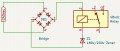
Or, if you are using relays with low voltage coils, a transformer with low voltage secondary, full wave rectified, capacitor smoothed, with enough DC volts to switch the relays at 110VAC and a comparator with a resistor and zener diode into one input, resistor divider into the other input and transistors to choose which relay according to whether the comparator goes high or low. I could sketch this if it sounds like it would work for you.
 

MrSalts

Joined Apr 2, 2020
2,767
I would use a suitable volt meter (or DMM) equipped with suitable leads - just push the leads into the outlet and read the voltage on the display. Not rocket science.
 

Ian0

Joined Aug 7, 2020
13,097
It may depend on the current the device demands but I believe electric shavers (used to) simply half wave rectify the voltage with a single diode to switch between 220 and 110. Maybe plug in assuming it's 110 and throw a rocker switch if the device isn't happy?

Or, if you are using relays with low voltage coils, a transformer with low voltage secondary, full wave rectified, capacitor smoothed, with enough DC volts to switch the relays at 110VAC and a comparator with a resistor and zener diode into one input, resistor divider into the other input and transistors to choose which relay according to whether the comparator goes high or low. I could sketch this if it sounds like it would work for you.
Unfortunately, half-wave rectified 220V isn't the same rms voltage as 110V AC. Half-wave rectified 220V AC is 155V rms.
Hair dryers use half-wave rectification to give half power.
110V AC is enough to keep a 220V coil relay contacts pulled it, although it wouldn't be enough voltage to close the contacts if they were open.
 

Pyrex

Joined Feb 16, 2022
501
as i remember, in some old TVs with vacuum picture tube with dual power supply it was used a mains voltage detection circuit . A relay at the output was actuated if voltage is 230V , if 120V in the mains, the relay is not actated. Or vice versa...The detection circuit was built on several transistors, no special ICs
 

Thread Starter

haythamhakla

Joined Apr 10, 2017
14
Any possibility of replacing that unit's PSU with a universal switching unit that can handle inputs from 90 to 270 volts?
The problem is that I couldn't find a GFCI unit that handles that wide voltage range.
As mentioned, the goal is to provide GFCI protection under all voltage conditions ( 110/220VAC)
 

Thread Starter

haythamhakla

Joined Apr 10, 2017
14
as i remember, in some old TVs with vacuum picture tube with dual power supply it was used a mains voltage detection circuit . A relay at the output was actuated if voltage is 230V , if 120V in the mains, the relay is not actated. Or vice versa...The detection circuit was built on several transistors, no special ICs
I did exactly that, using a 230VAC coil relay. The issue is that the relay doesn't just click at 230VAC, it clicks at around 150VAC depending on the relay model, and it buzzes severely at voltages lower than this.
Do you know of a 230VAC coil relay that has a clear cutoff voltage with some hysteresis?
 

Ian0

Joined Aug 7, 2020
13,097
Do Residual current circuit breakers (aka ground fault interruptors) really have a minimum voltage rating? They are operated by a current balance transformer in series with live and neutral. The device cannot know what the voltage is between live and neutral. The only thing that won't work is the test button, because it is in series with a resistor which determines the test current.
 

Thread Starter

haythamhakla

Joined Apr 10, 2017
14
Thanks @Ian0
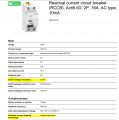
I had this 10ma RCCB, and its datasheet states it uses a voltage independent current sensing technology.
I tested it and it can trip at voltages as low as 60VAC using the included test button.
I also tested the RCCB at 110VAC using a regular GFCI tester and it still trips it.
So this seems like a good solution; however, the RCCB does not trip as fast as the regular GFCI outlets I have at home. In fact, if I press the GFCI Tester button very fast for a brief amount of time, it won't trip the RCCB. This is not the case when I test the GFCI outlets. I even hacked the GFCI tester and modified the resistor inside to draw 10mA instead of 5ma , but the tripping still feels slower.
So do you think this RCCB is enough for both 110VAC and 220VAC scenarios?

1677252627594.png
 

Pyrex

Joined Feb 16, 2022
501
I did exactly that, using a 230VAC coil relay. The issue is that the relay doesn't just click at 230VAC, it clicks at around 150VAC depending on the relay model, and it buzzes severely at voltages lower than this.
Do you know of a 230VAC coil relay that has a clear cutoff voltage with some hysteresis?
I meant, you can to find the circuit diagram of such an old TV. I saw it on an circuit diagram cataloque, issued to TV repairers. Probably, similar cataloques still stored in libraries... As i remember, circuit consists of the small diode bridge to rectify the mains voltage, the voltage comparator built on two or three transistors. The comparator drives the 24VDC or 48VDC relay.
Total number of components of the circuit is not huge, it's quite easy to built such a circuit by yourself. It will work properly, as it was tested thoroughly and implemented in hundreds of TV apparatus.

Concerning circuit , proposed above - diode bridge, zenner, relay- i'm not sure , will it work properly. Taking account mains fluctuations +/- 15%, relay will burn down , if mains rises to it's allovable value of 250V
 
Top