Small and Simple DIY RF Harvesting Circuit

Thread Starter

kwonsung

Joined Mar 16, 2026
2
Hello, thank you for your time to read this.
I need some guidance as to completing my school project.
I plan to build small and simple RF harvesting circuit that is capable of generating small enough voltage to light up a small led.

To make this possible...

Which frequency band should I aim for? Which spectrum of frequency is easiest for this application?
What kind of antenna should I aim to make?
For rectification from ac to dc I want to use full wave to have better efficiency. What kind of diodes should I use? I've read germanium diode 1N34A are good cause to consume less voltage than other diodes.
Any other points that I should be concerned about?
As for overall design and component value calculations, how do I go about doing this?

Please I would appreciate any guidance, or direction as to what and where I can refer for more additional help or readings that may guide me for success. Thank you.

Kind regards,
SK
 

MrChips

Joined Oct 2, 2009
34,628
Sorry to inform you, but you are off to a wrong start. You cannot harvest much energy from RF emissions.
You are better off trying to harvest energy by other means: solar, water, motion, thermoelectric.

LTC3108 is a useful IC for harvesting energy from low voltage sources.
 

crutschow

Joined Mar 14, 2008
38,321
I plan to build small and simple RF harvesting circuit that is capable of generating small enough voltage to light up a small led.
The total RF energy available for harvesting in a city is way below what can light an LED, typically in the tens of microwatts at best.
You need to rethink this.
 

MrChips

Joined Oct 2, 2009
34,628
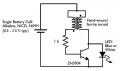
A useful and educational exercise is to build a Joule Thief circuit.
This will light an LED from a 1.5 V cell even when the cell has long past its usefulness as an energy source.


1773692057443.png
 

panic mode

Joined Oct 10, 2011
4,866
as good as it is, energy transmission today is still on average in the 30-40% range. rest is lost before it reaches your home.

typical power generation station operates at levels measured in MW (or GW). and then you take a look at things like NUCLEAR reactor which may have output of say 800MW in this case.
yes, it is WILD that some 500MW get lost even before energy reaches consumer homes. this massive win is a result of war of currents (Edison/Tesla). yeah, before AC was adopted things were much worse. and then there are green hair idiots with their green agenda who never could do any math (your teacher included). but they want people to abandon fossil fuel in favour of electricity. i to am all in in favour of electricity but - we still have some problems to solve.

anyway... the usual distance from power plant to your home is some 300-500km and the "journey" is accomplished by using WIRES. without wires 50 or 60Hz would travel way less. sensitive radio tuned to some AM station will pickup massive interference when near power line, but move just 30-40 steps away and interference is completely gone.

then you take a look at your local radio amateur and his radio gear, which may emit up to some, i don't know, lets call it 50W or 200W when he is communicating with someone on the other continent - even without any direct wires between them.

so what did we learn? higher frequencies travel further without wires. and that is one of top reasons that RF is used for communication.
the other way to look at it is that it can travel far because there is very little to stop it along the way. perhaps consider it "slippery" ;-)
and if you want to catch something like that, you will need a very large net.

you know what else we use to communicate? speach... taling is an ancient form of exchanging information, practiced by every culture we know of (and many animals)
but if you hope to funnel enough of voice/audio energy to light a match (or candle,) you will be disappointed even if you are next to massive crowd of screaming people and you just so happens to have a very very large cone.

if you really want free light, get out, bring fluorescent tube and hold it up under power line. it is not free, but it is something that others are paying for so nobody will try to chase you away. in fact they may be inclined to join you in weaving what looks like lightsaber.

the other option is to forget about using communication signal as source of power. use something much more practical... solar...windmill... carbon fuels.... even farts are type of it. may not be as green or carbon neutral but it is a renewable resource that can be lit and produce way more light than by harvesting weak RF communication signals.

here is an educational video:
https://www.southparkstudios.com/episodes/o0wg88/south-park-smug-alert-season-10-ep-2

when you get something that is only 30-40% good, there is a lot of room for improvement. even 0.01% when scaled to national grid is a massive win. suppose some day we will get to 90%, maling improvements there will be much harder but still easier than doing the same on 99.999%. schools should motivate students to tackle problems with biggest return. reducing losses in transporting energy is by far more significant issue than silly lighting an LED from energy stollen from communications. one big step forward would be to find a way to tell that teacher to change career.
 
Last edited:

Thread Starter

kwonsung

Joined Mar 16, 2026
2
Haha, I appreciate the insight. I've originally went to this route because I was soley fascinated by the idea of 'harvesting' from all the em waves around us, really to prove that theory is true and for demonstration sake. The project topic was given us freely for us to choose.

For now, I will continue to work toward my original objective, but now I've found an easier demonstration which is just to hold a fluorescent bulb under a power line, I may resort to this easier demonstration option if my main objective fails.

I'd appreciate any additional insights, information or guidance.
 

MrChips

Joined Oct 2, 2009
34,628
If you want to demonstrate that there is energy in radio waves, then build a crystal radio. You can listen to live music from an AM station without having to use any batteries in the receiver.

AM stations broadcast in the MW band, from 520 kHz to 1600 kHz.
 

MrAl

Joined Jun 17, 2014
13,667
Hello, thank you for your time to read this.
I need some guidance as to completing my school project.
I plan to build small and simple RF harvesting circuit that is capable of generating small enough voltage to light up a small led.

To make this possible...

Which frequency band should I aim for? Which spectrum of frequency is easiest for this application?
What kind of antenna should I aim to make?
For rectification from ac to dc I want to use full wave to have better efficiency. What kind of diodes should I use? I've read germanium diode 1N34A are good cause to consume less voltage than other diodes.
Any other points that I should be concerned about?
As for overall design and component value calculations, how do I go about doing this?

Please I would appreciate any guidance, or direction as to what and where I can refer for more additional help or readings that may guide me for success. Thank you.

Kind regards,
SK
Hello there,

This could be interesting, or very hard to get to work.

A few ideas...

1. Check the spec called "first light" for a high brightness LED. You'd want the one with the lowest current. If you can't find the spec, then you'd have to test a bunch of different high brightness LEDs. Unfortunately, I can't remember what I measured long ago with some of the LEDs I was using. The current can be very low though, and can be surprisingly low.
2. Instead of using a detector diode, maybe you can just use the LED as detector. That's if you can use a large enough antenna to get it to work at all. If not, you'd still need a detector diode.
3. If you don't get enough current from a single circuit, you may be able to combine several circuits to get an increase in current. If you got 1ua from one circuit and you needed 100ua, you would have to use 100 circuits. That's only if you can find a way to combine them efficiently, which would be very hard to do. It would also probably be hard to get the antennas away from each other enough to cover a wider area too. This would probably be very impractical, and I mean VERY impractical, but I never rule anything out when it comes to clever engineering.

The antenna has to be as long as possible, and use an earth ground, and high Q turned circuit, germanium diode. High brightness red LED. Maybe a voltage doubler type circuit.
To see any light you might have to be in total darkness with the eyes given enough time to adapt to the darkness (night vision).

You might be able to charge a capacitor, then release the energy into the LED to get a brief flash.

You'd have to experiment a lot with this to have any hope of success of even a brief flash of light.

So, let me know when you get this working so I can call my electric power supplier and cancel my contract with them.
I need to power a small microwave (1000 watts) and at least one stove burner (1500 watts) and oven (2600 watts).
I'll be waiting patiently :)
Sound: zzzzzzzzZZZZZZZZZZzzzzzzzzzzzZZZZZZZZZzzzzzzzzzzzZZZZZZZZZ

What you should probably do is try to find a group or forum with people that are already working on this idea. They would have already done the groundwork you need to get started.
 
Last edited:

WBahn

Joined Mar 31, 2012
32,703
Haha, I appreciate the insight. I've originally went to this route because I was soley fascinated by the idea of 'harvesting' from all the em waves around us, really to prove that theory is true and for demonstration sake. The project topic was given us freely for us to choose.

For now, I will continue to work toward my original objective, but now I've found an easier demonstration which is just to hold a fluorescent bulb under a power line, I may resort to this easier demonstration option if my main objective fails.

I'd appreciate any additional insights, information or guidance.
What is the purpose of the project in the first place. There seems a huge gulf between designing and building a circuit that demonstrates something, and picking up a fluorescent tube and standing under a transmission like and calling it your project demonstration.
 

BobTPH

Joined Jun 5, 2013
11,463
Stealing power from a transmission line is entirely doable, but it has nothing to do with RF energy harvesting. That project would be demonstrating the principle of a transformer.
 

panic mode

Joined Oct 10, 2011
4,866
school projects and assignments should be in line with curriculum and where students demonstrate they can apply what they learned in the class. this means any work (assigned or chosen) must have clear learning outcome, realistic goals and merit. if this thing is for a school assignment i would very much like to know what is the name of the course. this is more in line with entertainment stunts (youtube, TikTok, flea circus, magic...) than anything of practical value that may have actual benefit.
 

MrAl

Joined Jun 17, 2014
13,667
Stealing power from a transmission line is entirely doable, but it has nothing to do with RF energy harvesting. That project would be demonstrating the principle of a transformer.
Hi Bob,

Yes that's a lot different I believe, but not something to ignore if we are talking about very small energy harvesting and not huge power draws like for a 100 watt light bulb or even a 1 watt bulb.

The near field extends pretty far but not forever, dropping at something like 1/r^3 and it's reactive and two way back and forth. It's pretty far out but drops off fast.

The far field is radiative, and extends way out, dropping as 1/r, and it's a one way street where the waves propagate one way, energy transport is one way.

In between there's the 1/r^2 dropoff, somewhere between the two.

For the first I think we are looking at the current, for the 1/r^2 the derivative, and for 1/r the second derivative.

The near field travels far but drops off fast. The far field is far but does not drop off as fast. This leads to various cases.

In the case where we are tuned to 1MHz, we pick up far field radio waves, we get free energy.
In the case where we are inside the house using a pickup coil, we pickup 60Hz hum and the energy may or may not be free depending on the coupling. I'm divided on free vs pay for that case because it's hard to pin down the reflected wave as to how it varies the impedance of the house wiring. If it affects the impedance, we pay for that part, if it does not affect the impedance, we don't have to pay for that part because the leakage from the wiring was already present whether we picked it up or not.
 

nsaspook

Joined Aug 27, 2009
16,251
Anytime you draw 'real' power from a near field coupling it's a directly coupled energy transfer that likely would have remained reactive until some directed action to get real power at X point was taken.

The intent to draw real power should be the determining factor on 'pay' IMHO.
 
Top