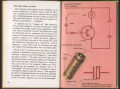
help with simple circuit please

Thread Starter

Homebrew1964

Joined Nov 22, 2024
104
I just dug this old book out which i've had for years and built this circuit, when i switch the power on the bulb is off, then when i connect the flying lead to 0V the bulb immediately lights at full brightness before slowly dimming to nothing over a period of about a second which isn't what the text tells me, how do i get the bulb to be off when i turn on the power then slowly light to full brightness over about a second when i put the flying lead to 0V? Do i need to use an NPN transistor?

I'm asking as i'm trying not to burn out components.
 

Attachments

WBahn

Joined Mar 31, 2012
32,702
The circuit is doing exactly what it is expected to do -- whoever wrote the book screwed up.

The gross behavior can be seen by considering that, in steady state (DC) operation, a capacitor looks like an open circuit.

So if the bulb is off when the flying lead is removed (creating an open circuit), the we would expect the bulb to be off with the capacitor connected after it has reached steady state.

Try this:

Remove the capacitor and resistor from the circuit.
Connect the capacitor between the base and the positive supply rail (if using a polarized cap, be sure to put the positive terminal on the positive supply rail).
Connect one end of the resistor to the base of the resistor transistor and use the other end as your flying lead.
Connect the flying lead to the negative supply rail.

The bulb should start out off and then, after connecting the flying lead, there should be a delay before the bulb turns on.

If you are using a 9 V source, the time delay should be somewhere around RC/10. This should be quite a bit quicker than the delay you are currently seeing, which should be about 2.5RC. So, if your current resistor is giving you about a second delay, you will probably need to increase it by about a factor of 25. However, if it gets too big, then the circuit will stall due to the leakage current in the cap. Also, if it is too large, then the non-zero base current in the transistor needs to be taken into account and, at some point, the circuit will not function because the resistor can't support enough base current to turn the transistor on. Without knowing a lot more information than you've provided, there's no way to really even guess at that. If you are using an incandescent 9 V bulb, then a resistor much over about 8 kΩ to 10 kΩ is going to start having issues. They way that you have your current circuit set up, this isn't so much of an issue -- there the issue comes when the leakage current of the cap starts approaching the base current needed to keep the transistor turned on, but most electrolytics of this size have leakage currents in the 10 µA to 100 µA range.

When asking a question, please provide complete information about the circuit. For instance:

What's the voltage you are using?
What's the size of the resistor you are using?
Are you using a 100 µF capacitor?
What transistor are you using?
What type of bulb are you using?

It's not uncommon for people to use components that aren't suitable for what they are trying to do and we can only key into that if we don't have to guess or use crystal balls.

EDIT: Fix typo. Thanks @panic mode.
 
Last edited:

Thread Starter

Homebrew1964

Joined Nov 22, 2024
104
Thanks WBahn....yes that worked with 100uf cap and 36K resistor and a 6V supply, the bulb is a 0.06A and i used a 2n4403 transistor.
 

WBahn

Joined Mar 31, 2012
32,702
Thanks WBahn....yes that worked with 100uf cap and 36K resistor and a 6V supply, the bulb is a 0.06A and i used a 2n4403 transistor.
What's the turn-delay that you are seeing? I'd expect it to only be about a third of a second. Does that seem close? Though it might be extended a bit as current shifts from the capacitor to the transistor base.
 
Last edited:

WBahn

Joined Mar 31, 2012
32,702
A 3rd of a second would be about right, the bulb glows dimly when fully lit.
That makes sense. The steady state base current is only going to be about 230 µA. If the transistor has a ß of 200, which is probably in the ballpark, then the collector current will be about 46 mA, or well under 60 mA you mentioned.
 
Top