Hello Mr.Chips can you reccomend an LED component with 3.3V voltage drop?
I understood they are better then Zenner because they have much lower inner series resistance.
Thanks.
What is it you are trying to do? What is the actual problem that you are trying to solve?
You keep trying to solve a simple problem with kludged solutions when there are simple solutions that have been around for a long time, such as precision voltage references.
A TL431 is an inexpensive programmable shunt reference, which can be set to any desired voltage 2.5V or greater, to emulate an accurate Zener.
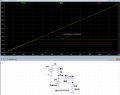
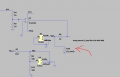
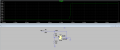
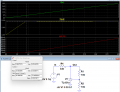
LTspice sim of example circuit below set for a 3.3V output:
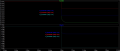
It regulates (green trace) to 3.3V at a Ref voltage of 2.5V (red trace) as determined by the voltage divider resistors R4 and R5.
Note that the Out voltage is essentially independent of the In voltage (yellow trace) once it reaches the regulated Out voltage (less then 5mV change over the simulated range).
Hello Mr.Chips can you reccomend an LED component with 3.3V voltage drop?
I understood they are better then Zenner because they have much lower inner series resistance.
Thanks.
What do you mean by an LED component with 3.3 V voltage drop?
If you want a 3.3 V voltage reference, then get one. They are available in thousands of varieties.
Look up 3.3 V precision voltage reference.
Also look up 3.3 V voltage regulator.
I used a 3.3k resistor bzx84 b33 12V multisim simulation confused the variables.
I tryed the virtual zener and that was a little better but nothing great
I found 3.3V zener that disipates 500 mW in a DO35 low TC BZX55 A33
better voltage Vz more current needed lots of Zz the Simulation for Zener's is not reliable.
The last of the BZX84 SOT23 from Eris Taiwan are obsolete others will never disapate no caveat found
Hello Crutshow I nee to convert -12V into -2.5V so i need a programmable negative voltage reference instead of positive.
Could you reccomend a component i could try and simulate?
Thanks.
A TL431 is an inexpensive programmable shunt reference, which can be set to any desired voltage 2.5V or greater, to emulate an accurate Zener.
LTspice sim of example circuit below set for a 3.3V output:
It regulates (green trace) to 3.3V at a Ref voltage of 2.5V (red trace) as determined by the voltage divider resistors R4 and R5.
Note that the Out voltage is essentially independent of the In voltage (yellow trace) once it reaches the regulated Out voltage (less then 5mV change over the simulated range).
I nee to convert -12V into -2.5V so i need a programmable negative voltage reference instead of positive.
Could you reccomend a component i could try and simulate?
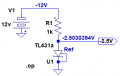
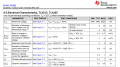
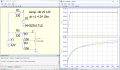
If you connect the Ref terminal of the TL431 to its cathode, it will act as a stable 2.5V Zener (tolerance is 2.44V to 2.55V [±2%]) from cathode (+) to anode (-), so can be used as either a positive or negative reference (LTsim below):
The TL431 requires at least 1mA of current for proper regulation (spec'd at 10mA) with a 150mA absolute maximum.
At 12V 4.7mA R1 dissipates 40.9mW, D1 disapates 15.5mW the problem with -12V is the 40mW is now on the zener.
If you adjust Vdd to -6V then the negative polarity circuit is then comparable to +12V, 40mW zener dissipation.
The Zener diode topology reversing the polarity results in keeping the resistor cool however the heat is now on the zener. Not for replication, these show heat issue that defeats purpose of using a reference See below TL431
Using simulation checked output with 3k resistor. operating at -12Vdc to get -3.3V is not as advantageous as Vdd= -8V
Operate TL431 at -8V trim R1, capable of sinking 1mA, total current 2.35mA, capacitor is recommended on output,
TL431 dissipates 1.48mW cool, stable, tight, not too shabby, will not compare to an expensive reference source.
Hello, I am trying to bias with this reference component a PMA5-83-2W gate data sheet below.
As you can see in the last stage of the schematics presented below, I have succeeded in converting the -12V into a -2.5 as shown below.
I used a comparator with constant voltage which is passing M12 signal, then using TL431 i converted -12V to -2.5V.
I know that choosing comparator is because we want low impedance.
How can I know according to the datasheet if this signal will fit good the components gate ?
Full LTspice simulation is attached. https://www.minicircuits.com/pdfs/PMA5-83-2W+.pdf
Hello Crutschow,I have built the following circuit shown belowusing the TL431 configuration you presentested.
I have been told the following workd regarding this circuit.
Which are basickly cucerened regarding it.
COuld you help me with answering the concerns presented below?
Thanks.
"I've never seen a negative polarity applied to TL431. Is it made to sink current? Is there such a thing as a negative version of TL431? In the case of negative circuitry you must re-think and revise your approach.
The location of your 0V ground becomes important.
The direction of electron travel (or current bundle travel) must dictate your selection of devices.
Example, notice manufacturers have a series of 79xx voltage regulators because we can't use 78xx series in negative territory."
The TL431 acts as a two-terminal Zener (yes it sinks current) so either end can be grounded to generate either a positive or negative voltage, as shown in my simulation.
If you can't understand that, I don't know what else I can say to further clarify.
I'm sorry to disappoint you all. I did the calculation and used the spice model of zener diode from Diodes. As it turned out, the model is completely wrong. I found out that there is not only one such bad model! I corrected some of the models, but I did not do a full check and correction. I decided to do it as needed. But I rarely use zeners in my developments, so there was no such necessity. My advice: check the model before using it!
Hello crutschow,I used your method to bias Vg1 input of PMA5-83-2W link below.
I need to know if my reference voltage can sink enough current (negative voltage) -2.5V for the device.
The ability of the circuit bellow to sink current while keeping the desired -2.5V
When I swept RLoad for different value and i see that at some Rload values i get 8mA(twice the maximal rating)
How do i know that it will get enough current from my reference regular source ?
After running the transient response, move the cursor to the cathode node on the TL431 until it changes to the current probe (below), then left click.
That will plot the cathode current.
It's the same as when the cathode is +2.5V.
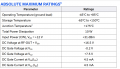
The absolute maximum current through the device is 150ma (below):
I would not go much above 100mA.
If you want a voltage greater than 2.5V, you also need to make sure the power dissipation rating (cathode-anode voltage times the cathode current) is not exceeded.
Hello Crutshow,I have used the positive configuration to supply 5V.How can you see in the datasheet the link between the voltage and the current it could supply with that voltage.
In zener we have specific values of current we expect to get out of the diode keeping the voltage drop steady as it was designed.
Is there such a thing in TL431?
Thanks.
In zener we have specific values of current we expect to get out of the diode keeping the voltage drop steady as it was designed.
Is there such a thing in TL431?
Due to it being an active device with internal negative feedback, a TL431 has a much lower voltage change vs. current than a standard Zener so the actual operating current is much less critical.
It also generally has a lower voltage change with temperature than a Zener.
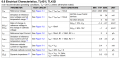
As you can see in the spec you posted, the voltage is specified at 10mA (Ika), but the sim below shows it only varies 78mV for a 5V output (yellow trace) for a cathode-anode current change of about 2mA to 75mA (red trace).

 Facebook
 Google
 GitHub
 Linkedin