zener diode acting abnormally question

WBahn

Joined Mar 31, 2012
32,702
Sure -- the fact that you are operating it WAY outside its characterized limits.

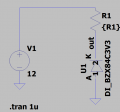
The device is characterized to be within 5% of 3.3 V at a current of 5 mA.

It's completely unreasonable to expect it to somehow maintain regulation at well over an order of magnitude greater current.

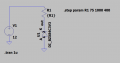
If you want it to behave like it's within spec, you need to operate it so that it is within spec, which means that R1 needs to be at least 1.75 kΩ.
 

ronsimpson

Joined Oct 7, 2019
4,645
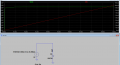
I changed the input to a current source. In 1mS the current goes from 0 to 100mS. Here is a graph of current verses voltage. Try with your diode.
1725491212029.png
 

Attachments

crutschow

Joined Mar 14, 2008
38,316
It's always a puzzle to me why someone will ignore what's in a data sheet, use a device outside its rated limits/operating conditions, and then wonder why it doesn't work. :rolleyes:

Zeners are not perfect, not even in a simulator, as they have a significant series resistive value.
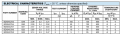
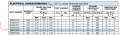
Look at the dynamic resistance below from the data sheet, which is 95Ω @ 5mA.

The Spice model (bottom) uses an RS series resistive value of 79.5(ohms).

Thus for example, at 50mA you would expect the simulated voltage to rise by about 45mA * 79.5Ω = 3.6V, for a total voltage drop of 6.9V (amazingly close to the 7V you mentioned).
So its behavior is not "weird" at all.

1725490008150.png

From Zener Spice Model:
.MODEL DR D ( IS=8.74f RS=79.5 N=3.00 )
 
Last edited:

WBahn

Joined Mar 31, 2012
32,702
In one of your runs you have 100mA in the diode. It was tested at mA.
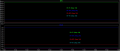
I don't see 100 mA in any of the sims. It looks to me like the 75 Ω run has about 60 mA (may just a bit more), placing the voltage across the zener at about 7.5 V.

Note: The coloring on the bottom graph doesn't match the supplied legend.

Any sims that operate a device well outside of it's specified operating range have to be taken with a serious grain of salt -- the person that developed the model has no motivation to care whether the model behaves like the real device outside of that range, especially since they almost certainly have no idea how it actually behaves when well outside of that range.
 

sparky 1

Joined Nov 3, 2018
1,218
(27) LTSpice zener diode 3V model | All About Circuits
The recommendation to replace the part with GP3V0 and set R=500 in the simulation, that was successful.
However the "why" is again being considered. Other peculiarities have been reported on other software.
Most of the electronic simulation software are not new beta versions, these are tested and reliable for many years.

It raises the possibility that corrupted libraries were installed by auto-update. If there are corrupted components, the incident would necessitate reverting to a library version prior to May 2024 or adopting a wait-and-see approach.
 
Last edited:

Thread Starter

yef smith

Joined Aug 2, 2020
1,445
Hello,So If i Have 12V and GND in a reversed bias connection to the diode.
I want it to work properly and have 3.3V voltage drop between the anode and kathode.
so there is 8.7V across the resistor R1.
At Izt1=5mA we have 95ohm so the voltage drope across the zenner isV=95*5mA=475mV
far away from 3.3V
why the voltage drop according to ohms law shown in the datasheet doesnt match the formal 3.3V ?
Thanks.
1725524053729.png
1725524508567.png
 

Alec_t

Joined Sep 17, 2013
15,101
why the voltage drop according to ohms law shown in the datasheet doesnt match the formal 3.3V ?
You are only calculating the drop across the dynamic resistance and ignoring the Zener junction voltage. Think of the zener diode as a 3.3V voltage source in series with 95Ω.
 

WBahn

Joined Mar 31, 2012
32,702
And keep in mind that that is the dynamic resistance at 1 kHz, not DC. It is also the specified maximum that it can be -- any random part picked up off the shelf will be well below that.
 

Thread Starter

yef smith

Joined Aug 2, 2020
1,445
5mA is 95ohm of series resistance.
3.3+0.475=3.775 across the zenner.
My big question is in real life how do I properly calculate the series resistor ?assuming there is no simulation tool to help me .
Purely on data sheet.
 

crutschow

Joined Mar 14, 2008
38,316
Think of the zener diode as a 3.3V voltage source in series with 95Ω.
Not quite.
The 3.3V is specified at 5mA current, so the effect of the 95Ω is included in that voltage.
Thus the internal Zener voltage source is closer to 3.3V - 95Ω*5mA = 2.825V.
 
Last edited:

crutschow

Joined Mar 14, 2008
38,316
My big question is in real life how do I properly calculate the series resistor ?assuming there is no simulation tool to help me .
Purely on data sheet.
Yes, the dynamic resistance at the Izt1 test current is what you would use, but remember there can be significant variation from unit to unit.
 

Thread Starter

yef smith

Joined Aug 2, 2020
1,445
Hello, So suppose I have done as in the data sheet but in real life I have the zener 3.8 instead of 3.3.
I’ll just increase the series resistor .
Correct ?
Thanks .
 
Last edited:

Thread Starter

yef smith

Joined Aug 2, 2020
1,445
Hello, You said there would be significant variations from unit to unit , so I assumed the voltage across Vz could be 3.8 instead of 3.3, Is that the variations you ment ?
Because dynamic current differ so inner resistor voltage drop will change too.
Thanks .
 

MrChips

Joined Oct 2, 2009
34,626
I have said it before. The zener voltage is not abrupt. It changes with zener current. Ignore the effective zener resistance because this too is not constant.

Assuming that you are operating the zener diode in its specified operating range, adjust the series resistance R experimentally until you get the nominal zener voltage.

Low voltage zener diodes are not precision devices. If you want a precision voltage source then you have to look for another solution.
 
Top