Your thoughts please - Soft-start cct for 240V universal motor

tcmtech

Joined Nov 4, 2013
2,867
Thanks Dave, I looked at the link, and I see that the triacs shown are all heavier than the BT137 - but you say "Several triacs available". The BT137 was also one of several available. I figured that at 240V RMS, 8A, it should be capable of driving about 1920W, which is 2.5HP - and as the plate on the motor says "1.72A; 370W", I thought I'd be OK with that triac. I therefore repeat my question - would you have expected this triac to instantly pop? If so, can you explain why it was a bad choice?
I'm not disputing what you say, Dave - for me, it's a learning experience, and I came here because it's a room full of people who know better than I.
As max said, the inrush current for a electric motor of that design is pretty high.

Theoretically extramly high given such a motor may have an equivalent series resistance of ~3 ohms and one a 240 VAC supply system with a peak voltage of ~340 volts that equates to a theoretical inrush current of ~115 amps. In reality all the various line voltage losses in the supply wiring will at least cut that in half but still in electronics terns a I would not be using anything rated for less than 120 amps peak current and 20 - 30 continuous.

Now for bonehead simple soft starting (old school series resistance current limiting soft starter) you could get by with as little as a properly sized resistor and a relay set up.

All you would need is a realy with a AC coil that is rated for your line voltage and resistor that when inserted with the motor limits the motors input voltage at no load to something just above whatever voltage the relay will pull in at.
The resistor is wired across the normally open contacts of the relay and the relay coil is wires in parallel with the motor so that when the power is first applied the resistor works as a current limiter until the motor gets up to speed far enough for the voltage across it and the relay coil to get high enough for the relay to close its contacts and bypass the resistor thus putting full line power to the motor.

Most 240VAC rated relays will pull in at around 180 - 200 volts if not less so all you would need to do is size your resistor to let the motor have enough current at no load to get its voltage up at least that high.
 

Thread Starter

cognas

Joined Feb 24, 2017
58
I would not be using anything rated for less than 120 amps peak current and 20 - 30 continuous.
Thanks tcmech, I've just ordered a couple of BTA24's. They have an off-state voltage of 600V, continuous current of 25A and instantaneous, non-repetitive current of 250A. If that doesn't do it, I'll have some thinking to do. I still have the circuit I built or that project, and I checked through it as far as I could today (without connecting the motor), and it seems OK. I'll have to replace the TDA1085C and the triac.

Now for bonehead simple soft starting (old school series resistance current limiting soft starter) you could get by with as little as a properly sized resistor and a relay set up. All you would need is a relay with a AC coil that is rated for your line voltage and resistor that when inserted with the motor limits the motors input voltage at no load to something just above whatever voltage the relay will pull in at.
The resistor is wired across the normally open contacts of the relay and the relay coil is wires in parallel with the motor so that when the power is first applied the resistor works as a current limiter until the motor gets up to speed far enough for the voltage across it and the relay coil to get high enough for the relay to close its contacts and bypass the resistor thus putting full line power to the motor.
Most 240VAC rated relays will pull in at around 180 - 200 volts if not less so all you would need to do is size your resistor to let the motor have enough current at no load to get its voltage up at least that high.
I may have a play with that idea, as I may have a suitable resistor - the heater element out of my daughter's old hair straighteners. If it looks promising, I can easily get a relay. I may already have one, if I look for it. However, even if it works, I think I'll still "follow the dream" at a later date. My AVR uProcessors and a couple of Arduino boards arrived yesterday, so I want to play with them - and the soft-start will be only the first, relatively trivial project.
 

Thread Starter

cognas

Joined Feb 24, 2017
58
I just found the "resistor". It's 160 ohms.

Tried it - it didn't work. The resistance is way too high. It gets hot pretty quickly (almost too hot to touch in 4-5 seconds), and the motor doesn't budge. I guess something nearer to 10 ohms would be better. To motor (at rest) measures 8 ohms.
 
Last edited:

Thread Starter

cognas

Joined Feb 24, 2017
58
The only thing with the TDA1085 it is intended for rpm control of a Universal motor, which it does very well, but it also requires a simple digital tach.
Yes - it was for a different project some time ago, to drive a band saw. It was trumped by my acquisition of a 1/3HP induction motor, but I still have the washing machine motor (with tach) and the circuit I built around the TDA1085C, and I think all it needs is a triac and the chip. I don't actually need it any more, but I'll get the bits and see if it works. I want to make a belt sander, so I could use it for that. In ordering the triac, I ordered a few of them, so I'll have one for the current table saw project.

I also came cross another chip with a soft start - the U2010B. It holds some promise, but I haven't ordered one.
 

vrainom

Joined Sep 8, 2011
126
Thanks - good info, but I don't think it likely that my motor has that feature.
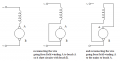
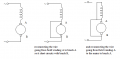
I just thought of something: even if a tool doesn't have the brake winding the point remains that an universal motor electric brake requires the field winding to be short-circuited while reversing its polarity, that is: reconnecting the wire going from field winding A to brush A so it short circuits with brush B, and reconnecting the wire going from field winding A to the mains to brush A. It could potentially be done with a beefy dpdt switch or relay. I'm gonna try this to see how / if it works.
 

MaxHeadRoom

Joined Jul 18, 2013
30,699
It appears that the pic's of the patents applied for show using an existing field coil.
This is similar to how it is done on a induction motor by injecting DC into a winding when turned off.
Max.
 

Thread Starter

cognas

Joined Feb 24, 2017
58
I just thought of something: even if a tool doesn't have the brake winding the point remains that an universal motor electric brake requires the field winding to be short-circuited while reversing its polarity, that is: reconnecting the wire going from field winding A to brush A so it short circuits with brush B, and reconnecting the wire going from field winding A to the mains to brush A. It could potentially be done with a beefy dpdt switch or relay. I'm gonna try this to see how / if it works.
Yes, thanks for that, but it was already covered by MaxHeadRoom. See this link.
Patent US3673481 - Dynamic braking for universal motors
 

vrainom

Joined Sep 8, 2011
126
That is almost but not exactly the way I described, minus the cap circuit which I assume must be kind of big for that application.
 

Thread Starter

cognas

Joined Feb 24, 2017
58
That is almost but not exactly the way I described, minus the cap circuit which I assume must be kind of big for that application.
If you try that out (if you have any need of stopping a motor) and it works, I'd definitely be interested. Yes, I agree that my gut feeling about the capacitor solution is that it would need quite a big one. Also, the patent says it will stop the motor within a couple of turns, and that really isn't what I want. If starting too quickly can strip the teeth off gearwheels, I'm sure that stopping too quickly can do the same thing. I already tried shorting the motor with a view to stopping it, but it didn't stop it any quicker. I suppose yet another solution would be to replace the field with permanent magnets, then shorting the motor would be more likely to work - but that's a bit extreme! I ain't gonna do it.
 

MaxHeadRoom

Joined Jul 18, 2013
30,699
If you want to stop relatively slowly then the cap solution may work, you could use a induction motor start cap as these are fairly large in value, but you would need a rectifier to charge it up when the motor is running then when it switches off the cap would dump across one of the fields to get the generation effect.
Might involve a little tricky switching arrangement.
The cap value and injected DC level would decide the stopping rate.
Max.
 
Last edited:

vrainom

Joined Sep 8, 2011
126
I just tried the brake arrangement with a sewing machine universal motor and it worked fine, no cap, just a dpdt switch and the remnant energy in the motor itself.

 
Last edited:

Thread Starter

cognas

Joined Feb 24, 2017
58
I just tried the brake arrangement with a sewing machine universal motor and it worked fine, no cap, just a dpdt switch and the remnant energy in the motor itself.
Thanks very much for the demo, vrainom. It's clear that you have made it work, but universal motors are clearly much more second-nature to you than they are to me - and I'm a bear of very little brain - so I'm not sure I understood your explanation.

Is this what you meant? I'm a bit confused by the term "short circuits".
upload_2017-3-6_14-37-59.png
 

Attachments

MaxHeadRoom

Joined Jul 18, 2013
30,699
For this method to work, there has to be some residual magnetism somewhere.
Being an AC operated motor, your particular motor may, or may not have it.
Max.
 

vrainom

Joined Sep 8, 2011
126
For this method to work, there has to be some residual magnetism somewhere.
Being an AC operated motor, your particular motor may, or may not have it.
Max.
Yes. It depends on the alloy but my bet is most motors being laminated iron cores will. This isn't my idea, a lot of mitter saws, hand saws and routers have this arrangement albeit with a dedicated brake winding.

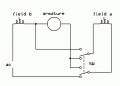
@cognas, yes that's pretty much what I meant, here goes the schematic. The switch is shown in the "run" position.
Electric brake arrangement.gif
 
Last edited:

Thread Starter

cognas

Joined Feb 24, 2017
58
yes that's pretty much what I meant, here goes the schematic.
Is your schematic of the Mitter saw, with the dedicated stop winding, or are you assuming that my table saw will have an A- and a B- field winding? Maybe that's how field windings work - but I didn't think so.

In reality, it will be a while till I get to this, as I want to make the soft-start first. I'm working on that, but I'm having to wait for parts through the post, and figuring out a microprocesor program will take me some time anyway . There are always unforeseen things to slow things down too. For example, in the middle of all this, my scope produced mega-smoke, and with waiting for components etc, that took me 3 weeks. Ho hum!
 

Thread Starter

cognas

Joined Feb 24, 2017
58
There are two field windings in a Universal motor, one on either side of the stator.
Thanks, Max, I had realised that there was a winding for each magnetic pole of the field, but as they are in series, I considered them a single winding. I'm surprised that the circuit given uses only one of them to stop the motor. Maybe it's better that way. I'll experiment with it when I get to that point.

There is also another Pic controlled Triac controller today that also could be adapted for slow start.
https://forum.allaboutcircuits.com/threads/light-dimmer-using-pic16.132846/
I am initially trying one that is a marriage of AN958 and the AN-3006.
Max.
I had already read through that - I see you're working on something similar. I haven't looked at the code yet, but I will - it may well help with mine. I'm using an 8-pin ATtiny85, but assemblers are roughly equivalent. I have the general idea blocked out, but the detail will take a bit of figuring out (interrupts). I won't go into that here - uController stuff is a it off-topic, and besides, I don't need help at this point.
 
Top