Wound healing medical device, design troubleshooting

Thread Starter

Kaimelar

Joined Jul 27, 2023
4
Hi, I’m fairly new to electronics so I appreciate any help I can get.

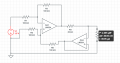
I’m trying to design a circuit that can provide a constant current of about 50 microamperes (μA) at the load, using a 1.5V battery.

In the image the load is represented by a resistor, which in reality will be a cathode and an anode. Between the anode and the cathode should be a poorly healing wound, such as a diabetic ulcer.

This is more of a thought experiment at the moment. Not even thinking about phase I trials yet. As far as I know there is no such medical device commercially available. A 1.5v battery can’t cause harm in it’s intended use in this design. TENS units work at far higher currents and are considered safe. Patients with epilepsy and pacemakers/arrythmias would of course be excluded, as a precautionary measure.

I’m looking at a current pump design, as discussed here (https://www.allaboutcircuits.com/te...design-a-precision-current-pump-with-op-amps/). I read that the LM324 can work at lower supply voltages and the 1.5V battery shouldn’t be a problem. But I’ll change the op amp if necessary of course.

Skin resistance is highly variable, that’s why I’m looking at this type of configuration. The situation can be helped using conducting gels, but I was planning on using an ohm meter to test it out. The device is to be worn for longer periods of time (72h+), so it could be the case that a close enough average for the skin resistance could work. This will also include failsafes in the final design.

I’m a physician, not an electronics engineer, so I really appreciate the help.BodyAmp device.png
 

Thread Starter

Kaimelar

Joined Jul 27, 2023
4
The LM324 minimum supply voltage is 3V.
Welcome to AAC!
I read that the op amp can work with lower voltages, so I wanted to try it out. Worst case scenario, I'll add another battery to complete the 3V. I want to keep the design as light as possible.

Assuming the LM324 can work with 1.5V, would the circuit work as it stands? It seems to work in CircuitLab.
 

Ian0

Joined Aug 7, 2020
13,158
I read that the op amp can work with lower voltages, so I wanted to try it out. Worst case scenario, I'll add another battery to complete the 3V. I want to keep the design as light as possible.

Assuming the LM324 can work with 1.5V, would the circuit work as it stands? It seems to work in CircuitLab.
You’re designing a commercial product and you intend to use a device outside its specifications. That is foolish in the extreme.
The output of a LM324 drops 1.3V from the positive rail. That only gives it 0.2V output left on a fully charged battery. Nothing at all as the battery nears the end of its life.

Secondly, the LM324 has a quiescent current of 300uA pew amplifier, which means you are using 1.25mA to get a 50uA output. Not smart, in terms of battery life.
 

Thread Starter

Kaimelar

Joined Jul 27, 2023
4
You’re designing a commercial product and you intend to use a device outside its specifications. That is foolish in the extreme.
The output of a LM324 drops 1.3V from the positive rail. That only gives it 0.2V output left on a fully charged battery. Nothing at all as the battery nears the end of its life.

Secondly, the LM324 has a quiescent current of 300uA pew amplifier, which means you are using 1.25mA to get a 50uA output. Not smart, in terms of battery life.
Ok, thanks for the feedback. Any suggestions on how to improve?
 

wayneh

Joined Sep 9, 2010
18,127
I'd start with a small experiment: Measure the current achieved when connecting the battery directly to the subject by way of whatever leads you think you'll use. My hunch is that you will not be able to hit your 50µA target. I could be wrong. I built a device that delivers up to 1mA using a 9V battery, so 50µA from 1.5V is not unbelievable. I just think you should confirm it.

You might benefit from taking a look at my project.
 

Audioguru again

Joined Oct 21, 2019
6,826
I doubt that a tiny DC current will help heal a wound.
The minimum supply for an LM324 is 3V then its maximum output will be+1.7V. But a battery voltage drop as as it is used then you probably need 4.5V to power the LM324 plus another 1.5V battery cell for the negative input voltage.
 

WBahn

Joined Mar 31, 2012
32,970
My recommendation is to think carefully about the following statement you made: "I’m a physician, not an electronics engineer"

If I went onto a medical forum and asked for guidance on the medical issues associated with some circuit idea I wanted to develop for use with patients and it was obvious that I had no clue about the most basic medical concepts, hopefully that guidance would be to seek out and engage the involvement of someone with the proper medical training and background for what I was trying to do. The same applies here -- if you want to hook up an electronic device to patients, I suggest you seek out and engage the involvement of someone that has training and experience in designing patient-connected electronics. Either pay them for services rendered, or a small fee up front with a larger fee once the project reaches a certain point, or form a company and give them a percentage, or some other mutually-agreeable arrangement.
 

DickCappels

Joined Aug 21, 2008
10,661
1.5 volts does not leave you much voltage to work with. An Lm324 or LM358 might be able to do a pretty good job when used with a 9 volt battery

Starting with something that doesn't work and that of which you are still developing an understanding and trying to work toward a lower power, lower cost solution is working backwards. Start with something that already works and then try modifying it to make it approach your ideal. That way you will always have something that works and you know instantly if one of your modifications fall short of your goal.

By there are some 1.5 volt opamps available. More expensive than the LM324/LM358 but work down below 1.5 volts. You can start looking at these opamps when you get to lower voltages. Check out the New Japan Radio Company Ltd. NJU7051.

Part of the problem statement is "How many volts do you need to get 50 uA flowing in patient's skin? Some TENS systems use pads soaked in salt water for the contacts, making skin resistance a minor consideration. 9 volts/180k = 50 uA.
 

Thread Starter

Kaimelar

Joined Jul 27, 2023
4
1.5 volts does not leave you much voltage to work with. An Lm324 or LM358 might be able to do a pretty good job when used with a 9 volt battery

Starting with something that doesn't work and that of which you are still developing an understanding and trying to work toward a lower power, lower cost solution is working backwards. Start with something that already works and then try modifying it to make it approach your ideal. That way you will always have something that works and you know instantly if one of your modifications fall short of your goal.

By there are some 1.5 volt opamps available. More expensive than the LM324/LM358 but work down below 1.5 volts. You can start looking at these opamps when you get to lower voltages. Check out the New Japan Radio Company Ltd. NJU7051.

Part of the problem statement is "How many volts do you need to get 50 uA flowing in patient's skin? Some TENS systems use pads soaked in salt water for the contacts, making skin resistance a minor consideration. 9 volts/180k = 50 uA.
Thank you, this is very helpful. I will take this approach.
 
Top