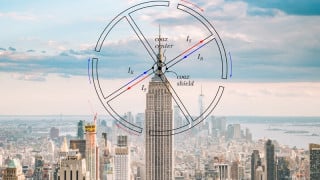
Bifilar wound double wires over ferrite rod core has both inductance and capacitance at the same time. What are benefits/ uses, as a transformer or special end uses? I believe Tesla had a special flat style wound wire coil made that way.
Bifilar wound double wires over ferrite rod core has both inductance and capacitance at the same time. What are benefits/ uses, as a transformer or special end uses? I believe Tesla had a special flat style wound wire coil made that way.
Tesla’s invention did not use a core. It was a way to avoid capacitors, which, at that time were not very good. His idea was to use two equal coils wound pancake style, and insulated from one another. The end of one coil was connected to the start of the other, so it was effectively one larger coil made of two laminated layers.
His goal was to include the necessary capacitance to reduce to the maximum extent the losses in the coil due to self inductance by storing charge capacitively in the coil itself. Again, his stated motivation was to avoid capacitors which, at the time, were not a mature technology. I am not sure his idea has a lot of application today, though possibly in the case of very small components it could be a benefit.
Bifilar wound double wires over ferrite rod core has both inductance and capacitance at the same time. What are benefits/ uses, as a transformer or special end uses? I believe Tesla had a special flat style wound wire coil made that way.
There are several applications for having identical coils in a transformer. Signal isolation would be one of them.
Don't really care about what Tesla does with anything including coils. There is nothing special with flat wound coils. The electric toothbrush been using one for years. I bet he is still patting himself on the back for rediscovering the efficacy increase of using a permanent magnet between poles in an induction motor. Nicola Tesla while working with Westinghouse came up with that, but decided not to develop it because they wouldn't make as much money with their power company.
Tesla‘s patent is for bifilar flat wound coils and it had a particular application. I don’t know if it was every commercially useful but his intention was to replace the dodgy capacitors available at the time.
Tesla‘s patent is for bifilar flat wound coils and it had a particular application. I don’t know if it was every commercially useful but his intention was to replace the dodgy capacitors available at the time.
Your personal beef with a dead man is not subject of the thread, but bifilar, flat wound inductors is. Tesla was mentioned, and he holds a patent on such a coil.
So your comment that there is nothing special about flat wound inductors is factually incorrect no matter how despicable you find him.
Please try to keep your personal feelings from causing you to provide inaccurate information.

 Facebook
 Google
 GitHub
 Linkedin