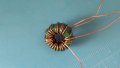
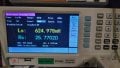
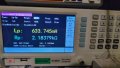
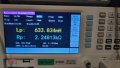
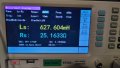
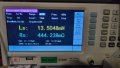
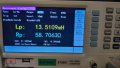
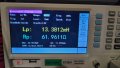
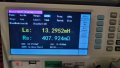
Hand wound transformer is drawing too much amperage and outputting too little voltage. Ideas?

Thread Starter

ballsystemlord

Joined Nov 19, 2018
249
Hello,
I was trying to create a voltage doubling transformer. Before I finished winding the secondary, I wanted to test it. So I hooked it up in series with a DMM and connected the secondary to another DMM only to discover that it's drawing too much amperage and the secondary has almost no voltage across it.

I'm pretty sure that the inductive reactance of the transformer is too low, but I'm uncertain how to fix that (reducing the wire size seems like an option, but then wouldn't the transformer overheat?). My Radio Shack book's chapter on transformers is rather brief.

The transformer I'm trying to make should do 9v in, 18v out, and 4a in, 2a out, at 60hz. I'm using a torrid core that measures 20mm OD, 12mm ID, and 10mm high. The core material is suspected to be MnZn. The wire's diameter is 0.67mm stripped and 0.73mm with coating. I'd know more specifically what size it is, but I also got it from Radio Shack as a child and I thew the packaging away eons ago.

As currently wound, the primary measures (at 10mA):
LResistanceReactanceZ
Series 2.177mHSeries 101.4mOhms820.71mOhms827mOhms
Parallel 2.211mHParallel 6.757 Ohms833.53mOhms6.808 Ohms

Ideas?

Thanks!
 

Attachments

Last edited:

dendad

Joined Feb 20, 2016
4,634
That is not suitable for 60hz, more like 60Khz. The turns are way too few and the inductance for 60hz is too low.
You could try an iron core transformer and with a lot more turns for the primary, or make a switch mode converter at much higher frequency with that core.
Just out of interest, get a mains transformer with low voltage out winding and measure the inductance it has on each winding.
 

Thread Starter

ballsystemlord

Joined Nov 19, 2018
249
Just out of interest, get a mains transformer with low voltage out winding and measure the inductance it has on each winding.
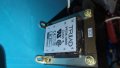
Okay, how about VPS36-4800?

115-230V in at 50/60hz.
18-36V out at 9.6A or 4.8A respectively.
175VA

I'm testing at 10mA. It has four coils, two primary and two secondary. I'm measuring the top two only. I decided to go with three to four digits for the readings because the instrument was taking forever to settle those later digits due to the size of the transformer. I hope you won't mind.
LResistanceReactanceZ
Primary Series699mH26.1 Ohms263.52 Ohms264.81 Ohms
Primary Parallel707mH1840 Ohms266.53 Ohms1859.2 Ohms
Secondary Series15.71mH48m Ohms5.923 Ohms5.9227 Ohms
Secondary Parallel16.9mH51.06 Ohms6.371 Ohms51.456 Ohms

I hope you enjoy it!

EDIT: Added some specs so you wouldn't have to look it up.
 
Last edited:

Pyrex

Joined Feb 16, 2022
501
My advice to you would be this- find a transformer with a secondary winding of 18V 2A (36VA ) and rewind the primary winding.The transformer you mentioned before is way too big - 175VA.
 

Ian0

Joined Aug 7, 2020
13,097
Okay, how about VPS36-4800?

115-230V in at 50/60hz.
18-36V out at 9.6A or 4.8A respectively.
175VA

I'm testing at 10mA. It has four coils, two primary and two secondary. I'm measuring the top two only. I decided to go with three to four digits for the readings because the instrument was taking forever to settle those later digits due to the size of the transformer. I hope you won't mind.
LResistanceReactanceZ
Primary Series699mH26.1 Ohms263.52 Ohms264.81 Ohms
Primary Parallel707mH1840 Ohms266.53 Ohms1859.2 Ohms
Secondary Series15.71mH48m Ohms5.923 Ohms5.9227 Ohms
Secondary Parallel16.9mH51.06 Ohms6.371 Ohms51.456 Ohms

I hope you enjoy it!

EDIT: Added some specs so you wouldn't have to look it up.
Primary series is four times primary parallel, so I don't have much confidence in your measurements.
 

Ian0

Joined Aug 7, 2020
13,097
A 40VA mains frequency toroidal transformer is 74mm diameter and 33mm high.
Your is 20mm diameter and 10mm high. The real one is 45 times bigger, so, on a silicon iron core that size, it will manage about 0.75VA.
Because it is ferrite and not silicon-iron, the saturation flux is only about a tenth, so expect a maximum power at 60Hz of about 0.075VA
 

Ian0

Joined Aug 7, 2020
13,097
I have a 25VA mains transformer, and it takes a magnetising current of 35mA. @ 230V. That’s an impedance of 6.5k,of which almost all will be the magnetising inductance, which works out at 21H.
For 9V input, instead of 230V, divide by (230/9)^2, so you should be expecting about 32mH.
 

MisterBill2

Joined Jan 23, 2018
27,164
Hello,
I was trying to create a voltage doubling transformer. Before I finished winding the secondary, I wanted to test it. So I hooked it up in series with a DMM and connected the secondary to another DMM only to discover that it's drawing too much amperage and the secondary has almost no voltage across it.

I'm pretty sure that the inductive reactance of the transformer is too low, but I'm uncertain how to fix that (reducing the wire size seems like an option, but then wouldn't the transformer overheat?). My Radio Shack book's chapter on transformers is rather brief.

The transformer I'm trying to make should do 9v in, 18v out, and 4a in, 2a out, at 60hz. I'm using a torrid core that measures 20mm OD, 12mm ID, and 10mm high. The core material is suspected to be MnZn. The wire's diameter is 0.67mm stripped and 0.73mm with coating. I'd know more specifically what size it is, but I also got it from Radio Shack as a child and I thew the packaging away eons ago.

As currently wound, the primary measures (at 10mA):
LResistanceReactanceZ
Series 2.177mHSeries 101.4mOhms820.71mOhms827mOhms
Parallel 2.211mHParallel 6.757 Ohms833.53mOhms6.808 Ohms

Ideas?

Thanks!
The resistance values claimed for the transformer in the picture are not believable at all. Especially that 101.4 ohms resistance for the primary. HOW are you measuring the resistance??
AND, as also has been mentioned, the core material is not suitable for the 60,or 50 Hz mains frequency.
There is a whole lot more to transformer design than turns ratios.
 

Ian0

Joined Aug 7, 2020
13,097
Do you have enough turns to avoid saturation?
n > Vt/(BA)
V is your average voltage (2.Vpeak/π) not the rms voltage
t is. Quarter of a cycle the time it takes to get from zero flux to peak (4.17ms for 60Hz)
B is 0.2T for ferrite
A is the cross sectional area of the core. (40x10^-6 square metres)

4200 turns by my calculations.
 

Janis59

Joined Aug 21, 2017
1,894
1 probable rerason - major mistake in turns count. Must apply the formula turns to volt = 50 divide to S(c) in cm^2 if 50 Hz and 1.2 Teslas. If ferrite thus the Teslas are 0.1...0.4, must make a correction, and if other frequency, other correction, and if meander not sinus, then additional 1.1 fold correction. Second probable mistake is intra-winding short coming turn. That is easily detectable by Q-meter or by VNA. Or, as I wrote today in the section of common electronics chapter, apply the i(idle) function graph v.s. input voltage. If there is voltage value under what idle current decreases near zero, means mistake is in turn count. If such place unexist, thus it consumes large current at any voltage, the problem is short circuit.
 

schmitt trigger

Joined Jul 12, 2010
2,027
Power transformers ARE NOT designed by inductance. Rather they follow other requirements.
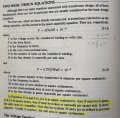
The first is that the selected primary turns and core cross section area do not cause core saturation at the primary applied voltage and frequency.
In other words, follow the transformer equation. From the “Practical Transformer Design Handbook” by E. Lowdon:
 

Attachments

MisterBill2

Joined Jan 23, 2018
27,164
The wire might be bare, or it might be enameled magnet wire.
Certainly power transformers do have quite a bit of inductance, because of all the iron and all of the turns. AND, in fact, there certainly are torroidal style power transformers. BUT they have steel cores. Also, they are much larger.
So read and understand the book mentioned by S.T. in post #13.
 

Thread Starter

ballsystemlord

Joined Nov 19, 2018
249
Primary series is four times primary parallel, so I don't have much confidence in your measurements.
Well, I can't say my LCR meter is the best in the world, and the test leads are definitely a bit off when moved. So I'll post screen shots for you. I'll give my instrument over an hour to warm up so that it reaches full accuracy (which I didn't do before), and I'll calibrate the lead error out.

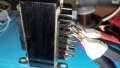
Physical test method:
IMG_20250401_204700_026a.jpgIMG_20250401_204720_074a.jpg

Leads on 5 and 6:
IMG_20250401_204532_788a.jpgIMG_20250401_204636_042a.jpg

Leads on 1 and 2:
IMG_20250401_204746_095a.jpgIMG_20250401_204803_279a.jpg

Leads on 11 and 12:
IMG_20250401_204828_173a.jpgIMG_20250401_204851_418a.jpg

Leads an 7 and 8:
IMG_20250401_204923_907a.jpgIMG_20250401_204938_212a.jpg

I hope that clarifies things for you.

As always, if you spot something I missed, feel free to point it out.

Thanks
 
Last edited:

Thread Starter

ballsystemlord

Joined Nov 19, 2018
249
1 probable reason - major mistake in turns count. Must apply the formula turns to volt = 50 divide to S(c) in cm^2 if 50 Hz and 1.2 Teslas. If ferrite thus the Teslas are 0.1...0.4, must make a correction, and if other frequency, other correction, and if meander not sinus, then additional 1.1 fold correction.
You lost me here. What is the formula you gave again?

From what you wrote, I got.
((volts * 50) / Sin(conductor-cm^2)) * 0.1

Which I'm pretty sure is wrong.
I'm assuming S(c) is Sin(c) and c is the conductor?

Second probable mistake is intra-winding short coming turn. That is easily detectable by Q-meter or by VNA. Or, as I wrote today in the section of common electronics chapter, apply the i(idle) function graph v.s. input voltage. If there is voltage value under what idle current decreases near zero, means mistake is in turn count. If such place unexist, thus it consumes large current at any voltage, the problem is short circuit.
The wire came directly off of the spool, so I don't think the insulation is damaged. That being said, I also don't have an insulation test meter (Is that what you mean by Q-meter?) or VNA to test with.

Thanks
 

MisterBill2

Joined Jan 23, 2018
27,164
The transformer in post #15 resembles the transformer in post #1 only in the most basic description. So exactly what is the point I do not see.
 
Top