Well, yes... I do have a cnc mill... but it's rather a micro-mill. It's not a toy (it's far more rigid and accurate than it appears at first sight ) but it's not robust nor ample enough to accurately make that bore.
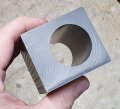
I forgot to mention... while the boring tool is cutting and finishing the part, a continuous strip of waste material is generated, as expected. Avoiding said material from accumulating and forming a clumped mass inside the bore while processing was extremely easy: the only thing I did was fit the hose (which coincidentally has the same diameter as the bore) of my vacuum cleaner on the opposite side of the hole as it was being machined.... it worked like a charm.
You can use some 600 grit sand paper mounted on a cylinder hone (repeat with 800 and 1000grit) with water to clean it up without impacting diameter significantly (600 grit barely removes any material thickness).
Then hit the bore with an open flame for a few seconds to get a glass-like polish. PVC is very flame resistant but reflows to make a glassy surface. Don't overheat to get blisters. Just some quick hits. Whether necessary or not, who knows. I didn't see the end goal for the part.
Flame polishing works well on many plastics - not acrylic/plexiglas because it unzips the polymer and burns easily. Polycarbonate looks similar but flame polishes very well (not that you're using either).
You can use some 600 grit sand paper mounted on a cylinder hone (repeat with 800 and 1000grit) with water to clean it up without impacting diameter significantly (600 grit barely removes any material thickness).
Then hit the bore with an open flame for a few seconds to get a glass-like polish. PVC is very flame resistant but reflows to make a glassy surface. Don't overheat to get blisters. Just some quick hits. Whether necessary or not, who knows. I didn't see the end goal for the part.
Flame polishing works well on many plastics - not acrylic/plexiglas because it unzips the polymer and burns easily. Polycarbonate looks similar but flame polishes very well (not that you're using either).
Thanks for the tip. Fortunately, the surface finish left by the boring tool I made is so smooth that it's almost glass-like. This part belongs to the body of a valve that I'm building, and potable water will be flowing through it. So surface finish is important.
HUH? They have done it for years and years, since back when Lucite was the big name brand for acrylic. When working for the company where I served my apprenticeship We did a lot of work for B&W Research. One thing was scale models of nuclear reactor heat exchangers. We bent brazing rod to simulate the pipes and machined Plexiglas to make the outside envelope. After the milling it was on to sanding then flame polishing to make it clear so they could see the turbulence of the water flowing around the simulated tubes. https://www.regal-plastics.com/blog/polishing-acrylic-edges/
HUH? They have done it for years and years, since back when Lucite was the big name brand for acrylic. When working for the company where I served my apprenticeship We did a lot of work for B&W Research. One thing was scale models of nuclear reactor heat exchangers. We bent brazing rod to simulate the pipes and machined Plexiglas to make the outside envelope. After the milling it was on to sanding then flame polishing to make it clear so they could see the turbulence of the water flowing around the simulated tubes. https://www.regal-plastics.com/blog/polishing-acrylic-edges/
Lucite/Plexiglas/acrylic/PMMA can be flame polished but, it takes a lot more technique and the risk of blistering or igniting the part is MUCH higher than with polycarbonate (Lexan or Makrolon).
My milling machine is producing a rather serious amount of PVC chips/flakes that together take an astounding volume and quickly saturate my vacuum cleaner. My vac has a small capacity of only 6 gallons. And it takes only 3 pieces machined from a 3" diam bar a little under 4" long to saturate it and fill it up. In fact, I have a good trash bin in my shop (must be about 12 gal capacity) and emptying the vac into the bin (or just into a plain trash bag) has proved to be a complete nightmare... flakes float all around the place and refuse to leave the the vac's deposit... they even become electrically charged and start swirling around the place in intricate patterns that would have me mesmerized if I weren't so concerned with my poor lungs and nose... yeah, that's right... I've been coughing plastic the last couple of days and even my snot comes out a dull, dark gray when I blow my nose... which is grrrrreeeeaaatttt!!!!... now I have to wear a mask inside my house and outside of it too!!!!! [/ END RANT]
Anyway... any suggestions as to how more easily empty my vacuum cleaner? ... or at least how to discharge the darn flakes so that they will more easily leave the vac's deposit and fall into the trash bin? ... or should I get myself another vacuum cleaner to suck the dirt out of the one I already have? [/END SARCASM]
Yes. Get a second shop vac and a cyclone collector as well.
Since I have gotten a wood planer I have been generating garbage can full amount a wood shavings regularly. The shop vac cannot handle the volume.
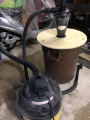
Now the problem is solved with a cyclone collector mounted on top of a garbage bin. The shop vac pulls the air through and the wood chips settle to the bottom of the garbage bin. The fine dust gets collected into the shop vac bag. Then about once a week I have to clean out the shop vac using another shop vac. And then the clean shop vac is used the clean the other shop vac. Complicated.
Since I have gotten a wood planer I have been generating garbage can full amount a wood shavings regularly. The shop vac cannot handle the volume.
Now the problem is solved with a cyclone collector mounted on top of a garbage bin. The shop vac pulls the air through and the wood chips settle to the bottom of the garbage bin. The fine dust gets collected into the shop vac bag. Then about once a week I have to clean out the shop vac using another shop vac. And then the clean shop vac is used the clean the other shop vac. Complicated.
Wood shavings are heavier than PVC flakes ... and I too have worked with wood for a long time.... of course I'll try your suggestion, but I have my doubts... I'll let you know how it goes... thanks for the advice
What about neutralizing the PVC flakes electric charge? ... any suggestions that don't involve adding some sort of liquid to the process?
Wood shavings are heavier than PVC flakes ... and I too have worked with wood for a long time.... of course I'll try your suggestion, but I have my doubts... I'll let you know how it goes... thanks for the advice
What about neutralizing the PVC flakes electric charge? ... any suggestions that don't involve adding some sort of liquid to the process?
You are correct about it being static charges, and it will probably get worse going into the cyclone dust collector. PVC is so static prone they don't like to use it for wood working dust collection pipes, but most people do use it, it's inexpensive. But they also run a bare copper wire to ground to keep from getting shocked when in use.
Even when you add soluble oil/water coolant it is static prone, and just makes a bigger mess. If you remember I suggested going to ABS earlier in the thread. It isn't near as bad to machine and has much less static.

 Facebook
 Google
 GitHub
 Linkedin



 ) but it's not robust nor ample enough to accurately make that bore.