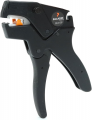
Wire Stripper

wayneh

Joined Sep 9, 2010
18,104
An even cheaper option:
That's exactly what I was referring to in #9. I used it for years. If it's nice and sharp, you can get pretty good at cutting the insulation enough without damaging the wire itself. I still keep it around but haven't used it since the good one arrived.

I've also used the sharp knife or razor method where you sort of roll the wire over the blade. With care you weaken the insulation enough to tear it and hope you don't come up with strands of metal.
 

SamR

Joined Mar 19, 2019
5,491
You say this would be good for me.
It all depends on steel quality/hardness and manufacturing precision. I know the Ideal and Hakko models are good from experience with them. Try it and give us a report. Anything bought from Amazon has a 30-day free return window if it doesn't do the job!
 

SamR

Joined Mar 19, 2019
5,491
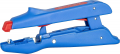
So these are good for 30 AWG to 20 AWG but can I use them with 22 AWG by not going to tight on the Wire?
The size is ~approximate the wire diameter, not the jacket. IF, the wire and jacket are smaller than the "notch" you can twist the tool from a totally perpendicular cut to an angle and most times it will strip the jacket. Also, don't forget that when you close the jaws over the wire you most times have to also rotate the tool 360° to evenly cut the jacket before stripping. Especially with multijacketed wire such as thhn/thwn, etc. which have an outer anti-scuffing/abrasion jacket as well as a soft/pliable PVC plastic under-jacket.
 

MisterBill2

Joined Jan 23, 2018
27,522
At about age 8 I had already been instructed as to the need to assure that the power was off before even approaching anything to investigate it. My parents were firm believers in education prior to experimentation, rather than "after the adventure."
One does not need to experience an electrical shock to gain the insight that electrical shocks should be avoided. AND, learning the means to avoid shocks was, and is, not that very complicated.
 
I haven't looked at all the rec's for strippers, but I have this tool that I found at a local (no longer exists) "electronic recycler/junkyard" that has been very helpful for most wire stripping needs:

It's about 3-4 inches long, and hinged like a stapler. There's a couple of sliding things with thumbscrews to adjust length of the insulation to strip, and to adjust to the gauge of the wire. Near the hinge is a slot to cut wires with. It works best on anything from about 12-14 awg and smaller wire. Once set, it works time after time. The trick is getting it properly set. Old thing (probably from the 1960s or 70s), but fits in a pocket, isn't complex, lightweight, and does the one job very well. I have other stripping tools, of course...but that particular one is always kept quickly at hand on my bench.
 

Ya’akov

Joined Jan 27, 2019
10,235
I haven't looked at all the rec's for strippers, but I have this tool that I found at a local (no longer exists) "electronic recycler/junkyard" that has been very helpful for most wire stripping needs:

It's about 3-4 inches long, and hinged like a stapler. There's a couple of sliding things with thumbscrews to adjust length of the insulation to strip, and to adjust to the gauge of the wire. Near the hinge is a slot to cut wires with. It works best on anything from about 12-14 awg and smaller wire. Once set, it works time after time. The trick is getting it properly set. Old thing (probably from the 1960s or 70s), but fits in a pocket, isn't complex, lightweight, and does the one job very well. I have other stripping tools, of course...but that particular one is always kept quickly at hand on my bench.
This design is probably similar, but it uses the button on top to push the wire out instead of relying on pulling on the wire, which is a nice refinement. I don't think this one has a stop, but it does have an easy to read scale for length.

1752492288000.png
 

Ya’akov

Joined Jan 27, 2019
10,235
My favorite wire stripper ever is the Paladin Mini-Stripax. It is 100% reliable, repeatable to an impressive extent and does 32-18AWG. It also has a guillotine cutter in the rear that makes lovely flat cuts. I bought mine more than 40 years ago, and I have replaced the blade once. You can also get blade for teflon insulation.

The main downside is they are pricey. But, give the longevity and utility, the price seems reasonable. They also make the full sized version with I think is the original design that was copied by versions like @SamR 's. I can say that these are entirely accurate when the stop is set so long as the insulation matches the installed blade.

1752492588382.png
 
This design is probably similar, but it uses the button on top to push the wire out instead of relying on pulling on the wire, which is a nice refinement. I don't think this one has a stop, but it does have an easy to read scale for length.

Something like that; mine has a much simpler construction, and is made of metal (no plastic at all), and nothing "automatic" - it's very utilitarian. Mine just has some line markings to the "length setting" - it's like a "stop" that you position, then tighten a thumbscrew. Maybe I'll take a pic or two of it to post (I couldn't find anything similar on Amazon).

Your other stripper you posted about is...yeah, pricey ($80!) - but, if that's something you're doing every day, or as part of your job...and given your long experience with it...$80 USD isn't that bad, as you mentioned.
 
I used my teeth once when a wire broke on my bike light; cannot recommend it. Rubbing the insulation on cement or pavement works better. My most commonly used strippers are the Millers; I leave them at a small setting and use my littlest fingers as springs to judge how much to squeeze.
https://ripley-tools.com/product/100-series/
I have one of those kind, too (probably a knock-off - it was part of toolkit I got from an electronics vo-tech school I attended in 1991-92) - I find them most useful for "scoring" the insulation of multi-conductor cables (probably because of the v-notch of the jaws), but you have to either have them set "just right" or be very careful with hand pressure, or you can nick the insulation of the inner wires...but when they are set up well, just squeeze, rotate 'em back-n-forth, and the outer sleeve will come off easily...
 
Top