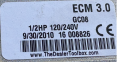
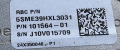
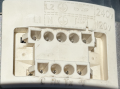
How to wire this motor, what kind of motor is it?

Thread Starter

B-JoJo-S

Joined Jan 3, 2026
274
New project.
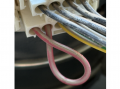
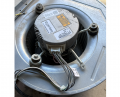
Had my furnace inspected. Due to combustion gas leaks the furnace has been replaced. Of course I kept the old parts. Now I have this motor and want to use it. It's the air handler blower. It has 9 pins as you'll see in the photos. I also have the control board so if I have to use it via the control board I can.
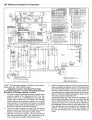
Here's several pictures. The blower ran on 120 VAC but I don't think the 120V was what was being controlled. As you can see there are several wires doing what - I don't know. Not yet.
Screenshot 2026-05-06 at 11.07.43 AM.pngScreenshot 2026-05-06 at 11.08.22 AM.png

Screenshot 2026-05-06 at 11.08.02 AM.png Screenshot 2026-05-06 at 11.09.55 AM.png
Screenshot 2026-05-06 at 11.13.19 AM.png Screenshot 2026-05-06 at 11.07.26 AM.png

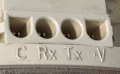
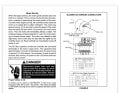
OK, managed to get a clear picture of the C • Rx • Tx • +V terminals.
I've rotated the motor shaft and have found 12 distinct detents so I'm thinking this is probably some sort of inverter motor. The heater was able to modulate the fan speed depending on the need for heat. If the furnace was producing a lot of heat the fan would run at full speed. If it was merely warming the house by one degree the fan would run at a much slower speed.

WHAT I WANT TO DO:
Use this fan and build a wind tunnel for my other project - model rocketry. Being able to find the CG (center of gravity), hang the rocket body in the airflow and determine whether the design is stable or not. None of that probably matters. The BIG question is "How to run this motor". As for the furnace schematic - the HVAC company now has that panel. If they still have it - if it hasn't been taken to the dump - they will shoot a copy of it and send it to me. I would still like some help figuring this thing out.

I haven't removed the back cover of the motor yet. I'm hesitant to do so because I don't know what may pop out - what I might not be able to put back together without some specialized tooling. So before I go any further I thought I'd ask you Guru's.

Thanks for the assistance.
 

MaxHeadRoom

Joined Jul 18, 2013
30,630
Most motors in HVAC systems now are ECM (electronically commutated motor).
They are much more versatile regarding variable speed control than the older methods. often the commutator electronics is on board the motor.
 

Thread Starter

B-JoJo-S

Joined Jan 3, 2026
274
Thanks @MaxHeadRoom. You saw the plug body. On the 5 pin connector pin 5 is hot (120VAC) pin 4 is neutral, pin 3 is ground, pins 1 & 2 are jumped for a 120VAC system. If 240 pin 3 is still ground, pins 4 & 5 are 120V each.

It's the 4 pin side I am unsure of. Heck, never mind "unsure". I have NO IDEA what each is for. Perhaps C is for common, Rx & Tx seem to be self explanatory but +V is obviously a positive voltage. Just how much voltage I have no idea.
 

panic mode

Joined Oct 10, 2011
4,967
to me that looks like legacy fieldbus interface. the data cable would be daisy chained from one motor to the next and each can be controlled from some central place. most of the time voltage present is 5VDC but it can be 24VDC as seen with DeviceNet. when you have chance measure it. even if it is RS232 and not a bus interface, it may be to connect some sort of programming (parametrizing) or for monitoring...
 

MisterBill2

Joined Jan 23, 2018
27,442
What the TS will find to b the simplest scheme is to rescue the motor, THE INTERCONNECTION HARNESS, and the control module, as well as any associated transformers and ALL of the existing documentation. The consideration being that some manufacturers produce the whole system that has no parts interchangable with any other manufacturer's system pieces.
I am guessing that the motor controller provides variable speed operaation, but it may be just some set speeds.
 

Thread Starter

B-JoJo-S

Joined Jan 3, 2026
274
What the TS will find to b the simplest scheme is to rescue the motor, THE INTERCONNECTION HARNESS, and the control module, as well as any associated transformers and ALL of the existing documentation.
The only item on your list I DON'T have is the documentation. That went with the rest of the machine. But I DO have the motor, 24V transformer, control board and harnessing.
I am guessing that the motor controller provides variable speed operaation, but it may be just some set speeds.
It may be just two speeds. And I don't know if it's done via PWM. The motor seems to have an electronic package that is encapsulated and I have no desire to try and dig that stuff out. Nor do I know if it is even possible.
 

Thread Starter

B-JoJo-S

Joined Jan 3, 2026
274
See if you agree with me on this:
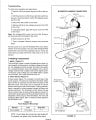
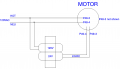
Based on the last document, the motor is AC powered on P48 pins 4 & 5. Pin 3 is ground. Pins 1 & 2 are jumpered for use on 120VAC systems.
On P49 pins 3 & 4, 24VAC is applied (to test the motor). It should run at 75% Max RPM. Should be no need for pins 1 & 2. I think I have my answer.
Do you agree with this?

I'm wondering if I vary the 24VAC from 24 down to a lower voltage if the motor will run slower. That IS one of my desires with this.
 

MisterBill2

Joined Jan 23, 2018
27,442
CAUTION!!! Although it is not mentioned, I suggest using an ISOLATED 24 volts AC, such as from a separate thransformer, as shown in figure 10.
 

Thread Starter

B-JoJo-S

Joined Jan 3, 2026
274
This works. Bill: Why do you say to isolate these? Even if they have their own plug they're still plugged into the same source. Same breaker.
Screenshot 2026-05-08 at 12.05.04 PM.png
EDIT: P48-3 is the ground wire. And yes, it's there.
 

Thread Starter

B-JoJo-S

Joined Jan 3, 2026
274
When energized, the motor hesitates for about one to two seconds before beginning to rotate. Later today I'll have the fan assembly back together and see just how much air flow I get with 75% max RPM.
 

vandveuser16776

Joined Feb 21, 2026
198
Deductive reasoning
Since it is (almost certainly) a brushless motor, it needs a DC for the commutation board. The fact that the figure 10 does not indicate polarity of the probes, it somewhat guarantees that there is a rectifier and a complete driver module inside the motor.
That said, this is how I would do it.
Skip all testing and first open the motor. If you see a control board covered with resin (usually black) then I think you wont need the upper jumper at all. I think those are feedback from motor to the main furnace board to tell the board "how the motor is doing. Is it spinning? Has any wire broken? etc." for safety things. The motor must be 24v and should run with the original transformer connected to C and Rx
 

vandveuser16776

Joined Feb 21, 2026
198
When energized, the motor hesitates for about one to two seconds before beginning to rotate. Later today I'll have the fan assembly back together and see just how much air flow I get with 75% max RPM.
The "hesitation" is because the motor is Hallless. It determines the position of the rotor (magnets) by energizing windings and sensing feedback
 

Thread Starter

B-JoJo-S

Joined Jan 3, 2026
274
Skip all testing and first open the motor. If you see a control board covered with resin (usually black) then I think you wont need the upper jumper at all.
The jumper is already there. No need to chop it off. Instructions claim it is necessary to run on 120VAC.
I think those are feedback from motor to the main furnace board to tell the board "how the motor is doing. Is it spinning? Has any wire broken? etc." for safety things.
Motor spins, no broken wires.
The motor must be 24v and should run with the original transformer connected to C and Rx
The transformer is tiny. I doubt that little txfmr could spin such a large fan.
 

vandveuser16776

Joined Feb 21, 2026
198
If the transformer is small compared to the motor, then yes, it wont be able to run 1/2HP motor. There was no picture to give me any idea the transformer is "tiny"
 
Top