How to identify 2 unmarked wires in a 12 lead wire motor?

Thread Starter

SanjayKizhakethil

Joined Oct 4, 2024
7
Hi,

I have a 55kW motor, which has 12 lead wires. Two cables do not have any markings on them. By checking the continuity, I was able to group them in pairs.

T1 (U1) - T4 (U2)
T2 (V1) - T5 (V2)
T3 (W1) - T6 (W2)
T7 (U3) - T10 (U4)
T8 (V3) - T11 (V4)
T9 (W3) - T12 (W4)

This is the 6 pairs. T9 and T12 cable is not marked. How can we figure out which is T9 & T12?
 

MisterBill2

Joined Jan 23, 2018
27,159
OK,, the 3-phase motor is a dual voltage motor as well, so that the winding sets can be either series or parallel connected. That makes for a rather crowded junction box. If also allows for a whole lot of wrong connection arrangements.
To experimentally determine the polarity will require an AC voltmeter and a lower power AC voltage source.
When the two sections of a phase winding are correctly connected, the voltage across the ends of the pair will add. So if you connect T4 to T7 and apply 24 volts, you should read 48 volts between T4 and T10 This is based on the guess that T4-T7 are opposite ends of the same winding. Use an ohm meter to verify that for us.
The principle I am suggesting is that each phase with two field windings can act like a transformer, and so when connected correctly the two parts will produce twice the voltage on either half. That is why I suggest starting with those that are correctly marked.

Of course, this whole suggestion is based on the guess that the marked connections are all correct.
 
Last edited:

MisterBill2

Joined Jan 23, 2018
27,159
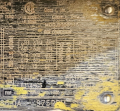
I thought that I saw not only an ID plate but also a tag stating connections for both low and high voltages. That was separate from the data plate.
Or was that on a different thread a day ago???
 

MaxHeadRoom

Joined Jul 18, 2013
30,557
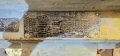
The plate is barely readable!
If you can see it clearly in person, post a DWG of the plate connections.
Heck of a big motor, BTW !
 

LowQCab

Joined Nov 6, 2012
5,101
If all of the normal Phase-Windings are accounted for,
and the 2 odd wires are the same color with no other markings,
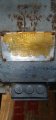
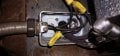
then the 2 odd wires are the connections to internal PTC-Thermistor in the picture, on the far left.
.
.
.
 

Thread Starter

SanjayKizhakethil

Joined Oct 4, 2024
7
If all of the normal Phase-Windings are accounted for,
and the 2 odd wires are the same color with no other markings,
then the 2 odd wires are the connections to internal PTC-Thermistor in the picture, on the far left.
.
.
.
Out of 12 phase wires, only 5 or 6 were marked. I figured out the loop and got almost 10 wires—the remaining 2 wires, which are T9 & T12. I have no idea how to find out which is which.
 

Grave98

Joined Oct 12, 2024
7
I need help wiring up this old Westinghouse motor I have decent knowledge about wiring and I've figured out what lead Is ground but am unsure of the others and when I first wired it up all it did was hum. Here's the tag for it.
 

Attachments

MisterBill2

Joined Jan 23, 2018
27,159
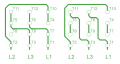
Obviously T8 must connect someplace, RIGHT??? For the high voltage the two windings for each phase are connected in series, which is standard. For the low voltage the two windings for each phase will be in parallel. That is how dual voltage motors are done. Nothing is left open.
AND, on a 3-phase motor none of the wires connect to "ground", but only L1, L2, and L3. And the resistance between phases should all be the same.A resistance measurement between terminals should reveal that there are six separate windings. That will allow verifying if the drawings may possibly be correct or not. and there is no risk in taking a resistance measurement. And if the high voltage connection shown in post #12 is correct then the low voltage connection can not possibly be correct. BUT it appears that the low voltage connection matches one of the connections on the photo of the actual nameplate, except that T2 and T8 are connected. So that implies that the high voltage connection is suspect.
This makes a resistance check more important than ever!!!
 
Last edited:
Top