Wire Stripper

wayneh

Joined Sep 9, 2010
18,096
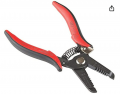
That wire stripper is nice but can only handle thickness down to 22 gauge. I wouldn't call that "very small". 22 gauge is very common for hobbyist work but is by no means as small as some common wiring.

The reviews of that battery pack mention that the wires are "tiny" and smaller than 22 gauge. So the result is predictable.

FWIW, I have this stripper and it would likely work well for you:
https://www.amazon.com/Greenlee-PA1118-GripP-Stripper-Cutter/dp/B0006BHHDQ
 

SamR

Joined Mar 19, 2019
5,473
I have a couple of these @ ~20USD. One Ideal for 10-22AWG and one Hakko for 20-30AWG. They never fail. I also have several automatic wire strippers that don't work. Including a Vise Grip and a ZOTO stripper. These were the only strippers that our plant electrical and instrument shop guys used.
1752018250343.png

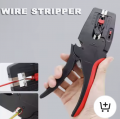
And then I have a pair of this design for ~12USD. Marked for 32-7AWG. Kind of a pain adjusting the stop for the precise length of jacketing stripped but once you have it right it will go to town and not miss a beat. Setting it by the markings on the jaws is useless and only a rough guide. I think it's a kind of luck of the draw thing with the automatic strippers.
1752018216823.png
Even though it is rated for larger wire sizes, I've always used it for the ~22AWG or less sizes.

God only knows just how many wires I've stripped with my pocket knife. Far more than I've used a wire stripper for.
 
Last edited:

wayneh

Joined Sep 9, 2010
18,096

MisterBill2

Joined Jan 23, 2018
27,315
I have strippers similar to both of the types linked, and they work well for the appropriately sized wires. The reality is that in many instances they are not applicable. They ALWAYS require some free length of wire to allow them to grip it, and many times that is not possible to do and still have a satisfactory connector installation. Coiled cords with microphones are a common example of such situations.
So there are times when there is no alternative to CAREFULLY cutting the insulation with an actual knife of some sort. That takes both patience and practice, and is not possible for the impatient. There are also thermal wire skinners that work for some types of wire.
 

wayneh

Joined Sep 9, 2010
18,096
So these are good for 30 AWG to 20 AWG but can I use them with 22 AWG by not going to tight on the Wire?
https://www.amazon.com/Greenlee-PA1118-GripP-Stripper-Cutter/dp/B0006BHHDQ
If you look at the provided notches on that tool you can see that one is labeled 22, and that will give you a perfect strip of 22 gauge wire. You can use a cheap stripper that has no pre-cut grooves, and with that kind of device you have to use feel and experience to get a good strip without damaging the conductor(s). I've done it, but now that I have the better tool I'll never go back.
 

WBahn

Joined Mar 31, 2012
32,753
Several solutions. The best one is to use a tool that works with the size wire you are trying to strip. Your tool goes down to 20 AWG and the product description says that the wires coming out of the box are 26 AWG.

Then there are lots of ways to strip wires without a wire stripper -- but they carry greater risk of damaging the wire unless you have taken the time to develop sufficient skill. I've often stripped small wires with just a pair of fingernail clippers. The trick is to apply just enough pressure to cut part way through the insulation and then pull so that the insulation breaks where it's been nicked. With a bit of practice, this works very well for wires of this size that use typical insulation materials since they don't require much of a nick or much force to do the job.
 

Tonyr1084

Joined Sep 24, 2015
9,744
You say this would be good for me.
https://www.amazon.com/Greenlee-PA1118-GripP-Stripper-Cutter/dp/B0006BHHDQ

It is good for 30 AWG to 20 AWG and it says it is good for Speaker Wire.

The Wires coming off of my Battery Box is Thinner than Speaker Wire.

So how can this be good for me?
It's unlikely you'll ever see speaker wires that small. Of course, they are making very tiny speakers these days so I could (probably) be wrong. But if like @MaxHeadRoom said, those wires are 26 gauge then yes, that stripper would do the job, and likely do it nicely. If you don't mind spending close to $20 (US) to do the job.

Saw the "Teeth" method. If this is a "One-Off" project then why spend the money. Me? I commonly use my fingernails for small wires with thin insulation. But then again I have thick nails. I've even used an exacto knife on one side and using my thumb on the other side of the wire, gently but with enough force to cut through the insulation. Typically once the insulation is broken it will tear circumferentially. Just be sure you don't nick or break wire strands. THAT is the real trick.
 
Top