Where to buy soldering wire with real rosin inside?

Thread Starter

sonohe

Joined Jan 11, 2025
92
So far I worked from an old big pile of soldering wire, that my father purchased long ago. It had a classic rosin smell when melted, that I could always smell when working with soldering wires. But I run out of the pile, and first I tried to buy something on Aliexpress. When it arrived and I tried it, I was satisfied to see that it melted more easily than my old pile, but it emitted very very bad smell. It had a smell like gummed paper tape, that is used by artists to fasten paper onto boards. Then, I tried to buy something at the local electronics shop, where the quality is not outstanding but usually OK. Tried the wire purchased there: the same bad smell. Now I wonder where I could buy the wire that has a similar rosin smell like my old pile. Any idea from Aliexpress? If not, from a store in the US or Germany?
 

Ya’akov

Joined Jan 27, 2019
10,278
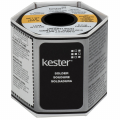
I would reocommend Kester 44 in 63Sn/37Pb alloy. It will run you around $50.00USD for a one pound spool but that will last for a very long time. Kester is a very well regraded solder used in industry. I can't guarantee it will smell like your father's solder, but I can guarantee it will be some of the best solder available.

1781443033910.png
 

dl324

Joined Mar 30, 2015
18,449
I wonder where I could buy the wire that has a similar rosin smell like my old pile.
If you want the smell of rosin, you should buy solder with a rosin core. Kester 44 is a rosin core solder.

That being said, you shouldn't be inhaling the fumes while you're soldering. I too like the smell of rosin and take an occasional whiff when I'm using it (my liquid flux is rosin), but I mostly hold my breath.

I mostly use Alphametals Cleanline 7000 solder (63/37), which is a no-clean flux. I usually clean it with isopropyl alcohol, but it's supposed to be water soluble at 140F.
 

Ian0

Joined Aug 7, 2020
13,230
If you want the smell of rosin, you should buy solder with a rosin core. Kester 44 is a rosin core solder.

That being said, you shouldn't be inhaling the fumes while you're soldering. I too like the smell of rosin and take an occasional whiff when I'm using it (my liquid flux is rosin), but I mostly hold my breath.

I mostly use Alphametals Cleanline 7000 solder (63/37), which is a no-clean flux. I usually clean it with isopropyl alcohol, but it's supposed to be water soluble at 140F.
Yes. Don't inhale fumes from colophony. Get a fume extraction system.
https://www.hse.gov.uk/asthma/solderer.htm
 

WBahn

Joined Mar 31, 2012
33,076
So far I worked from an old big pile of soldering wire, that my father purchased long ago. It had a classic rosin smell when melted, that I could always smell when working with soldering wires. But I run out of the pile, and first I tried to buy something on Aliexpress. When it arrived and I tried it, I was satisfied to see that it melted more easily than my old pile, but it emitted very very bad smell. It had a smell like gummed paper tape, that is used by artists to fasten paper onto boards. Then, I tried to buy something at the local electronics shop, where the quality is not outstanding but usually OK. Tried the wire purchased there: the same bad smell. Now I wonder where I could buy the wire that has a similar rosin smell like my old pile. Any idea from Aliexpress? If not, from a store in the US or Germany?
Be sure you don't have your priorities messed. I prefer the solder/flux combination that works the best and I'm not going to use something that doesn't work as well just because I might like the smell. Also, as others have pointed out, you shouldn't be going out of your way to sniff soldering fumes. Occasional exposure is probably not harmful (there are always those that claim otherwise, of course), but prolonged exposure can have effects, from adverse health effects to possibly making you sensitive to it to the point where you can't tolerate much exposure (unlikely for hobbyist-level exposures).

You don't need a fume extraction hood -- that's overkill for most hobbyists (if you are doing a lot of soldering, though, it's not a bad idea at all). A simple and fairly small, low-speed fan to blow the fumes away from you and disburse them in the room will likely make a huge difference in the level of objectionable odor. If possible, set up so that you can blow the fumes out a nearby open window.
 

Futurist

Joined Apr 8, 2025
940
I had episodic asthma as a child and right into my 40s. As a teen I did a lot of soldering, first at home then at electronics college. I hated the soldering fumes, it definitely felt physically uncomfortable when I inhaled any.

I became skilled at taking a deep breath and holding it, then start soldering, then blow the joint to dissipate the fumes, I'd do that for each wire or pin. In fact I still do this. The fumes definitely irritated my lungs, sometimes triggering an asthmatic episode, I can only wonder what long term exposure does.
 
Last edited:

B-JoJo-S

Joined Jan 3, 2026
475
A simple and fairly small, low-speed fan to blow the fumes away from you
I agree. And I'd like to add that this should not be blowing on your work, your solder joint. Rather, it should be close enough to draw the fumes away and to blow them away from you. Having a fan blowing directly on your work will make soldering much more difficult.

I would also like to add that over the years chemicals change. What once was the only way to solder electronics now has many options. Different formulations of solder exist. While I can't name them all, there's 60/40 tin/lead (most common of the time) 63/37 tin/lead came about because it was easy enough to solder and a little cheaper to manufacture. Both of these have rosin cores. I would imagine the rosin chemical composition may have changed over time. Now there's "No Clean" cored solders, "Water Washable" cored solder, Silver Solder, High Temp solder, solder with no cores whatsoever, I've even seen cored solder with 5 cores. I don't know if they all had the same flux or if they had differing fluxes or if they were different chemicals that became flux under temperature. Bottom line is there are many different types of solder and fluxes. But like @WBahn said, using an extractor fan to pull fumes away from the workpiece and away from you is greatly adequate for what you wish to do.

And like all the rest have said - I, too, do not recommend smelling soldering fumes. ESPECIALLY if you are using a solder with lead in it.
 

B-JoJo-S

Joined Jan 3, 2026
475
That's a myth. Lead doesn't vaporize at normal soldering temperatures.
True, lead does not vaporize. However, and I don't know this for any kind of scholarly knowledge, flux vapor may carry lead in it. Rome fell because of lead goblets filled with wine. The acids in the wine leached out lead which is what made Romans behave in odd manor. Nero fiddling while Rome burned. And I don't even know if that's fact or fiction. But it's documented that lead brought Rome down.

While it may be a myth as you say I'm not so confident that I'd wish to be inhaling flux vapors.
 

B-JoJo-S

Joined Jan 3, 2026
475
Just occurred to me; some materials in certain conditions can sublimate. Cadmium is one of the banned materials in space satellites. It can sublimate and deposit itself on circuits and on lenses causing satellite failure. Who's to say lead is not capable of sublimation when exposed to heat and flowing flux. I can't say either way. If jumping off a cliff might be hazardous to my life then I'm not going to jump. I'm not afraid of lead. Played with it as a child. Probably been exposed to lead paint on toys and on household walls. Look at me! Do I look twisted? No! I'm cute as hell.;)
.
 

Ian0

Joined Aug 7, 2020
13,230
Just occurred to me; some materials in certain conditions can sublimate. Cadmium is one of the banned materials in space satellites. It can sublimate and deposit itself on circuits and on lenses causing satellite failure. Who's to say lead is not capable of sublimation when exposed to heat and flowing flux. I can't say either way. If jumping off a cliff might be hazardous to my life then I'm not going to jump. I'm not afraid of lead. Played with it as a child. Probably been exposed to lead paint on toys and on household walls. Look at me! Do I look twisted? No! I'm cute as hell.;)
.
The air pressure in my workshop is unlikely to get that low.
 

dl324

Joined Mar 30, 2015
18,449
Do you trust that information? I've read reports from Weller and CMU and neither mentioned lead in the fumes. Weller stated that about 20% of users experience clinical symptoms of asthma from fumes. I'm in the other 80%.
 

Ya’akov

Joined Jan 27, 2019
10,278
The primary hazard from hand soldering is exposure to fumes generated when colophony (rosin) flux is heated. These fumes contain irritants and fine particulates that can cause eye, nose, and throat irritation because of aldehydes such as formaldehyde and acetaldehyde; organic acids including abietic acid derivatives; and ultrafine particulate matter capable of penetrating deep into the lungs.

With repeated exposure, may lead to occupational asthma or sensitization, after which even small exposures can trigger symptoms. Local fume extraction near the soldering point is the preferred mitigation however a respirator with P100 particle filter and organic vapor cartridges is effective against the hazard. An N/KN95 mask may protect against the particulates but will not protect against the other hazards.

All smoke extractors are not created equal. Recirculating types (lacking exhaust to the outside) can be effective but the activated charcoal used in them must be substantial because degrades with use and you will be depending on it to capture all the VOCs, aldehydes, acids. and particulates. If properly maintained, a recirculating extractor is effective for hobbyist and limited commercial use.

A venting type is far superior but be aware where you are venting it to ensure you are not exposing others as a trade-off in avoiding it yourself.

Lead-bearing solders present a heavy-metal exposure risk through contamination of hands and surfaces not inhalation of solder fumes. Soldering temperatures are far below lead’s boiling point.

Material / AlloyTemperature (°C)Temperature (°F)
Lead (Pb) Boiling Point1749 °C3180 °F
Tin (Sn) Boiling Point2602 °C4716 °F
60/40 Sn/Pb Soldering Temperature (typical iron setting)315–370 °C600–700 °F
63/37 Sn/Pb Soldering Temperature (typical iron setting)315–350 °C600–660 °F

However, there is a very real risk of ingestion of lead residues which can elevate blood lead levels over time. Fortunately effective mitigation is just a matter of simple discipline:

  1. hand washing, or wearing disposable gloves;
  2. keeping food away from the work area; and,
  3. routine cleaning of work surfaces.

Lead-free solders eliminate lead exposure but may contain other hazardous metals, and do not eliminate the need for fume control while providing inferior results with more effort.
 
Top