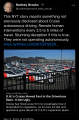
“We have decided to proactively pause driverless operations across all of our fleets while we take time to examine our processes, systems, and tools and reflect on how we can better operate in a way that will earn public trust,” Cruise wrote on X, the platform formerly known as Twitter, Thursday night.
This study compares the safety of autonomous- and human drivers. It finds that the Waymo One autonomous service is significantly safer towards other road users than human drivers are, as measured via collision causation. The result is determined by comparing Waymo’s third party liability insurance claims data with mileage- and zip-code-calibrated Swiss Re (human driver) private passenger vehicle baselines.
Not shocking or a big revelation, these cars are not really fully self-driving. The trials were supposed to greatly reduce the reliance on human intervention but it seems progress has been slower than expected.
Not shocking or a big revelation, these cars are not really fully self-driving. The trials were supposed to greatly reduce the reliance on human intervention but it seems progress has been slower than expected.
Pardon my naiveté, but wouldn't one expect insurance data to be more or less reliable and objective? ... or at least profit driven, which could go both ways.
Pardon my naiveté, but wouldn't one expect insurance data to be more or less reliable and objective? ... or at least profit driven, which could go both ways.
You're right, I don't really mean insurance data to be more or less reliable and objective for their own, for profit, motives, I mean the AI car company mainly. The AI cars are on a computer defined 'track' in some city, mapped to the millimeter, with human interaction for lots of driving corner-cases that are likely to cause accidents if left to the AI. Humans are on their own in the driving jungle of the entire planet where AI cars fear to tread.
You're right, I don't really mean insurance data to be more or less reliable and objective for their own, for profit, motives, I mean the AI car company mainly. The AI cars are on a computer defined 'track' in some city, mapped to the millimeter, with human interaction for lots of driving corner-cases that are likely to cause accidents if left to the AI. Humans are on their own in the driving jungle of the entire planet where AI cars fear to tread.
I'm with you on this one ... you've made a solid case claiming that AI is uncapable of predicting a situation and reasoning a proper action/reaction without prior specific programming.
I just HATE the way the term AI is being used nowadays. It confuses ordinary people into thinking that simple machine code based on heuristics is capable of reason, or even of a basic self-awareness. It's not ... in (more or less) the words of Michio Kaku "LLM are nothing more than glorified tape recorders"
A big part of the problem -- and this is not anything new -- is that both the public perception and the perception of decision makers is being driven by marketing-type folks, who neither know nor care about being accurate in their claims, and who strive to feed off of sci-fi fantasy pipe dreams that people have come to expect the reality should be just because lots of authors over the years have told them that it could be. What makes it all the harder for so many people to fathom why it isn't so easy is that they see all kinds of marvelous things that have been accomplished by technology all around them and they don't realize that the problems involved are vastly different on very fundamental levels.
Safety always the top priority
Although Level 4 autonomy promises a reduction in incidents and collisions from ‘human error’, building trust among consumers in the ability of automated vehicles to ‘drive safe’ will take time.
It would definitely be easier for them to get me to trust the technology if they would first make the effort to convince me that I can trust THEM enough to have any faith in what they spout about the technology. I don't see much evidence that they think that's worth their time or effort.
"Knowing that the Autopilot system had previously failed, had limitations" and "had not been modified, Tesla still permitted the 'Autopilot' system to be engaged on roads that encountered areas of cross traffic... It would be reasonable to conclude that Tesla dismissed the information it had available in favor of its marketing campaign for the purpose of selling vehicles under the label of being autonomous."
New York — Tesla is recalling nearly all 2 million of its cars on US roads to limit the use of its Autopilot feature following a two-year probe by US safety regulators of roughly 1,000 crashes in which the feature was engaged.
The limitations on Autopilot serve as a blow to Tesla’s efforts to market its vehicles to buyers willing to pay extra to have their cars do the driving for them.
The over-the-air software update will give Tesla drivers more warnings when they are not paying attention to the road while the Autopilot’s “Autosteer” function is turned on. Those notifications will remind drivers to keep their hands on the wheel and pay attention to the road, according to a statement from the National Highway Traffic Safety Administration.
After the recall, Teslas with Autosteer turned on will more routinely check on the driver’s attention level – and may disengage the feature – when the software determines the driver isn’t paying attention, when the car is approaching traffic controls, or when it’s off the highway when Autosteer alone isn’t sufficient to drive the car.
After the recall, Teslas with Autosteer turned on will more routinely check on the driver’s attention level – and may disengage the feature – when the software determines the driver isn’t paying attention

 Facebook
 Google
 GitHub
 Linkedin