Will this work??? 3 dc inputs that add together...

Thread Starter

bigjoncoop

Joined Feb 1, 2019
204
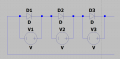
I just saw this youtube video of a guy making a 3 dc input circuit board for a project he was doing and i made a schematic myself and i'm curious if this makes sense... I've included a link to video and my schematic
thx

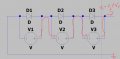
replaced schematic (Ignore diode values and Voltage input) Just wondering if the circuit will work properly )

AND unike his video, I plan on powering all 3 at all times.

my schematic:
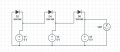
3inputs.JPG3inputs.JPG


Heres the video:
 
Last edited:

djsfantasi

Joined Apr 11, 2010
9,237
I just saw this youtube video of a guy making a 3 dc input circuit board for a project he was doing and i made a schematic myself and i'm curious if this makes sense... I've included a link to video and my schematic
thx.

my schematic:
Heres the video:
Your schematic has critical portions blocked by a drop-down menu.

Can’t help. Sorry.
 

djsfantasi

Joined Apr 11, 2010
9,237
From what I can see if your schematic, you’ve got it wrong. Try to show your entire schematic. Otherwise, it’s near impossible to comment.
 

Thread Starter

bigjoncoop

Joined Feb 1, 2019
204
replaced schematic (Ignore diode values and Voltage input) Just wondering if the circuit will work properly )
 
Last edited:

cmartinez

Joined Jan 17, 2007
8,759
It should work. But the added voltages won't be exactly the sum of all three (15v as shown in your first post). Nor of each supply individually. This because of the forward voltage drop caused by each diode.
 

SamR

Joined Mar 19, 2019
5,487
See post #3 which are 3 series voltages. Not sure what the purpose of diodes would be for that ckt however. A true DC voltage booster ckt requires some capacitors in addition to diodes. But you can only get out what you put in so as Voltage goes up, Current goes down. IVin = IVout
 
Last edited:

LesJones

Joined Jan 8, 2017
4,511
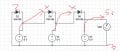
Your schematic in post #1 is totally different to the one in the video. The purpose of the schematic in the video is to have three power supplies in series to give voltage output equal to the sum of the voltages from the individual supplies. If one power supply is removed the output is then the sum of the remaining two less the volts drop across the diode (About 0.6 to 0.7 volts for a normal silicon diode.) on the socket for the removed power supply. In your schematic the output will be 5 volts and all the current will be provided by V3. Removing V1 and/or V2 will have no effect. If V3 is removed the output voltage will be 5 volts minus one diode volt drop so it will be about 4.4 volts with all the current supplied by V2. If V2 is also removed then the output will be about 3.8 volts with V1 supplying all the current.

Les.
 

Wolframore

Joined Jan 21, 2019
2,619
Do you have purpose in mind for this? I’m not sure if I see an application...

278C2572-5C0C-433B-B18C-3677FEC3B350.jpeg
if any voltage is off it bypasses through a diode dropping 0.7 V of remaining voltage (each time)


1CDCB05C-1A55-493A-9ACE-066ADBC65ABB.jpeg
 
Last edited:

AlbertHall

Joined Jun 4, 2014
12,625
Note that the circuit in the video uses the switch in the power socket to short the diode when no adaptor is plugged into that socket so you don't lose any voltage.
The disodes are there to protect the adaptor when it is plugged into this board but not connected to the wall socket. Without the diodes the output of this adaptor would be subjected to negative voltage - not a good idea.
 

MisterBill2

Joined Jan 23, 2018
27,505
Both circuits will provide a sum of the voltages, minus two diode drops for the circuit in post #1. The only purpose for having diodes would be to bypass any supply that is not active. So now the big question is about just what you are wanting to accomplish.

IT certainly worked well to put three 5 volt 20 amp surplus supplies, each adjusted down to 4.6 volts, in series to get 13.8 volts to run a mobile transceiver from mains power. The 3 surplus supplies cost a lot less than one 20 Amp DC supply.
 
Top